A new avenue for MEMS-based sensor design
Mr Pradyumna Thiruvenkatanathan, a second year doctoral student in Engineering, is the recipient of the best student paper award in the sensors and transducers sub-field at the IEEE Frequency Control conference. The IEEE Frequency Control conference is a premier event highlighting research in the areas of frequency and timing, frequency control and related technologies including Micro-Electro-Mechanical Systems (MEMS).
MEMS leverages integrated circuit technology to miniaturise sensors and actuators and integrate complex systems combining mechanical and electronic functionality on a single substrate. These thumbnail sized complex physical systems can "compute" as well as "sense" and "interact" with their environment. MEMS, therefore, adds the "eyes" and "arms" to the "brains" on microelectronic integrated circuits. MEMS technology first emerged in the 1960's during the early years of development in integrated circuit manufacturing. However, it has only been over the past decade that the technology has seen wider commercial success with applications in disparate domains such as portable electronics, automotive systems and biomedical devices.
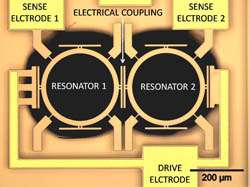
Pradyumna's conference paper presents a new avenue for MEMS-based sensor design taking advantage of the concept of vibration localisation in nearly identical coupled resonators. In the device implementation reported in the conference paper, a pair of miniature "tuning forks" are coupled together electrically in a way which can be precisely controlled, and the resulting pattern of vibration is strongly dependent on any asymmetry or mismatch between the coupled resonators.
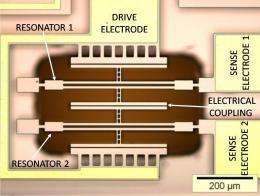
In a sensor application, the variation in the structural properties of one of the resonators relative to the other would be picked up by measuring the extent of this vibration localization. Pradyumna's conference paper experimentally verified a significant enhancement in the sensitivity to perturbations in stiffness compared to current MEMS sensors, while demonstrating a substantial rejection of common mode effects such as temperature and pressure. Pradyumna is now investigating the limitations to sensitivity enhancement and signal-to-noise in these systems, as well as extending the concept to demonstrate high sensitivity inertial sensors and electrometers.
Pradyumna is advised by Professor Jim Woodhouse and supervised by Dr Ashwin Seshia. Dr Jize Yan, a postdoctoral research associate in Engineering, is a co-author on the conference paper. The research group is embedded in the Nanoscience Centre.
Pradyumna's conference paper can be downloaded from the IEEE website here.
Source: University of Cambridge (news : web)


