When a whistle beats a tweet
Sep 01, 2009
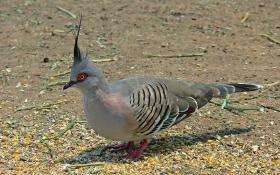
A crested pigeon, Ocyphaps lophotes
A crested pigeon, Ocyphaps lophotes. Image: Wikimedia Commons

Biologists have discovered that a species of Australian pigeon has a secret way of alerting fellow birds to predators -- a "whistle" emitted by flapping wings when the bird takes off in alarm.

The crested pigeon (Ocyphaps lophotes) is well known for the abrupt metallic-sounding whistle that it makes on takeoff.

Until now, though, no-one has analysed the sound or explored whether it may have a use.

Robert Magrath and Mae Hingee of the Australian National University in Canberra recorded a crested pigeon as it tucked into grain on a feeding table.

They tossed a model of a accipiter hawk from behind a hide to capture the sound of the bird taking off in fright.

They then recorded the takeoff of a bird as it flew unprompted from a flock, unbothered by any threat.

Magrath and Hingee discreetly played back the two sets of whistles to 15 groups of birds to see what happened.

The first whistle stirred to take to the skies in panic, whereas the second caused no disturbance.

To the human ear, the two whistles may well seem simple and identical but acoustic analysis shows the sounds to be quite complex and distinct, the investigators say.

The whistles each comprise two tonal elements and an atonal "clap".

But the "alarm" version of the whistle is louder and has a more rapid tempo than the "non-alarm" version -- and the pigeons easily spot the difference.

Many birds have the ability to make vocal cries to alert other members of their flock, but this is the first proof that flight noise can also serve as an alarm call, the scientists believe.

The whistle is probably produced by the vibration of an unusually slender primary in the pigeon's wingtip, they say.

This suggests that the whistle evolved not as a by-product of flight but as a warning signal to help the species survive.

The paper appears in , a journal of Britain's Royal Society.

(c) 2009 AFP

Explore further: Navy dolphins discover rare old torpedo off Calif. coast near Coronado

add to favorites email to friend print save as pdf

Related Stories

Duetting birds with rhythm present a greater threat

Jun 04, 2007

Birds that sing duets with incredible rhythmic precision present a greater threat to other members of their species than those that whistle a sloppier tune, according to a study of Australian magpie-larks reported in the ...

Bird Calls May Have Meaning

Nov 09, 2005

A deep-voiced black-capped chickadee may wonder why other birds ignore it, but there may be a good reason behind the snub, says a University of Alberta study that looked into how the bird responds to calls.

Recommended for you

Scientists take a new look at an ancient crop

14 hours ago

Though the price makes you wince, you might just buy that bottle of your favorite olive oil anyway. Perhaps it's exactly what you want for the salad dressing you're making tonight and for your special stir-fry ...

Bittersweet: Bait-averse cockroaches shudder at sugar

May 23, 2013

Sugar isn't always sweet to German cockroaches, especially to the ones that avoid roach baits. In a study published May 24 in the journal Science, North Carolina State University entomologists show the ne ...

White tiger mystery solved

May 23, 2013

White tigers today are only seen in zoos, but they belong in nature, say researchers reporting new evidence about what makes those tigers white. Their spectacular white coats are produced by a single change ...

User comments : 1

Adjust slider to filter visible comments by rank

Display comments: newest first

Shaffer
not rated yet Sep 02, 2009
I've head pigeons in DC do this too...not much of a discovery.

More news stories

EU bans three pesticides harmful to bees

The European Commission said Friday that it will ban for two years beginning in December pesticides blamed for killing the bees that pollinate food and fruit crops.

Galaxies fed by funnels of fuel

(Phys.org) —Computer simulations of galaxies growing over billions of years have revealed a likely scenario for how they feed: a cosmic version of swirly straws.

Google eyes emerging markets networks

Google has become deeply involved in a series of projects to build and operate wireless networks in emerging markets including sub-Saharan Africa and Southeast Asia, a report said Friday.