EU invests millions in 'ultra high-speed' mobile internet
Aug 18, 2009
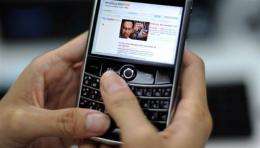
A girl reads an online news portal on her mobile phone. The European Union on Tuesday announced an 18 million euro (25 million dollar) investment in an "ultra high-speed" internet system to underpin the next generation of mobile services.

The European Union announced Tuesday an 18 million euro (25 million dollar) investment in an "ultra high-speed" internet system to underpin the next generation of mobile services.

"Europe's research know-how will continue to set the tone for the development of mobile services and devices around the globe, just as we did in the past decades with the GSM standard," promised EU Telecoms Commissioner Viviane Reding.

The funding will be released on January 1 next year for research on what is known as Long Term Evolution (LTE) Advanced technology, the high end of the fourth generation of mobile technology which should offer users " speeds up to a hundred times faster than current 3G networks," according to the European Commission.

The new LTE technology, not the advanced version which the EU will fund, is currently being trialled by mobile operators in Finland, Germany, Norway, Spain, Sweden and Britain and is expected to be commercially available in Sweden and Norway in the first half of next year.

That will provide mobile internet speeds of up to 100 megabits per second, 10 times faster than the 3G mobile networks.

"LTE technologies will turn mobile phones into powerful mobile computers. Millions of new users will get ultra high-speed access on their portable devices, wherever they are," Reding enthused.

LTE Advanced promises lower prices and mobile broadband speeds up to one gigabit (thousand megabits) per second.

This would allow excellent mobile access to televisions and video-on-demand systems for example.

Between 2004 and 2007, the EU gave 25 million euros to LTE development. leading to the first blueprint for an LTE-based network infrastructure.

The 18 million euros will go to the enhanced version, LTE Advanced.

Next month the commission will open negotiations on the details with project consortia, including the flagship ARTIST4G which united 4G industry and researchers from Britain, Finland, France, Germany, Italy, the Netherlands, Poland, Spain and Sweden.

The new projects are expected to begin in January.

LTE uses radio spectrum more efficiently, enabling mobile networks to benefit from the "digital dividend" and use frequencies freed by the switchover from analogue to digital TV.

Overall, from 2007-2013 the EU will invest more than 700 million euros on researching future networks.

Leading mobile operators and manufacturers around the world such as Orange, T-Mobile, Ericsson, and Nokia have already committed to using the LTE standard. By 2013, operators worldwide are expected to invest nearly six billion euros in LTE equipment, according to market analysts.

(c) 2009 AFP

Explore further: As online video thrives, TV companies push back

add to favorites email to friend print save as pdf

Related Stories

Beyond 3G -- ultra-fast mobile radio networks of the future

Aug 06, 2008

(PhysOrg.com) -- Today’s growing third generation (3G) of mobile data services are only a taste of what is to come. Now, European researchers are paving the way to a world where ultra-fast internet access is available from ...

NXP Launches The World’s Fastest Cellular Modem

Jun 12, 2008

NXP Semiconductors, the independent semiconductor company founded by Philips, today announced the world's fastest high-bandwidth cellular soft modem - Nexperia Cellular System Solution PNX6910. Powered by NXP's Embedded Vector ...

Recommended for you

As online video thrives, TV companies push back

May 14, 2013

The evolving TV and video industry faces uncertainty as it embraces new technology like wireless streaming, as traditional US broadcasters urged lawmakers Tuesday to help preserve their marketplace primacy.

Improving communication during disasters

May 13, 2013

A small armband which can be attached to the injured. An information board containing a complete visual record of events. This is technology helping to improve communications during major national disasters.

Samsung announces 5G data breakthrough

May 13, 2013

Samsung Electronics said Monday it had successfully tested super-fast fifth-generation (5G) wireless technology that would eventually allow users to download an entire movie in one second.

User comments : 0

More news stories

German energy shift faces headwinds

Tense engineers have their eyes peeled on complex colour-coded diagrams on a wall-sized screen that makes their control room look like the inside of a spaceship.

Internet in 'coma' as Iran election looms

Iran is tightening control of the Internet ahead of next month's presidential election, mindful of violent street protests that social networkers inspired last time around over claims of fraud, users and ...

China police billions spell profit opportunity

Mannequins in riot gear, armoured cars and drones line a police equipment and "anti-terrorism technology" trade fair in Beijing as vendors seek to profit from China's huge internal security budget.

Heat-related deaths in Manhattan projected to rise

Residents of Manhattan will not just sweat harder from rising temperatures in the future, says a new study; many may die. Researchers say deaths linked to warming climate may rise some 20 percent by the 2020s, ...

Kinks and curves at the nanoscale

One of the basic principles of nanotechnology is that when you make things extremely small—one nanometer is about five atoms wide, 100,000 times smaller than the diameter of a human hair—they are going ...