NASA Launches New Technology: An Inflatable Heat Shield
Aug 17, 2009
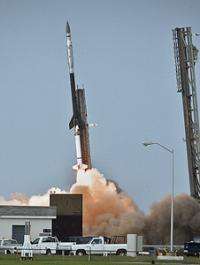
Black Brant 9 rocket carrying the Inflatable Re-entry Vehicle Experiment launches from NASA's Wallops Flight Facility. Credit: NASA/Sean Smith

A successful NASA flight test Monday demonstrated how a spacecraft returning to Earth can use an inflatable heat shield to slow and protect itself as it enters the atmosphere at hypersonic speeds.

The Inflatable Re-entry Vehicle Experiment, or IRVE, was vacuum-packed into a 15-inch diameter payload "shroud" and launched on a small sounding rocket from NASA's Wallops Flight Facility on Wallops Island, Va., at 8:52 a.m. EDT. The 10-foot diameter heat shield, made of several layers of silicone-coated industrial fabric, inflated with nitrogen to a mushroom shape in space several minutes after liftoff.

The Black Brant 9 rocket took approximately four minutes to lift the experiment to an altitude of 131 miles. Less than a minute later it was released from its cover and started inflating on schedule at 124 miles up. The inflation of the shield took less than 90 seconds.

"Our inflation system, which is essentially a glorified scuba tank, worked flawlessly and so did the flexible aeroshell," said Neil Cheatwood, IRVE principal investigator and chief scientist for the Hypersonics Project at NASA's Langley Research Center in Hampton, Va. "We're really excited today because this is the first time anyone has successfully flown an inflatable reentry vehicle."

According to the cameras and sensors on board, the heat shield expanded to its full size and went into a high-speed free fall. The key focus of the research came about six and a half minutes into the flight, at an altitude of about 50 miles, when the aeroshell re-entered Earth's atmosphere and experienced its peak heating and pressure measurements for a period of about 30 seconds.

An on board telemetry system captured data from instruments during the test and broadcast the information to engineers on the ground in real time. The technology demonstrator splashed down and sank in the Atlantic Ocean about 90 miles east of Virginia's Wallops Island.

"This was a small-scale demonstrator," said Mary Beth Wusk, IRVE project manager, based at Langley. "Now that we've proven the concept, we'd like to build more advanced aeroshells capable of handling higher heat rates."

Inflatable heat shields hold promise for future planetary missions, according to researchers. To land more mass on Mars at higher surface elevations, for instance, mission planners need to maximize the drag area of the entry system. The larger the diameter of the aeroshell, the bigger the payload can be.

Provided by JPL/ (news : web)

Explore further: Collisions of coronal mass ejections can be super-elastic

add to favorites email to friend print save as pdf

Related Stories

Rocket to Launch Inflatable Re-entry Capsule

Aug 14, 2009

(PhysOrg.com) -- Inflatable aircraft are not a new idea. Hot air balloons have been around for more than two centuries and blimps are a common sight over many sports stadiums. But it's hard to imagine an inflatable ...

Heat Shield Readied for Next Mars Rover

Jul 10, 2009

Lockheed Martin Space Systems, Denver, has finished building and testing the heat shield for protecting the Curiosity rover of NASA's Mars Science Laboratory project. This heat shield is even larger than the ...

Phoenix Images Discarded Heat Shield

Sep 18, 2008

(PhysOrg.com) -- A new color high-resolution image from the Phoenix Mars Lander shows its crumpled heat shield about 150 meters away from the spacecraft.

Recommended for you

Forecast for Titan: Wild weather could be ahead

14 hours ago

(Phys.org) —Saturn's moon Titan might be in for some wild weather as it heads into its spring and summer, if two new models are correct. Scientists think that as the seasons change in Titan's northern hemisphere, ...

SDO observes mid-level solar flare

14 hours ago

UPDATE 16:30 p.m. EDT: The M7-class flare was also associated with a coronal mass ejection or CME, another solar phenomenon that can send billions of tons of particles into space. While this CME was not Ea ...

NASA's IRIS mission readies for a new challenge

23 hours ago

(Phys.org) —The time draws near. NASA is getting ready to launch a new mission, a mission to observe a largely unexplored region of the solar atmosphere that powers its dynamic million-degree outer atmosphere and drives ...

User comments : 0

More news stories

Very Large Telescope celebrates 15 years of success

(Phys.org) —With this new view of a spectacular stellar nursery ESO is celebrating 15 years of the Very Large Telescope—the world's most advanced optical instrument. This picture reveals thick clumps ...

US House sends message on Keystone pipeline

US lawmakers agreed to a bill that would speed construction of a Canada-US oil pipeline and circumvent the need for President Barack Obama's approval for the $5 billion project.

Be prepared for weather extremes

Unsettled weather is an Iowa mainstay, and so is Inside's annual reminder of the university's severe weather safety and preparedness guidelines—for storms, extreme heat, flooding and more.

Unlocking secrets of cell reproduction

Research published in Open Biology today identifies, for the first time, nearly all the genes required for reproduction of a cell in a living organism.

US teen birth rate drops to record low

US teen births have dropped to a record low, but the country still has one of the highest rates among developed nations, the US Centers for Disease Control and Prevention said Thursday.

Solar plane sets distance record on US tour

The first manned aircraft that can fly day and night powered only by solar energy set a new distance record Thursday when it landed after the second leg of a cross-country US tour.

Submerged structure stumps Israeli archaeologists

The massive circular structure appears to be an archaeologists dream: a recently discovered antiquity that could reveal secrets of ancient life in the Middle East and is just waiting to be excavated.