Orchids and fungi -- partners for life
Aug 13, 2009
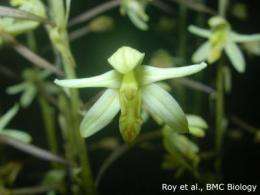
This is an Aphyllorchis montana orchid. Credit: Roy et al., BMC Biology

Three Thai orchids have been found to rely on a wide range of fungi to help them take carbon out of the soil instead of producing their own organic carbon. A detailed study of the relationship, published in the open access journal BMC Biology, also features stunning pictures of the plants.

Marc-André Selosse and Mélanie Roy, from the Centre d'Ecologie Fonctionnelle et Evolutive, Montpellier, France, studied Aphyllorchis montana, A. caudata and Cephalanthera exigua orchids with Suyanee Vessabutr and Santi Watthana from the Queen Sirikit Botanic Garden, Thailand. These orchids have no chlorophyll and rely on fungi colonizing their roots for their carbon supply.

The , which grow on the ground in mountain forests, were collected from 10 different sampling sites in diverse parts of Thailand. The two Aphyllorchis orchids studied were found to associate with a wide range of fungi, while the Cephalanthera was much more specific.

Selosse said, "We show for the first time that certain tropical orchids associate with highly diverse soil fungi colonizing their roots; using stable isotopes, we show that they are likely to use these fungi as a carbon source". Most importantly for conservation concerns, all these fungi associate in turn with the roots of nearby green trees, where they collect carbon for the orchids.

Speaking about the results of the study, Selosse said, "Plants really interact with fungi in an unexpectedly diverse way - the impression one gains is that there is a great need for more research on biological interactions in the tropics to unravel this diversity".

More information: Two mycoheterotrophic orchids from Thailand tropical dipterocarpacean forests associate with a broad diversity of ectomycorrhizal ; Mélanie Roy, Santi Watthana, Anna Stier, Franck Richard, Suyanee Vessabutr and Marc-André Selosse; BMC Biology (in press); http://www.biomedcentral.com/bmcbiol/

Source: BioMed Central (news : web)

Explore further: Scientists announce Top 10 New Species from 2012

add to favorites email to friend print save as pdf

Related Stories

Saving the wild orchids of Borneo

Jul 17, 2008

Borneo (Kalimantan) is the third largest island in the world. It is rich with a variety of indigenous orchid species that grow in the forests. Borneo's rain forests are also home to some extremely rare species of orchids, ...

Fungi important in Arctic nitrogen cycle

May 09, 2006

U.S. biologists say a new method of calculating nitrogen transfer from mushrooms to plants is proving that fungi is important in the Arctic nitrogen cycle.

Recommended for you

Scientists announce Top 10 New Species from 2012

15 minutes ago

An amazing glow-in-the-dark cockroach, a harp-shaped carnivorous sponge and the smallest vertebrate on Earth are just three of the newly discovered top 10 species selected by the International Institute for ...

New cave-dwelling arachnids discovered in Brazil

11 hours ago

Two new species of cave-dwelling short-tailed whipscorpions have been discovered in northeastern Brazil, and are described in research published May 22 in the open access journal PLOS ONE by Adalberto Santos ...

Do songbirds hold key to stuttering?

17 hours ago

A tiny Australian songbird may hold the answer to discovering the biological source of stuttering, which affects 3 million Americans and is notoriously difficult to treat.

User comments : 0

More news stories

Scientists announce Top 10 New Species from 2012

An amazing glow-in-the-dark cockroach, a harp-shaped carnivorous sponge and the smallest vertebrate on Earth are just three of the newly discovered top 10 species selected by the International Institute for ...

Theorists weigh in on where to hunt dark matter

(Phys.org) —Now that it looks like the hunt for the Higgs boson is over, particles of dark matter are at the top of the physics "Most Wanted" list. Dozens of experiments have been searching for them, but ...