Pushing quantum mechanics to higher levels
Aug 11, 2009
Experiments at UCSB push quantum mechanics to higher levels
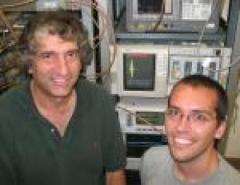
John Martinis and Matthew Neeley are researchers at University of California - Santa Barbara. Credit: George Foulsham, Office of Public Affairs, UCSB.

Scientists at UC Santa Barbara have devised a new type of superconducting circuit that behaves quantum mechanically -- but has up to five levels of energy instead of the usual two. The findings are published in the August 7 issue of Science.

These circuits act like in that they can only gain or lose energy in packets, or quanta, by jumping between discrete energy levels. "In our previous work, we focused on systems with just two energy levels, 'qubits,' because they are the quantum analog of 'bits,' which have two states, on and off," said Matthew Neeley, first author and a graduate student at UCSB.

He explained that in this work they operated a quantum circuit as a more complicated artificial atom with up to five energy levels. The generic term for such a system is "qudit," where 'd' refers to the number of energy levels -- in this case, 'd' equals five.

"This is the quantum analog of a switch that has several allowed positions, rather than just two," said Neeley. "Because it has more energy levels, the physics of a qudit is richer than for just a single qubit. This allows us to explore certain aspects of that go beyond what can be observed with a qubit."

Just as bits are used as the fundamental building blocks of computers, qubits could one day be used as building blocks of a quantum computer, a device that exploits the laws of quantum mechanics to perform certain computations faster than can be done with classical bits alone. "Qudits can be used in quantum computers as well, and there are even cases where qudits could be used to speed up certain operations with a quantum computer," said Neeley. "Most research to date has focused on qubit systems, but we hope our experimental demonstration will motivate more effort on qudits, as an addition to the processing toolbox."

Source: University of California - Santa Barbara (news : web)

Explore further: Hydrogen atoms under the magnifying glass

add to favorites email to friend print save as pdf

Related Stories

2 qubits in action, new step towards the quantum computer

Jun 14, 2007

Researchers at Delft University of Technology have succeeded in carrying out calculations with two quantum bits, the building blocks of a possible future quantum computer. The Delft researchers are publishing ...

Yale scientists bring quantum optics to a microchip

Sep 08, 2004

A report in the journal Nature describes the first experiment in which a single photon is coherently coupled to a single superconducting qubit (quantum bit or "artificial atom"). This represents a new paradigm in which ...

Recommended for you

A quantum simulator for magnetic materials

59 minutes ago

Physicists understand perfectly well why a fridge magnet sticks to certain metallic surfaces. But there are more exotic forms of magnetism whose properties remain unclear, despite decades of intense research. ...

Researchers forward quest for quantum computing

6 hours ago

Research teams from UW-Milwaukee and the University of York investigating the properties of ultra-thin films of new materials are helping bring quantum computing one step closer to reality.

Hydrogen atoms under the magnifying glass

May 22, 2013

To describe the microscopic properties of matter and its interaction with the external world, quantum mechanics uses wave functions, whose structure and time dependence is governed by the Schrödinger equation. ...

Making quantum encryption practical

May 21, 2013

One of the many promising applications of quantum mechanics in the information sciences is quantum key distribution (QKD), in which the counterintuitive behavior of quantum particles guarantees that no one can eavesdrop on ...

Lab sets a new record for creating heralded photons

May 20, 2013

(Phys.org) —Entanglement, by general consensus of physicists, is the weirdest part of quantum science. To say that two particles, A and B, are entangled means that they are actually two parts of an inseparable ...

Competition in the quantum world

May 20, 2013

Innsbruck physicists led by Rainer Blatt and Peter Zoller experimentally gained a deep insight into the nature of quantum mechanical phase transitions. They are the first scientists that simulated the competition ...

User comments : 1

Adjust slider to filter visible comments by rank

Display comments: newest first

Alexa
1 / 5 (1) Aug 11, 2009
Or we can simulate the reality by real particles and we have quantum computer with billions of quantum states available. This is what the analogue computer is called.

More news stories

A quantum simulator for magnetic materials

Physicists understand perfectly well why a fridge magnet sticks to certain metallic surfaces. But there are more exotic forms of magnetism whose properties remain unclear, despite decades of intense research. ...

Engineers pioneer flat spray-on optical lens

A University of British Columbia engineer and a team of U.S. researchers have made a breakthrough utilizing spray-on technology that could revolutionize the way optical lenses are made and used.

Researchers forward quest for quantum computing

Research teams from UW-Milwaukee and the University of York investigating the properties of ultra-thin films of new materials are helping bring quantum computing one step closer to reality.

How do cold ions slide

Things not always run smoothly. It may happen, actually, that when an object slides on another, the advancement may occur through a 'stop and go' series in the characteristic manner which scientists call ...