Single-molecule technique captures calcium sensor calmodulin in action
Aug 10, 2009
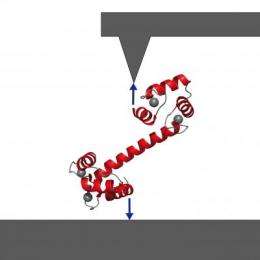
Biophysicists at the Tecdhnische Universitaet Muenchen use a specially designed atomic-force microscope to manipulate the signaling protein calmodulin and watch it do its work. Credit: M. Rief, TUM Dept. of Physics

It's well known that the protein calmodulin specifically targets and steers the activities of hundreds of other proteins - mostly kinases - in our cells, thus playing a role in physiologically important processes ranging from gene transcription to nerve growth and muscle contraction But just how it distinguishes between target proteins is not well understood. Methods developed by biophysicists at the Technische Universitaet Muenchen (TUM, Germany) have enabled them to manipulate and observe calmodulin in action, on the single-molecule scale.

In recent experiments, as they report in the early edition of PNAS, the Proceedings of the National Academy of Sciences, they compared the sequences of structural and kinetic changes involved in binding two different kinases. The results reveal new details of how calmodulin binds and regulates its target proteins.

A so-called signaling protein and "calcium sensor," calmodulin gives start and stop signals for a great number of intracellular activities by binding and releasing other proteins. Calmodulin can bind up to four calcium ions, and the three-dimensional spatial structure of calmodulin varies with the number of calcium ions bound to it. This structure in turn helps to determine which amino acid chains - and proteins - the calmodulin will bind.

Techniques such as X-ray structural analysis offer snapshots, at best, of steps in this intracellular work flow. But single-molecule atomic-force spectroscopy has opened a new window on such dynamic processes.

Professor Matthias Rief and colleagues at the Technische Universitaet Muenchen had previously shown that they could fix a single calmodulin molecule between a surface and the cantilever tip of a specially built , expose it to calcium ions in solution, induce peptide binding and unbinding, and measure changes in the molecule's mechanical properties as it did its work.

"What is special about our technique," Rief says, "is that we can work directly in aqueous solution. We can make our measurements in exactly the conditions under which the protein works in its natural environment. So we can directly observe how the calmodulin snatches the amino acid chain and folds itself, to hold its target fast." Measuring the force needed to bend the calmodulin molecule out of its stable condition at any given moment enables the researchers to compute the energies associated with binding both the calcium ions and the amino acid chains. And by following changes in the molecule's mechanical properties over time, they also can determine how long a protein fragment remains bound.

The results Rief and biophysicist Jan Philipp Junker report in the early edition of PNAS show that their approach also enables detailed comparative studies of binding sequences for different target proteins. The target sequences observed in these experiments are called skMLCK and CaMKK. Rief and Junker used mechanical force - actually pulling on complexes of calmodulin and the target peptides at rates of 1 nanometer per second or less - to slow down the processes to observable time scales and to clearly separate the individual unbinding steps.

"By applying mechanical force," Junker says, "we are able to dismantle the calmodulin-target peptide complex with surgical precision. Using conventional methods, this would be very difficult to do."

Among the detailed insights this approach made accessible are the hierarchy of folding and target binding, the sequence of unbinding events, and target-specific differences in terms of what is called cooperative binding.

More information: "Single-molecule force spectroscopy distinguishes target binding modes of calmodulin," by Jan Philipp Junker and Matthias Rief, published in the online Early Edition of PNAS, for the week of August 10, 2009.

Source: Technische Universitaet Muenchen

Explore further: RNA capable of catalyzing electron transfer on early earth with iron's help, study says

add to favorites email to friend print save as pdf

Related Stories

Squeeze play: Protein's grip like a baseball bunter's

Oct 10, 2006

Like all good baseball players, the protein calmodulin appreciates the importance of maintaining a good grip. A vital regulatory protein in all plants and animals, calmodulin is known to grab hold of hundreds of different ...

Like eavesdropping at a party

Jul 31, 2008

Cells rely on calcium as a universal means of communication. For example, a sudden rush of calcium can trigger nerve cells to convey thoughts in the brain or cause a heart cell to beat. A longstanding mystery has been how ...

Muscular protein bond -- strongest yet found in nature

Jul 20, 2009

A research collaboration between Munich-based biophysicists and a structural biologist in Hamburg (Germany) is helping to explain why our muscles, and those of other animals, don't simply fall apart under stress. Their findings ...

Enzyme doesn't act alone in atrial fibrillation

Jun 17, 2009

(June 17, 2009) - An overactive enzyme is behind a leaky calcium channel that plays a role in the development of atrial fibrillation, which is the most common cardiac arrhythmia that is responsible for a third of all strokes. ...

Uncharged organic molecule can bind negatively charged ions

Feb 26, 2008

Indiana University Bloomington chemists have designed an organic molecule that binds negatively charged ions, a feat they hope will lead to the development of a whole new molecular toolbox for biologists, chemists and medical ...

Recommended for you

Attacking MRSA with metals from antibacterial clays

May 17, 2013

In the race to protect society from infectious microbes, the bugs are outrunning us. The need for new therapeutic agents is acute, given the emergence of novel pathogens as well as old foes bearing heightened antibiotic resistance.

Keeping fruit, vegetables and cut flowers fresh longer

May 15, 2013

New technology offers the promise of reducing billions of dollars of losses that occur each year from the silent, invisible killer of fruits, vegetables and cut flowers—a gas whose effects are familiar to everyone who has ...

Why don't beetles freeze in the winter?

May 14, 2013

For 37 years, Queen's University Biochemistry professor Peter Davies has been unraveling the mystery of why some organisms including insects and fish don't freeze in the winter. His research into insect antifreeze protein ...

The molecular basis of strawberry aroma

May 13, 2013

You know that summer is here when juicy red strawberries start to appear on the shelves. In Germany, this seasonal fruit has never been more popular: on average 3.5 kilos per head were consumed in 2012—a ...

A new dimension for 3-D protein structures

May 13, 2013

(Phys.org) —3D structures of biological molecules like proteins directly affect the way they behave in our bodies. EPFL scientists have developed a new infrared-UV laser method to more accurately determine ...

User comments : 0

More news stories

Attacking MRSA with metals from antibacterial clays

In the race to protect society from infectious microbes, the bugs are outrunning us. The need for new therapeutic agents is acute, given the emergence of novel pathogens as well as old foes bearing heightened antibiotic resistance.

Beautiful 'flowers' self-assemble in a beaker

By simply manipulating chemical gradients in a beaker of fluid, materials scientists at Harvard have found that they can control the growth behavior of crystals to create precisely tailored structures—such ...

Heat-related deaths in Manhattan projected to rise

Residents of Manhattan will not just sweat harder from rising temperatures in the future, says a new study; many may die. Researchers say deaths linked to warming climate may rise some 20 percent by the 2020s, ...

Kinks and curves at the nanoscale

One of the basic principles of nanotechnology is that when you make things extremely small—one nanometer is about five atoms wide, 100,000 times smaller than the diameter of a human hair—they are going ...