The cosmic comic: Riding early waves
Aug 05, 2009
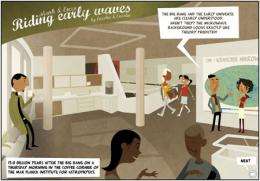
13.8 billion years after the Big Bang: Two scientists arrange to go surfing of a cosmic wave. Image: Jojo Enßlin

(PhysOrg.com) -- Fundamental research in cosmology continues to disclose ever more mysteries of the first millennia of the universe. More detailed knowledge will be delivered by the recently launched Planck Satellite which will measure the microwave background - the so-called echo of the Big Bang. How can we expose the broader public to the complex physics of the early universe? In the "International Year of Astronomy" (2009) the Max Planck Institute for Astrophysics (MPA, Germany) tries an unusual experiment: a comic on the Internet about the physical processes that took place during the first 400,000 years after the Big Bang.

Two fictitious high-spirited scientists of the institute, passionate surfers, take off to visit the early Universe. Not to do serious research there but to experience the ultimate ride on the plasma waves of the . However, they quickly realize that they would be stuck without their knowledge of the physics of the early Universe. This is not meant to replace textbooks or scientific texts but to guide the reader in an amusing way through a series of phenomena of . Even one of the unsolved puzzles of cosmology - the strange "Cold Spot" in the microwave background - receives a new explanation.

The knowledge is always passed on casually via the story. The internet comic contains short, interactively selectable background information on the which leads to more detailed external internet pages about physics and cosmology. In this way a broader audience can be reached: youth that could be attracted by the unusual surfer story; interested amateurs who get an entertaining introduction into microwave background; and finally teachers who may use the material for illustrating their lessons.

This comic was created by the Ensslin brothers Torsten and Jojo. Torsten Ensslin is a cosmologist at MPA and heads the German participation in the Planck Satellite mission. Jojo Enßlin is a freelance illustrator, surfer and cofounder of the "Galerie Revolver" in Duesseldorf. MPA is one of the leading research institutes for theoretical astrophysics, and is one of its major research areas.

More information: The cosmic comic: Riding early waves

Provided by Max Planck Institute

Explore further: Dark, massive asteroid to fly by Earth on May 31

add to favorites email to friend print save as pdf

Related Stories

Planck Satellite ready to measure the Big Bang

May 11, 2009

(PhysOrg.com) -- The last tests of the Ariane 5 rocket system have been finished and ESA's Planck satellite is sitting ready for launch at the Guiana Space Centre in Kourou. Together with ESA's space telescope ...

Universe in crisis as experts question Big Bang model

Jul 07, 2005

The widely accepted idea that the universe began with a Big Bang could be wrong, according to astrophysicists who took part in a "Crisis in cosmology" meeting in Portugal and reported in this month's Physics World magazi ...

Could the Universe be tied up with cosmic string?

Jan 18, 2008

A team of physicists and astronomers at the University of Sussex and Imperial College London have uncovered hints that there may be cosmic strings - lines of pure mass-energy - stretching across the entire Universe.

Home computers to help researchers better understand universe

Oct 24, 2007

Want to help unravel the mysteries of the universe" A new distributed computing project designed by a University of Illinois researcher allows people around the world to participate in cutting-edge cosmology research by donating ...

Recommended for you

Dark, massive asteroid to fly by Earth on May 31

22 hours ago

It's 1.7 miles long. Its surface is covered in a sticky black substance similar to the gunk at the bottom of a barbecue. If it impacted Earth it would probably result in global extinction. Good thing it is ...

Research team explains 'Lazarus' comets

May 24, 2013

Astronomers from the University of Antioquia have discovered a graveyard of comets. These once-dormant comets, dubbed by astronomers as "The Lazarus comets," are now rejuvenated.

NASA ships sensors for seafaring satellite to France

May 24, 2013

(Phys.org) —Three NASA-built instruments that are integral components of the next in a series of U.S./European ocean altimetry satellites have arrived in France for integration with their spacecraft in ...

Trip into space with DiCaprio costs $1.55m

May 24, 2013

Leonardo DiCaprio is going to get closer to stars of a different kind as he heads into space aboard the Virgin Galactic, and a well-heeled bidder at the Cannes Film Festival has paid 1.2 million euros (1.5 million) to be ...

User comments : 0

More news stories

Galaxies fed by funnels of fuel

(Phys.org) —Computer simulations of galaxies growing over billions of years have revealed a likely scenario for how they feed: a cosmic version of swirly straws.

Dark, massive asteroid to fly by Earth on May 31

It's 1.7 miles long. Its surface is covered in a sticky black substance similar to the gunk at the bottom of a barbecue. If it impacted Earth it would probably result in global extinction. Good thing it is ...