Rare Angolan antelope tracked by research team
Jul 27, 2009
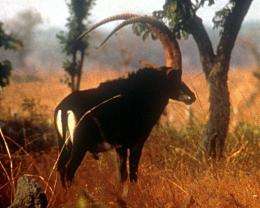
One of the last remaining images of Angola's elusive giant sable antelope, last seen 30 years ago before the country's civil war. A rare Angolan antelope feared to have been killed off during a 27-year civil war has been located, giving hope for the future preservation of the species, a government official said Monday.

A rare Angolan antelope feared to have been killed off during a 27-year civil war has been located, giving hope for the future preservation of the species, a government official said Monday.

Scientists at the weekend spotted three giant black sable antelope -- endemic to Angola where they are the country's national symbol and known in Portuguese as the Palanca Negra -- in two northern reserves.

"This is a huge step for us and it really pushes the project forward," Vladimir Russo, Angola?s national director of environmental management, told AFP.

"We were able to put a collar on one of the females which contains a (GPS) tracker so we can follow her to find the rest of the herd. It?s really great news, we are all very excited."

A project was launched at the end of the war in 2002 to find the elusive Palanca Negra, which is also the nickname for the country?s football team, with fears that decades of conflict had wiped out the animals.

Until now there had been just a handful of sightings, mostly via cameras left in national parks or by local shepherds, but the team struck gold at the weekend by spotting the three animals by helicopter in the Cangandala National Park and Luando Reserve.

Russo said the plan was to try to find more animals over the next two weeks and then using the GPS trackers, round up as many as possible and take them to a specially-built 400-hectare sanctuary within Cangandala.

The giant sable is listed as critically endangered by the International Union for of Nature.

(c) 2009 AFP

Explore further: White tiger mystery solved

add to favorites email to friend print save as pdf

Related Stories

Photo reveals rare okapi survived poaching onslaught

Sep 10, 2008

A set of stripy legs in a camera trap photo snapped in an African forest indicates something to cheer about, say researchers from the Wildlife Conservation Society. The legs belong to an okapi -- a rare forest ...

Are Ice Age relics the next casualty of climate change?

Apr 24, 2008

The Wildlife Conservation Society (WCS) recently launched a four-year study to determine if climate change is affecting populations of a quintessential Arctic denizen: the rare musk ox. Along with collaborators ...

First albino buffalo spotted in Kenyan park

Apr 24, 2009

Rangers in Kenya's Hellsgate National Park have spotted an albino buffalo, the first of its kind ever recorded in the wildlife rich country, park officials said Friday.

Recommended for you

White tiger mystery solved

1 hour ago

White tigers today are only seen in zoos, but they belong in nature, say researchers reporting new evidence about what makes those tigers white. Their spectacular white coats are produced by a single change ...

Scientists announce Top 10 New Species from 2012

8 hours ago

An amazing glow-in-the-dark cockroach, a harp-shaped carnivorous sponge and the smallest vertebrate on Earth are just three of the newly discovered top 10 species selected by the International Institute for ...

New cave-dwelling arachnids discovered in Brazil

20 hours ago

Two new species of cave-dwelling short-tailed whipscorpions have been discovered in northeastern Brazil, and are described in research published May 22 in the open access journal PLOS ONE by Adalberto Santos ...

User comments : 0

More news stories

White tiger mystery solved

White tigers today are only seen in zoos, but they belong in nature, say researchers reporting new evidence about what makes those tigers white. Their spectacular white coats are produced by a single change ...

Unlocking secrets of cell reproduction

Research published in Open Biology today identifies, for the first time, nearly all the genes required for reproduction of a cell in a living organism.

A hidden population of exotic neutron stars

(Phys.org) —Magnetars – the dense remains of dead stars that erupt sporadically with bursts of high-energy radiation - are some of the most extreme objects known in the Universe. A major campaign using ...

The secret lives, and deaths, of neurons

As the human body fine-tunes its neurological wiring, nerve cells often must fix a faulty connection by amputating an axon—the "business end" of the neuron that sends electrical impulses to tissues or other ...