Putting Plankton in Perspective, from Sea to Sky (w/ Video)
Jul 24, 2009 by Kathryn Hansen
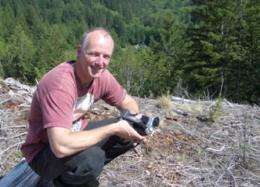
Mike Behrenfeld, a phytoplankton ecologist and physiologist at Oregon State University, studies the floating ocean plants in the lab and out in their natural environment. His broad view contributed to a new theory about the timing and cause of the annual phytoplankton bloom in the North Atlantic. Credit: Oregon State University

(PhysOrg.com) -- From the time he was 21 and working toward his Ph.D., Mike Behrenfeld has been observing phytoplankton -- floating ocean plants that have a global impact. Observing these tiny plants under a microscope, Behrenfeld discovered early on that how you set up an experiment matters.

Researchers had previously observed that "fat and happy" plankton in a sterile laboratory dish suffer considerably when exposed to . But perform the same experiment while simulating the abundance of real-world stresses that face every day in the ocean, and the impact of ultraviolet radiation is much smaller, Behrenfeld found.

Now a phytoplankton ecologist and physiologist at Oregon State University, Behrenfeld studies phytoplankton in the lab but also makes a point of regularly going out to sea to stay grounded in the "real world."

He also employs a big-picture tool: the view from space.

This video is not supported by your browser at this time.
Nearly a decade of data from the space-based SeaWiFS instrument reveals the seasonal abundance of plant life in the North Atlantic. Dark blue represents warmer areas where there is little life, and greens and reds represent cooler nutrient-rich areas where life is abundant. Credit: NASA Scientific Visualization Studio

Behrenfeld's introduction to came during his tenure at Brookhaven National Laboratory, where he learned how space-based instruments can measure ocean color and detect phytoplankton's green pigment.

"That's when I began thinking in earnest about the global aspects of phytoplankton ecology," Behrenfeld said. "I was able to combine physiological knowledge of processes at the cellular level that I learned from the lab with the big picture of looking at global systems from space."

Now, with more than ten years of ocean color data from NASA's Sea-viewing Wide Field-of-view Sensor (SeaWiFS) instrument, Behrenfeld has developed a new theory about the timing and cause of the North Atlantic Bloom. This annual bloom of phytoplankton spans the entire ocean at northern latitudes, and responsible for feeding marine birds and mammals, as well as soaking up carbon dioxide from the atmosphere.

Behrenfeld found that the classic understanding of the bloom -- that warm spring temperatures and abundant sunlight drive its onset -- may be mistaken. Instead, satellite data show that the bloom begins in winter, when phytoplankton habitat extends deeper below the surface. Phytoplankton are diluted over a larger habitat volume, decreasing their chance of encountering a predator, allowing the population to grow, and initiating a bloom. Only later, in spring, do favorable growth conditions at the surface contribute to the bloom.

"With space-based tools, we can go back and look at these old paradigms in a new way," Behrenfeld said. "The satellite measurements were the absolute central piece of the work, but their interpretation required background knowledge from the laboratory and field techniques."

Behrenfeld encourages the next generation of young scientists -- whether they are focused on satellite data, computer models, laboratory experiments or optics -- to take a diversified approach to scientific inquiry and to get out into the real world as much as possible.

"Getting away from the computer and simply thinking about things for awhile opens up new questions you want to ask," he said, "and feeds our scientific curiosity about how organisms and natural ecosystems work."

Provided by JPL/NASA (news : web)

Explore further: NASA sees Cyclone Mahasen hit Bangladesh

add to favorites email to friend print save as pdf

Related Stories

NASA Development May Help Solve Ocean Biology Problem

Feb 11, 2005

NASA and university scientists have made a breakthrough in using satellites to study the tiny, free-floating ocean plants, called phytoplankton. The plants form the base of the ocean food chain and produce half of the oxygen ...

Study Solves Ocean Plant Mystery

Aug 31, 2006

A NASA-sponsored study shows that by using a new technique, scientists can determine what limits the growth of ocean algae, or phytoplankton, and how this affects Earth's climate.

Summer Storms Could Mean More Dead Zones

Jul 11, 2008

(PhysOrg.com) -- It's summertime and people are flocking to the coasts around the country. But when summer storms arrive, it's not only beach-goers who are affected; the rains can also have an impact on living ...

Recommended for you

Alaska volcano shoots ash 15,000 feet into the air

17 hours ago

(AP)—One of Alaska's most restless volcanoes has shot an ash cloud 15,000 feet into the air in an ongoing eruption that has drawn attention from a nearby community but isn't expected to threaten air traffic.

NASA sees Cyclone Mahasen hit Bangladesh

May 17, 2013

NASA's Tropical Rainfall Measuring Mission satellite known as TRMM measured Cyclone Mahasen's rainfall rates from space as it made landfall on May 16. Mahasen has since dissipated over eastern India.

Rapid climate change ruled out ice age trees

May 17, 2013

Short, sharp fluctuations in the Earth's climate throughout the last ice age may have stopped trees from getting a foothold in Europe and northern Asia, scientists say.

Earth's iron core is surprisingly weak, researchers say

May 17, 2013

The massive ball of iron sitting at the center of Earth is not quite as "rock-solid" as has been thought, say two Stanford mineral physicists. By conducting experiments that simulate the immense pressures deep in the planet's ...

User comments : 0

More news stories

Galaxy's Ring of Fire

Johnny Cash may have preferred this galaxy's burning ring of fire to the one he sang about falling into in his popular song. The "starburst ring" seen at center in red and yellow hues is not the product of ...

Alaska volcano shoots ash 15,000 feet into the air

(AP)—One of Alaska's most restless volcanoes has shot an ash cloud 15,000 feet into the air in an ongoing eruption that has drawn attention from a nearby community but isn't expected to threaten air traffic.

Chinese, Indian airlines face EU pollution fines

Eight Chinese and two Indian airlines face fines of up to several million euros for not paying for their greenhouse gas emissions during flights within the bloc, the European Commission said on Friday.

Morocco to harness the wind in energy hunt

Morocco is ploughing ahead with a programme to boost wind energy production, particularly in the southern Tarfaya region, where Africa's largest wind farm is set to open in 2014.

US seizes Bitcoin operator accounts

US authorities seized the accounts of a Bitcoin digital currency exchange operator, claiming it was functioning as an "unlicensed money service business," court documents showed Friday.