Tropical zone expanding due to climate change: study
Jul 06, 2009
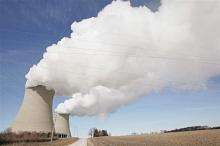
Steam billows from the cooling towers at Exelon's nuclear power generating station in Byron, Illinois, in 2006. Climate change is rapidly expanding the size of the world's tropical zone, threatening to bring disease and drought to heavily populated areas, an Australian study has found.

Climate change is rapidly expanding the size of the world's tropical zone, threatening to bring disease and drought to heavily populated areas, an Australian study has found.

Researchers at James Cook University concluded the tropics had widened by up to 500 kilometres (310 miles) in the past 25 years after examining 70 peer-reviewed scientific articles.

They looked at findings from long-term satellite measurements, weather balloon data, and studies to determine how global warming was impacting on the tropical zone.

The findings showed it now extended well beyond the traditional definition of the tropics, the equatorial band circling the Earth between the Tropic of Cancer and the Tropic of Capricorn.

Professor Steve Turton said that meant the subtropical arid zone which borders the tropics was being pushed into temperate areas, with potentially devastating consequences.

"Such areas include heavily-populated regions of southern Australia, southern Africa, the southern Europe-Mediterranean-Middle East region, the south-western United States, northern Mexico, and southern South America," he said.

"All of (them) are predicted to experience severe drying.

"If the dry subtropics expand into these regions, the consequences could be devastating for water resources, natural ecosystems and agriculture, with potentially cascading environmental, social and health implications."

Turton said tropical diseases such as dengue fever were likely to become more prevalent.

"Some models predict the greatest increase in the annual epidemic potential of dengue will be into the subtropical regions, including the southern United States, China and northern Africa in the northern hemisphere, and South America, southern Africa, and most of Australia in the southern hemisphere," he said.

James Cook University vice-chancellor Sandra Harding said the evidence showed climate change was already affecting wildlife and rainfall in Australia, which is in the grip of its worst drought in a century.

She said studies showed changes to wind patterns meant rain was now being dumped in the ocean south of the continent, rather than over land.

"There is also evidence that many Australian animal and plant species are moving south in an attempt to track their preferred climatic conditions," she said.

"Some won?t make it."

Harding said the world had to get serious about finding solutions to problems caused by climate change in the tropics.

"Tropical climate conditions are expanding and the impact of this expansion is immense because the tropics is a big, complex and important zone of the world," she said.

(c) 2009 AFP

Explore further: Astonishing hi-resolution satellite views of the destruction from the Moore, Oklahoma tornado

add to favorites email to friend print save as pdf

Related Stories

The tropics may be expanding

May 25, 2006

Scientists don't know if global warming is responsible Atmospheric temperature measurements by U.S. weather satellites indicate Earth's hot, tropical zone has expanded farther from the equator since 1979, says ...

New Ice Age maps point to climate change patterns

Jan 19, 2009

(PhysOrg.com) -- New climate maps of the Earth’s surface during the height of the last Ice Age support predictions that northern Australia will become wetter and southern Australia drier due to climate change.

Human-generated aerosols affect our weather

Jan 22, 2008

The rise of human-generated pollution in the global atmosphere is forcing a change in ocean circulation in the Southern Hemisphere, in turn affecting our region’s weather systems.

Ocean Bridge Links Climate In Mid-Latitudes And Tropics

Jan 22, 2008

It's no surprise when a tropical El Niño brings wet storms to the U.S. Southwest; now researchers are finding that the relationship may be two-way, with atmospheric variability outside of the tropics impacting the formation ...

Recommended for you

Strong earthquake at exceptional depth

May 24, 2013

This morning at 05:45 CEST, the earth trembled beneath the Okhotsk Sea in the Pacific Northwest. The quake, with a magnitude of 8.2, took place at an exceptional depth of 605 kilometers. Because of the great ...

Marine forecasting on the horizon for Indian Ocean Rim

May 24, 2013

Nearly all of the member countries of the Indian Ocean Rim Association for Regional Cooperation (IOR-ARC) will attend the week-long workshop to further cooperation and understanding on international ocean ...

Russia evacuates drifting Arctic research station

May 23, 2013

Russia has ordered the urgent evacuation of the 16-strong crew of a drifting Arctic research station after ice floe that hosts the floating laboratory began to disintegrate, officials said Thursday.

User comments : 2

Adjust slider to filter visible comments by rank

Display comments: newest first

GregHight
4.8 / 5 (4) Jul 06, 2009
Why do tthey use a picture of a steam cooling tower that produces no CO2 for this article? I guess it's too hard to find a real smokestack spewing pollution anymore.
MitchGonzalez
4.8 / 5 (4) Jul 06, 2009
GregHight makes a good point, we should be using as much nuclear power as possible to prevent climate change, that picture has no bearing to this article.

If the US converted producing 80% of its electricity from Nuclear Power as France does we would eliminate the carbon-emmission equivalent of every automobile on the road.

More news stories

Galaxies fed by funnels of fuel

(Phys.org) —Computer simulations of galaxies growing over billions of years have revealed a likely scenario for how they feed: a cosmic version of swirly straws.

Century-old science helps confirm global warming

(Phys.org) —Ocean measurements taken more than 135 years ago during the scientific expedition of HMS Challenger have provided further confirmation of human-produced global warming over the past century.

Yahoo, pay-TV operators among Hulu bidders

Online video site Hulu is again up for sale, with Yahoo and pay TV operators DirecTV and Time Warner Cable among the seven bidders, according to a person with direct knowledge of the matter.