A 'quantum of sol' -- how nanotechnology could hold the key to a solar-powered future
Jun 30, 2009
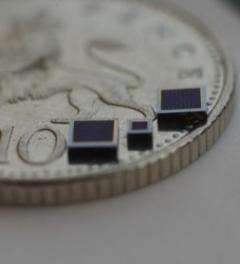
The new millimetre-sized solar cells capture more of the sun's energy than traditional solar panels.

(PhysOrg.com) -- A new generation of 'nano-structured' millimetre-sized solar cells that could convert the sun's energy to electricity more than twice as efficiently as current technology, is the subject of an Imperial College London exhibit called 'A Quantum of Sol' at the Royal Society Summer Science Exhibition 2009, which opens to the public today.

Visitors to the exhibit will be able to play at being solar power engineers, and use prisms to see how much electrical power can be generated by the different colours within the spectrum of light.

The exhibit is led by Dr Ned Ekins-Daukes, a researcher from the Department of Physics and the Grantham Institute for at Imperial, who also launches the first in a series of Grantham Institute briefing papers at the exhibition today (30 June).

The 'Quantum of Sol' exhibit explains the technology behind so-called 'third generation' solar cells. These are designed on the nano-scale, which means the materials they are made of are custom-built on a scale 1000 times smaller than the size of a human hair. These third generation solar cells can capture more of the sun's energy than existing silicon because they contain different layers of material that absorb a broader spectrum of colours. Individually targeting different colours of sunlight in this way captures more of the sun's energy, creating much more efficient solar cells.

Visitors to the exhibit will be able to see this principle in action by sliding a working solar cell through light that has been split by a prism into its constituent colours, to see how each colour generates different amounts of energy.

They will also get the chance to play the role of solar power engineers, positioning small mirrors and lenses on a board to focus a beam of light onto a miniature solar cell. This is a scaled-down representation of a type of solar technology used in the desert, known as a 'concentrator power system', where swathes of mirrors or lenses are used to focus sunlight onto small but highly efficient solar cells.

Silicon solar panels, which have been around since the 1950s and are relatively cheap to produce, lose a lot of the sun's energy, and tend to operate with just 12 - 20% efficiency. The new generation of so-called 'multi- junction' solar cells has the potential to perform much better, with the current world record for efficiency standing at 41%, and Dr Ekins-Daukes predicting that 50% efficiency will be achieved within a decade.

"One of the biggest challenges for scientists working in the field is finding ways of harnessing the sun's energy more efficiently," says Dr Ekins-Daukes. "Our exhibit gives people the chance to get a hands-on understanding of the research underway at Imperial and elsewhere in the world to develop new solar cells that capture the light missed by other solar panel designs."

Although using nanotechnology to build these new is expensive at present - $14 per square centimetre - a solar concentrator system collects and focuses sunlight using inexpensive mirrors. In this way, the electricity generated can become affordable. In 2007, Imperial College London spun out a company, Quantasol, which has recently developed a particularly efficient single-junction solar cell, which forms part of the exhibit.

The international efforts to improve the efficiency of this new generation of cells and the potential for the technology to become more affordable in the future are outlined Dr Ekins-Daukes' Grantham Institute for Climate Change briefing paper - copies of which will be available at the Royal Society exhibition.

Entitled 'Solar energy for heat and electricity: the potential for mitigating climate change', the briefing paper appraises the current state of play in the solar energy field, describing solar energy's potential contribution to climate mitigation goals, and outlining what needs to be done to reach these goals.

It is the first in a planned series of briefing papers that will be published by the Grantham Institute for Climate Change to provide a source of information about key issues linked with climate change science, adaptation and mitigation. Aimed at key policy- and decision-makers, the series of briefing papers is part of the Grantham Institute's mission to generate and communicate the highest quality research on climate change and to translate this research into sustainable technological, political and socio-economic responses.

Director of the Grantham Institute for Climate Change at Imperial, Professor Sir Brian Hoskins, commented: "I'm delighted that the first of our planned briefing papers is being launched at the Royal Society's Summer Science Exhibition. This event provides a great opportunity for Dr Ekins-Daukes to share his expertise in photovoltaics with young people and the general public, whilst the briefing paper's more in-depth analysis of the broader solar energy field makes it a must-read for those in business and government charged with making decisions that will affect how we get energy and heat for our homes and workplaces in the future."

Provided by Imperial College London (news : web)

Explore further: Researchers develop method to inkjet print highly conductive, bendable layers of graphene

add to favorites email to friend print save as pdf

Related Stories

Desert power: A solar renaissance

Apr 01, 2008

What does the future hold for solar power? “Geotimes” magazine looks into more efficient ways of turning the sun’s power into electricity in its April cover story, “Desert Power: A Solar Renaissance.”

Solar cells of the future

Dec 18, 2007

A new material, nano flakes, may revolutionise the transformation of solar energy to electricity. If so, even ordinary households can benefit from solar electricity and save money in the future.

Unique Quantum Effect Found in Silicon Nanocrystals

Jul 24, 2007

Researchers at the U.S. Department of Energy’s National Renewable Energy Laboratory, collaborating with Innovalight, Inc., have shown that a new and important effect called Multiple Exciton Generation (MEG) occurs efficiently ...

Plastic solar cell efficiency breaks record

Apr 19, 2007

The global search for a sustainable energy supply is making significant strides at Wake Forest University as researchers at the university’s Center for Nanotechnology and Molecular Materials have announced that they have ...

Recommended for you

Kinks and curves at the nanoscale

May 19, 2013

One of the basic principles of nanotechnology is that when you make things extremely small—one nanometer is about five atoms wide, 100,000 times smaller than the diameter of a human hair—they are going ...

Snake's ultra-black spots may aid high-tech quest

May 16, 2013

Scientists have identified nanostructures in the ultra-black skin markings of an African viper which they said Thursday could inspire the quest to create the ultimate light-absorbing material.

User comments : 18

Adjust slider to filter visible comments by rank

Display comments: newest first

Soylent
1 / 5 (3) Jun 30, 2009
Generation is almost irrelevant. If you want solar cells to ever succede as a major powersource on the grid you need, absolutely need gob-smackingly stupid amounts of storage at low cost.
NeilFarbstein
2.2 / 5 (6) Jun 30, 2009
Thermal storage of CSP solar thermal can store energy with 99% efficiency for a week.
Ant
3.7 / 5 (3) Jun 30, 2009
surely the way to store energy is to do work with it which can be reversed such as pumping water to a higher level?
nkalanaga
3 / 5 (2) Jun 30, 2009
Or, for small systems, why not compressed air, which would turn a gas turbine generator when the sun isn't shining? All you would need is a reversible compressor/turbine and a pressure tank, both of which are already available.
PPihkala
4 / 5 (1) Jun 30, 2009
The problem with compressed air energy storage is that the longer you store the air the more you lose the energy that ends into heating the air during compression. One way to avoid this loss is to have big storage and low differential pressures, but then it's harder to regain the energy from the storage. Pumping water and then releasing it again through turbine has also associated pump and turbine losses.

Probably the cheapest way to harness solar power is by solar power heaters. There the efficiency is also high. Then again heat storage might need big containers.
Quantum_Conundrum
1 / 5 (3) Jun 30, 2009
In conceptualizing a hypothetical lunar colony I eventually concluded that thermal storage (either in water for cooking and cleaning, or in some solid state,) is likely the best way to store excess solar energy for future usage. Mainly, in my scheme, the excess energy is stored thermally because there is always a need for thermal energy anyway: cooking, cleaning, bathing all use hot water directly, and climate control can also be maintained with hot water and radiators.

In my colony half of the moon is dark for like 2 weeks at a time, and then light for two weeks at a time, so storing and transporting energy in the form of solar heated water was a very efficient idea, provided it is used in the manner I have here described, because even most of the "wasted" energy actually ends up going to useful purposes.

Well, in my hypothetical "colony" I am invisioning pre-designed planetary scale civilizations which are created with the utmost efficiency in material transports, particularly fluids.


In my concept, the moon has virtually no atmosphere, so un-filtered sunlight hits its surface. Waht I concieved of is using mirrors to collect sunlight and concetrate it onto water much like a solar tower. Some of this super-heated water is used to produce electricity, the remnant is used, as stated, for cooking, cleaning, bathing, and climate control. Cooking could be done directly on a stove which has a water-heated radiator. (This waster could easily be heated to several hundred degrees in direct sunlight on the moon.) Thus cooking requires no electricity, but we have boiling water and steam available in abundance, piped through the entire colony, and stored in insulated containers for usage during the 336 hour long "night," or else, directly piped to other parts of the moon for immediate usage.

Basicly, my concept realizes that converting from one form of energy to another is inefficient, so you may as well use the steam immediately for anything that involves heat, for maximum efficiency.
Soylent
1 / 5 (2) Jun 30, 2009
Thermal storage of CSP solar thermal can store energy with 99% efficiency for a week.


Irrelevant, you need about half a year to a year of storage.
nkalanaga
4 / 5 (1) Jun 30, 2009
Why would you need half a year of storage, unless you plan to live at the pole?

As for the solar power on the Moon, that's basically a solar thermal power plant. Use the steam to turn turbines and you have electricity. More efficient than solar cells, probably more reliable in a high-radiation environment, and it's been well tested here on the ground. Also lower tech, so could be made on the Moon easier than semiconductors.

And, as you said, for jobs needing heat, why not simply use the steam?
Ant
not rated yet Jun 30, 2009
PPihkala
you are rather missing the point the heat from the sun on a clear day is constant and for energy purposes at a low level. This can still be used to lift water slowly throughout the solar period. this then gives you a large mass of stored energy which can be released very quickly to provide short term energy at much higher intensities than the storage rate. As for losses all systems no matter what have energy losses. There is such a system in operaton in wales where this type of storage uses excess electrical generation to move the water to a higher resovoir.
Soylent
1 / 5 (1) Jul 01, 2009
Why would you need half a year of storage, unless you plan to live at the pole?


Because unless you live in the Sahara desert the seasonal variation is far from negligible.

It's not just the angle of incidence, it's also the amount of atmosphere sunlight has to pass through to get to the collector, the length of the day, weather(which can be consistently terrible for a season, at least if you prefer sunshine instead of overcast and rain), environment(like deciduous trees).

But it's not just that, you also want resistance against disasters. Solar collectors of all kinds are fragile things, they have to be since sunshine is such a diffuse resource. Things like hail, storms, hurricanes, earth quakes, volcano erruptions that spew a lot of particulate matter into the atmosphere(Pinatubo had a large impact on the amount of sunshine reaching ground level for years). Storage can be presumed to be about as robust as a gas turbine, nuclear station or hydroelectric plant; you need a great deal in a predominantely solar grid so you have time to clear up a problem in case there is a common-mode failure of some kind.

Building the grid larger is not acceptable for a whole slew of reasons. The electrical grid is already uncomfortably vulnerable to large solar coronal eruptions and there's no telling how many months or potentially years it would take to get the grid back up again after something like the massive one that occured in the 1850's(it's not known how frequent these are); building power-lines longer makes the grid far more vulnerable to EMP. Large grids also make you interdependent on distant actors; local mismanagement, conflict or disaster of some kind can have large reprecussions far and wide. Long transmission lines are terribly expensive and this is already a big problem for intermittent sources since they don't use it to it's full capacity.

I find it very hard to think that you'll be able to back it up with wind power since the resource is so unevenly distributed across the globe, tends not to occur much in areas with good solar resource and is quite limited in total size.
jcrow
1 / 5 (1) Jul 01, 2009
I like the idea of using your electric car's battery to store charge when you are home. Have distributed energy storage based on electric cars. And pushing the power to the grid when you are not. And every rooftop should be made directly of solar panel materials.
Doug_Huffman
not rated yet Jul 01, 2009
Solar Constant = 1350 Watts meter^-2 ~ 5 kWhm^-2 day^-1
Quantum_Conundrum
not rated yet Jul 01, 2009
Solar Constant = 1350 Watts meter^-2 ~ 5 kWhm^-2 day^-1


Is that neglecting atmosphere, or is that actual on-ground amount on a clear day?
Mynameisalex
not rated yet Jul 01, 2009
Solar Constant = 1350 Watts meter^-2 ~ 5 kWhm^-2 day^-1


Is that neglecting atmosphere, or is that actual on-ground amount on a clear day?


I believe he is neglecting atmosphere. Using the thermal radiation equation, Q/t = e%u03C3A(T^4), I'm getting 1370 W/m^2. But, about 30% of that energy is lost on its path through the atmosphere, so we are really only getting ~ 960 W/m^2. Still quite a bit of useful energy to harness.

Another interesting fact is that this tells us that the global temperature should be roughly -18°C, when the real temperature is ~ 14°C. That's climate change for you.
Mynameisalex
not rated yet Jul 01, 2009
"F@%#$&!$ Windows 98!"...My DOS commands aren't showing up. The equation should read Q/t=e(sigma)A(T^4), where e is the emissivity of Earth (taken to be 1), sigma is the Stefan-Boltzmann constant, A is surface area, and T is temperature in kelvin.
nkalanaga
not rated yet Jul 01, 2009
Also, the solar constant is a measure of the amount of energy on a surface in direct sunlight. If the surface isn't at right angles to the light, it receives less per square meter. As very little of the Earth is at the right angle, and half of it is dark, the actual average on the surface is closer to 350 W/m2.

And, yes, the Earth is warmer than predicted, due to the natural greenhouse effect. Without it, the oceans would have frozen long ago. The "climate change" everyone is arguing about is a few degrees on top of the natural, long-term average.
Birger
not rated yet Jul 06, 2009
Are there any realistic estimates about what nanotech solars cells in conjunction with solar concentrators might cost in, say, a decade from now, with mass production savings?
antialias
not rated yet Jul 24, 2009
Storing solar energy in car batteries is one of those ill-thought-out pipe dreams.

When do you generate solar energy? During the day (but during the day cars are in use). When could you store spare energy in car batteries? During the night when they are hooked up to the grid (but then you don't generate solar energy).

Having batteries is not enough. You need to have them hooked up to the grid during the time when you generate excess electricity (and you need them hooked up when you need the energy back. If the day is cold/overcast and all cars are out and about then that excess stored energy in them will do you no good)

More news stories

Engineers' nanoantennas improve infrared sensing

(Phys.org) —A team of University of Pennsylvania engineers has used a pattern of nanoantennas to develop a new way of turning infrared light into mechanical action, opening the door to more sensitive infrared ...

Advance in nanotech gene sequencing technique

(Phys.org) —The allure of personalized medicine has made new, more efficient ways of sequencing genes a top research priority. One promising technique involves reading DNA bases using changes in electrical ...

New immune system discovered

(Medical Xpress)—A research team, led by Jeremy Barr, a biology post-doctoral fellow, unveils a new immune system that protects humans and animals from infection.

Lab sets a new record for creating heralded photons

(Phys.org) —Entanglement, by general consensus of physicists, is the weirdest part of quantum science. To say that two particles, A and B, are entangled means that they are actually two parts of an inseparable ...

Protein study suggests drug side effects are inevitable

A new study of both computer-created and natural proteins suggests that the number of unique pockets – sites where small molecule pharmaceutical compounds can bind to proteins – is surprisingly small, meaning drug side ...