Melon research sweetened with DNA sequence
Jun 26, 2009
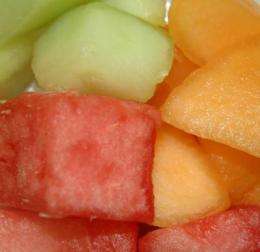
Colored melon flesh are full of nutrients. Plant breeders may develop even better varieties now that melon genome with hundreds of DNA markers has been mapped. Credit: Texas AgriLife Photo by Kathleen Phillips

People smell them, thump them and eyeball their shape. But ultimately, it's sweetness and a sense of healthy eating that lands a melon in a shopper's cart.

Plant breeders now have a better chance to pinpoint such traits for new varieties, because the melon genome with hundreds of has been mapped by scientists with Texas AgriLife Research. That means tastier and healthier melons are likely for future summer picnics.

"This will help us anchor down some of the desirable genes to develop better melon varieties," said Dr. Kevin Crosby, who completed the study with Drs. Soon O. Park and Hye Hwang. "We can identify specific for higher sugar content, disease resistance and even drought tolerance."

The results are reported in the Journal of the American Society of Horticultural Sciences.

Melons are fleshy, edible cucurbits grown worldwide in a multitude of varieties. Not only are they economically important, the scientists noted, but they are a favorite among consumers internationally.
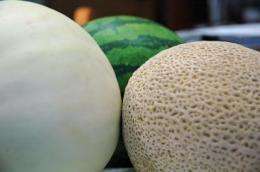
Melons -- they come in all sizes, shapes and colors. People around the world love them. Researchers at Texas AgriLife Research have mapped the melon genome with hundreds of DNA markers. Credit: Texas AgriLife Photo by Kathleen Phillips

The average person in the U.S. eats about 25 pounds of melon every year, according to the Agricultural Marketing Resource Center at Iowa State University.

Scientists from France and Spain already had completed partial maps of segments of the melon DNA sequence. The Texas researchers connected those segments with new findings in their study to complete the entire melon genome map.

For the study, the Deltex ananas melon was crossed with a wild melon called TGR 1551. More than 100 of the offspring from that cross were grown in the AgriLife Research greenhouses at Weslaco, Crosby noted.

DNA was extracted from leaf tissue collected 21 days after planting. Results from these tests were integrated into partial maps created by other researchers.

Previous knowledge of melon DNA was like two sets of directions - one from Miami to Houston and the other from El Paso to Los Angeles. That would make one wonder how to get from Houston to El Paso. The study by Crosby's group, in essence, devised the path from Miami to LA and all points between.

In addition to the complete map, the researchers located genetic markers linked to fruit sugars, ascorbic acid (vitamin C) and male sterility, which is useful for developing hybrid varieties.

The trio said the genetic map will be helpful for future studies in identifying fruit sweetness, quality, size, shape and resistance to disease.

Source: Texas A&M AgriLife Communications

Explore further: New formula invented for microscope viewing, substitutes for federally controlled drug

add to favorites email to friend print save as pdf

Related Stories

Cantaloupe recall continues to expand

Mar 31, 2008

The recall of Honduran-grown cantaloupes now includes the Dole Food Co., Bounty Fresh LLC, Spokane Produce Inc., and Chiquita Brands International Inc.

Building disease-beating wheat

Dec 12, 2007

Pioneered by CSIRO researchers, in collaboration with the International Maize and Wheat Improvement Center (CIMMYT) and Sydney University, the research illustrates the major genetic improvements possible without ...

Recommended for you

Turning up the heat on biofuels

May 16, 2013

(Phys.org) —The production of biofuels from lignocellulosic biomass would benefit on several levels if carried out at temperatures between 65 and 70 degrees Celsius. Researchers with the Energy Biosciences ...

Getting to the root of better crops

May 16, 2013

(Phys.org) —The more crop scientists know about how plant roots take up water and nutrients, the better able they will be to develop crop plants with roots that can cope with challenging soil and environmental ...

User comments : 0

More news stories

Front-row seats to climate change

By day, insects provide the white noise of the South, but the night belongs to the amphibians. In a typical year, the Southern air hangs heavy from the humidity and the sounds of wildlife.

Morocco to harness the wind in energy hunt

Morocco is ploughing ahead with a programme to boost wind energy production, particularly in the southern Tarfaya region, where Africa's largest wind farm is set to open in 2014.

US psychiatry gets makeover in new manual

The latest makeover to a massive psychiatric tome honored by some, reviled by others and even called the "Bible" of mental disorders is being released Saturday with a host of new changes.

New case of SARS-like virus in Saudi: ministry

A new case of the deadly coronavirus has been detected in Saudi Arabia where 15 people have already died after contracting it, the health ministry announced on Saturday on its Internet website.