Clones of 9/11 hero dog unveiled in Los Angeles
Jun 18, 2009
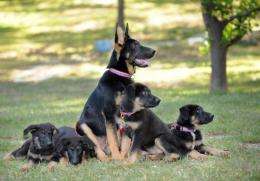
Clone puppies Trust, Solace, Prodigy, Valor and Dejavu
Trust, Solace, Prodigy, Valor and Dejavu in Los Angeles, California to present the cloned puppies of Trakr, a German shepherd, who sniffed out survivors from under the rubble of New York's World Trade Center after the 2001 terror strikes. Trakr was cloned in South Korea under the direction of Doctor Hwang Woo-Suk. AFP PHOTO / GABRIEL BOUYS

Five clones of a search and rescue dog which helped locate people trapped in the rubble of the 9/11 attacks were formally presented to their ancestor's former handler.

James Symington, a former Canadian police officer, choked back tears as he formally took possession of the five descendants of his beloved German shepherd named Trakr, who died in April.

Symington was presented with Trakr's offspring after winning a competition organized by California firm BioArts International -- the "Golden Clone Giveaway" -- to find the world's most "cloneworthy" dog.

Symington said he hopes the puppies -- Trustt, Valor, Prodigy, Solace and Deja Vu -- will go on to follow in Trakr's footsteps.

"We're here to celebrate that Trakr's legacy lives on in these five beautiful puppies," he told reporters. "If they have the same attributes Trakr did, then hopefully they'll develop into world class search and rescue dogs."

Symington and Trakr arrived at the site of the World Trade Center collapse, commonly referred to as Ground Zero, on September 12, 2001 and were one of the first K9 search and rescue teams on the scene.

After working nearly non-stop for 48 hours, Trakr located the last human survivor found in the rubble of the twin towers.

"Trakr was an extraordinary search and rescue dog. His work at Ground Zero was the culmination of his career," Symington said.

BioArts International, which says it offers the world's first commercial dog service, partnered with South Korea's SooAm Biotech Research Foundation to clone Trakr under the direction of scientist Hwang Woo-Suk.

BioArts International chief executive Lou Hawthorne said canine cloning would remain beyond the reach of ordinary pet lovers, with cloned dogs costing an average 144,000 dollars each.

Hawthorne defended the right of people to clone their dogs instead of obtaining new pets from rescue shelters.

"I think 99 percent of the time people should get their pets from shelters," he told AFP.

"But can we agree though that one percent of the time if you have a one in a million dog and you have the money to pay for it, you should be able to go to either a breeder or a cloner?"

Hawthorne said Trakr had been chosen for cloning because of his heroics on 9/11. "We received many very touching submissions to our contest, describing some truly amazing dogs," he said. "But Trakr's story blew us away."

Symington meanwhile said that one member of his new litter -- Trustt -- was an exact replica of Trakr.

"The physical similarities are uncanny," he told AFP. "He's the spitting image of the Trakr that I first met in 1995. He has exactly the same markings, the way he moves, everything. Very alert, very intelligent and intuitive.

"I respect that cloning's not for everyone. But there are few dogs that are born with extraordinary abilities and Trakr was one of those dogs," he said.

"I look forward to the day that these puppies can follow in Trakr's footsteps and play an important role in other rescues, like Trakr did."

(c) 2009 AFP

Explore further: Rice blast research reveals details on how a fungus invades plants

add to favorites email to friend print save as pdf

Related Stories

Couple welcomes home cloned dog

Jan 28, 2009

Sir Lancelot Encore spent his first Florida night in the master bedroom - along with nine other dogs, various cats and two humans - oblivious to the sensation he had caused earlier Monday.

SKorean experts claim to have cloned glowing dogs

Apr 28, 2009

(AP) -- South Korean scientists say they have engineered four beagles that glow red using cloning techniques that could help develop cures for human diseases. The four dogs, all named "Ruppy" - a combination ...

Dog 'laugh' silences other dogs

Dec 05, 2005

Washington state researchers report discovering what might be the sound of dog laughter. The scientists say the long, loud pant they recorded has a calming or soothing effect on the behavior of other dogs, ABC News reported.

Computer savvy canines

Nov 28, 2007

Like us, our canine friends are able to form abstract concepts. Friederike Range and colleagues from the University of Vienna in Austria have shown for the first time that dogs can classify complex color photographs and ...

Recommended for you

Gene discovery leads to new OPP test

10 hours ago

The discovery of a gene associated with a persistent viral infection that causes an incurable disease—ovine progressive pneumonia (OPP)—in sheep has led to the development of a genetic test that can be ...

Genome sequence for mother of ash dieback survival

Jun 17, 2013

The first sequence data for a survivor of the ash dieback epidemic has been made available by scientists from The Genome Analysis Centre (TGAC) as part of a research collaboration led by the John Innes Centre and The Sainsbur ...

User comments : 2

Adjust slider to filter visible comments by rank

Display comments: newest first

Bob_Kob
5 / 5 (3) Jun 18, 2009
Now we have 5x the dogs to help people in the next 9/11!
Egnite
not rated yet Jun 19, 2009
Hope they aren't all diseased with respiratory problems like all the other 911 rescuers ^^

More news stories

Lonely bees make better guests

Solitary bees are twice as likely to pollinate the flowers they visit as their more sociable counterparts, according to a new study.

Study reveals strategy behind spiders' web etiquette

(Phys.org) —A species of spider that, unusually, lives in a colony but hunts alone at night is the subject of a new study by an international team of scientists including University of Sussex biologists.

Study suggests new approach to fight lung cancer

Recent research has shown that cancer cells have a much different – and more complex – metabolism than normal cells. Now, scientists at The University of Texas at Dallas have found that exploiting these differences might ...