Italy recalls 'radioactive' wood pellets: report
Jun 14, 2009
The wood pellets contained caesium 137
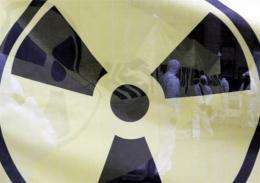
A 'radioactive' sign is seen during a protest in Moscow. An Italian court has ordered the recall of 10,000 tonnes of wood fuel pellets imported from Lithuania over fears that they could have dangerous levels of radioactivity.

An Italian court has ordered the recall of 10,000 tonnes of wood fuel pellets imported from Lithuania over fears that they could have dangerous levels of radioactivity, newspapers reported on Sunday.

The alarm was raised after someone in the northern Aosta Valley region, who had bought the pellets, sent them for analysis because they did not burn well.

The results showed that they contained caesium 137, a highly toxic radioactive substance normally produced by a nuclear explosion or from the combustion of a nuclear reactor.

The contaminated pellets themselves are not dangerous to humans, said Salvatore Aprile of the Aosta Valley court: the dangers comes from the ashes and the smoke produced when they are burned. The court ordered their recall on Saturday.

The at the centre of the alert were imported from Lithuania last autumn and were sold in 11 regions in the north and south of Italy.

(c) 2009 AFP

Explore further: Strong resistance to making people think green

add to favorites email to friend print save as pdf

Related Stories

Recommended for you

Chinese, Indian airlines face EU pollution fines

3 hours ago

Eight Chinese and two Indian airlines face fines of up to several million euros for not paying for their greenhouse gas emissions during flights within the bloc, the European Commission said on Friday.

Fracking risks to ground water assessed

May 17, 2013

(Phys.org) —Extraction of "unconventional" gas from sedimentary rocks such as shale could provide a clean energy source and help some regions to become energy independent, but concerns have been raised ...

Caribbean talks conservation on Branson's island

May 17, 2013

(AP)—Surrounded by a turquoise sea and a menagerie of exotic animals on a billionaire's private island, political and business leaders gathered Friday to back an initiative aimed at expanding protection ...

User comments : 4

Adjust slider to filter visible comments by rank

Display comments: newest first

Nik_2213
1 / 5 (1) Jun 14, 2009
Go for the glow !!
Ronan
3.7 / 5 (3) Jun 14, 2009
...That's an odd element for them to be contaminated with, though. Where did this wood come from, anyway? Has someone been sneaking into the forest around Chernobyl and cutting down radioactive trees?
Soylent
1.8 / 5 (4) Jun 14, 2009
Everything is radioactive and radioactivity is one of the easiest things to measure. You can even measure barium-133 in childrens teeth from atmospheric nuclear testing done 30 years ago(it's much less than background radiation from carbon-14, potassium-40, radon etc. but it's still rather trivial to take an x-ray spectrum and identify the Ba-133).

The only possible reason for not giving the number of becquerels/kg of Cs-137 found in the wood is that this has nothing to do with radiation and everything to do with protectionism.
omatumr
3.5 / 5 (2) Jun 14, 2009
CAESIUM-137, A LONG LIVED FISSION PRODUCT

This long-lived fission product (half-live = 30 years) is likely from the accidental release of radioactivity at Chernobyl.

In the environment Caesium (Cs) follows the chemistry of two elements that are abundant in living creatures, Sodium (Na) and Potassium (K).

With kind regards,
Oliver K. Manuel
http://www.omatumr.com/


More news stories

Chinese, Indian airlines face EU pollution fines

Eight Chinese and two Indian airlines face fines of up to several million euros for not paying for their greenhouse gas emissions during flights within the bloc, the European Commission said on Friday.

Alaska volcano shoots ash 15,000 feet into the air

(AP)—One of Alaska's most restless volcanoes has shot an ash cloud 15,000 feet into the air in an ongoing eruption that has drawn attention from a nearby community but isn't expected to threaten air traffic.

Fracking risks to ground water assessed

(Phys.org) —Extraction of "unconventional" gas from sedimentary rocks such as shale could provide a clean energy source and help some regions to become energy independent, but concerns have been raised ...

Bright explosion on the Moon

For the past 8 years, NASA astronomers have been monitoring the Moon for signs of explosions caused by meteoroids hitting the lunar surface. "Lunar meteor showers" have turned out to be more common than anyone ...

US seizes Bitcoin operator accounts

US authorities seized the accounts of a Bitcoin digital currency exchange operator, claiming it was functioning as an "unlicensed money service business," court documents showed Friday.

Temporal processing in the olfactory system

The neural machinery underlying our olfactory sense continues to be an enigma for neuroscience. A recent review in Neuron seeks to expand traditional ideas about how neurons in the olfactory bulb might encode information about ...