Thinnest superconducting metal created
Jun 08, 2009
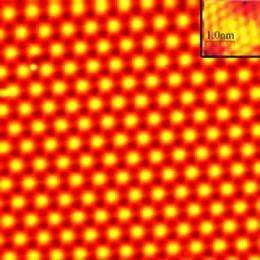
This is a scanning tunneling microscope image of the 2-atom thick lead film. The inset is a zoomed view showing the atomic structure. Credit: Dr. Ken Shih, The University of Texas at Austin

A superconducting sheet of lead only two atoms thick, the thinnest superconducting metal layer ever created, has been developed by physicists at The University of Texas at Austin.

Dr. Ken Shih and colleagues report the properties of their superconducting film in the June 5 issue of Science.

Superconductors are unique because they can maintain an electrical current indefinitely with no power source. They are used in MRI machines, particle accelerators, quantum interference devices and other applications.

The development of the thin superconducting sheets of lead lays the groundwork for future advancements in superconductor technologies.

"To be able to control this material—to shape it into new geometries—and explore what happens is very exciting," says Shih, the Jane and Roland Blumberg Professor in Physics. "My hope is that this superconductive surface will enable one to build devices and study new properties of superconductivity."

In , electrons move through the material together in pairs, called Cooper pairs.

One of the innovative properties of Shih's ultra-thin lead is that it confines the electrons to move in two dimensions, or one "quantum channel," like ballroom dancers gliding across the floor. Uniquely, the lead remains a good superconductor despite the constrained movement of the electrons through the metal.

Shih and his colleagues used advanced materials synthesis techniques to lay the two-atom thick sheet of lead atop a thin silicon surface. The lead sheets are highly uniform with no impurities.

"We can make this film, and it has perfect crystalline structure—more perfect than most made of other materials," Shih says.

Source: University of Texas at Austin (news : web)

Explore further: Breakthrough calls time on bootleg booze

add to favorites email to friend print save as pdf

Related Stories

Tiny superconductors withstand stronger magnetic fields

Feb 04, 2005

Ultrathin superconducting wires can withstand stronger magnetic fields than larger wires made from the same material, researchers now report. This finding may be useful for technologies that employ superconducting ...

Scientists create superconducting thin films

Oct 08, 2008

(PhysOrg.com) -- One major goal on the path toward making useful superconducting devices has been engineering materials that act as superconductors at the nanoscale -- the realm of billionths of a meter. Such ...

Secrets behind high temperature superconductors revealed

Feb 22, 2009

(PhysOrg.com) -- Scientists from Queen Mary, University of London and the University of Fribourg (Switzerland) have found evidence that magnetism is involved in the mechanism behind high temperature superconductivity.

One Mystery of High-Tc Superconductivity Resolved

Nov 16, 2006

Research published online in the journal Science this week by Tonica Valla, a physicist at the U.S. Department of Energy’s Brookhaven National Laboratory, appears to resolve one mystery in the 20-year study ...

Recommended for you

Breakthrough calls time on bootleg booze

1 hour ago

(Phys.org) —Using a laser, the St Andrews scientists can now carry out detailed analysis of a spirit sample no bigger than a teardrop and can even confirm whether it is toxic or not. It's hoped the testing ...

Competition in the quantum world

4 hours ago

Innsbruck physicists led by Rainer Blatt and Peter Zoller experimentally gained a deep insight into the nature of quantum mechanical phase transitions. They are the first scientists that simulated the competition ...

Promising doped zirconia

May 17, 2013

Materials belonging to the family of dilute magnetic oxides (DMOs)—an oxide-based variant of the dilute magnetic semiconductors—are good candidates for spintronics applications. This is the object of ...

Bringing life into focus

May 17, 2013

Spinning-disk confocal microscopy is an optical imaging technique that can be used to generate detailed three-dimensional fluorescence images of living cells and their contents. Although a powerful tool for ...

User comments : 2

Adjust slider to filter visible comments by rank

Display comments: newest first

jselin
5 / 5 (2) Jun 08, 2009
So what is the critical superconducting temperature? Bulk lead is superconducting below ~7K.
KBK
not rated yet Jun 09, 2009
I would ~VERY~ much appreciate if someone could direct me to a list of the known superconducting temperatures of the table of elements. Of course, only those that have been tested for that capacity.

OK. found some stuff on it. Nevermind....

More news stories

Breakthrough calls time on bootleg booze

(Phys.org) —Using a laser, the St Andrews scientists can now carry out detailed analysis of a spirit sample no bigger than a teardrop and can even confirm whether it is toxic or not. It's hoped the testing ...

Competition in the quantum world

Innsbruck physicists led by Rainer Blatt and Peter Zoller experimentally gained a deep insight into the nature of quantum mechanical phase transitions. They are the first scientists that simulated the competition ...

New principle may help explain why nature is quantum

Like small children, scientists are always asking the question 'why?'. One question they've yet to answer is why nature picked quantum physics, in all its weird glory, as a sensible way to behave. Researchers ...

Computer model predicts when viruses become infectious

A new computer model could help scientists predict when a particular strain of avian influenza might become infectious from bird to human, according to a report to be published in the International Journal Data Mining an ...