Japan explores using cell phones to stop pandemics
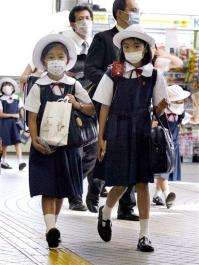
(AP) -- A few months from now, a highly contagious disease will spread through a Japanese elementary school. The epidemic will start with several unwitting children, who will infect others as they attend classes and wander the halls.
If nothing is done, it will quickly gain momentum and rip through the student body, then jump to parents and others in the community. But officials will attempt to stymie the disease and save the school - using mobile phones.
The sickness will be a virtual one, in an experiment funded by the Japanese government. A subsidiary of Softbank Corp., a major Japanese Internet and cellular provider, has proposed a system that uses phones to limit pandemics.
The exact details have yet to be fixed, but Softbank hopes to pick an elementary school with about 1,000 students and give them phones equipped with GPS. The locations of the children will be recorded every minute of the day and stored on a central server.
A few students will be chosen to be considered "infected," and their movements over the previous few days will be compared with those of everyone else. The stored GPS data can then be used to determine which children have crossed paths with the infected students and are at risk of having contracted the disease.
The families of exposed students will be notified by messages to their mobile phones, instructing them to get checked out by doctors. In a real outbreak, that could limit the rate of new infections.
"The number of people infected by such a disease quickly doubles, triples and quadruples as it spreads. If this rate is decreased by even a small amount, it has a big effect in keeping the overall outbreak in check," said Masato Takahashi, who works on infrastructure strategy at Softbank.
He demonstrates with a calculation: If an infected person makes about three more people sick per day, and each newly infected person then makes another three people sick, on the 10th day about 60,000 people would catch the disease. If each sick person instead infected two people a day, on the 10th day about 1,500 people would get sick.
The experiment was conceived before the current outbreak of swine flu, but has drawn fresh attention now that Japan has the highest number of confirmed cases outside of North America.
It is one of 24 trials the government recently approved as part of a program to promote new uses for Japan's Internet and cellular infrastructure. The country boasts some of the most advanced mobile phone technology in the world. It is blanketed in high-speed cellular networks, and phones come standard with features like GPS, TV and touchless train passes.
The mobile phone market is largely saturated, however, and fees are being driven down by an ongoing price war. For Softbank, a government-backed health-monitoring service could be boon to business.
GPS has its shortcomings, including hazy readings indoors. But Softbank believes it could keep readings accurate to several yards, at least for an experiment in a limited area.
Until now, technologies like GPS have mainly been used to help people figure out where they are and what is nearby. As networked devices like the iPhone become more popular, new applications let people track their children or friends, and could give companies and governments access to their location.
Aoyama Gakuin University, a prestigious school in Tokyo, is giving Apple Inc.'s iPhone 3G to students, partially as a way to check attendance via GPS readings from an application running on the phone.
That kind of project raises privacy concerns, and one of the goals of the Japanese experiment is to judge how participants feel about having their location constantly recorded.
If a disease-tracking system were launched for real, no one would be required to sign up, said Takuo Imagawa, an official at the Ministry of Internal Affairs and Communications.
Another concern for the experiment is how to inform people that they may be infected, even if it's just a virtual disease.
"If we don't think carefully about the nature of the warning, people that get such a message could panic," said Katsuya Uchida, a professor at the Institute of Information Security in Yokohama. Uchida serves on a board that evaluates such proposals for the government.
Softbank Telecom, the subsidiary that made the original proposal, might not be chosen by the ministry to run the experiment in the fall. But Takahashi says that whichever company is chosen, he hopes the potential benefits of a monitoring system are enough to persuade people to sign up and reveal their whereabouts.
"I think it would have a bigger impact than Tamiflu," he said.
©2009 The Associated Press. All rights reserved. This material may not be published, broadcast, rewritten or redistributed.


