New 'microcapsules' put more medication into the bloodstream to treat disease
May 27, 2009
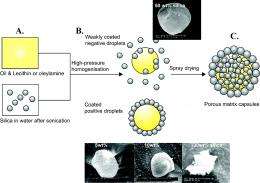
Scientists report that new "microcapsules" could help the stomach absorb certain medicines. Credit: The American Chemical Society

Scientists are reporting a potential solution to a problem that limits the human body’s ability to absorb and use medications for heart disease, Type-2 diabetes, cancer and other conditions. It is a “nano-hybrid microcapsule” that enables the stomach to absorb more of these so-called “poorly-soluble” medicines. Their study is scheduled for the June 1 issue of ACS’ Molecular Pharmaceutics.

Finding ways to improve the stomach’s uptake of poorly soluble medicines has been one of the major challenges facing pharmaceutical companies. Estimates suggest, for instance, that 40 percent of potential new drugs fall into this category. In the new study, Clive Prestidge and colleagues note that one solution has been to include detergent-like substances in pills and capsules. However, that approach involves safety concerns, since the detergent can irritate the stomach lining, making it unsuitable for drugs that must be taken month after month.

The scientists describe development of a first-of-its-kind microcapsule made from lipid oils and nanoparticles 1/50,000th the width of a human hair. Although acting like conventional detergents, they seem unlikely to irritate the stomach. In test tube experiments, microcapsule versions of the arthritis drug, indomethacin, dissolved up to five times faster than a regular version of the drug. Lab rats given the new microcapsule version absorbed almost twice as much of the drug.

More information: Molecular Pharmaceutics, “Dry Hybrid Lipid-Silica Microcapsules Engineered from Submicron Lipid Droplets and Nanoparticles as a Novel Delivery System for Poorly Soluble Drugs”


Provided by American Chemical Society (news : web)

Explore further: Attacking MRSA with metals from antibacterial clays

add to favorites email to friend print save as pdf

Related Stories

Tiny delivery system with a big impact on cancer cells

Dec 15, 2008

Researchers in Pennsylvania are reporting for the first time that nanoparticles 1/5,000 the diameter of a human hair encapsulating an experimental anticancer agent, kill human melanoma and drug-resistant breast ...

Chemical signaling may power nanomachines

Mar 31, 2008

In a finding that could provide controlled motion in futuristic nanomachines used for drug delivery, fuel cells, and other applications, researchers in Pennsylvania report that chemical signaling between synthetic ...

Recommended for you

Attacking MRSA with metals from antibacterial clays

May 17, 2013

In the race to protect society from infectious microbes, the bugs are outrunning us. The need for new therapeutic agents is acute, given the emergence of novel pathogens as well as old foes bearing heightened antibiotic resistance.

Keeping fruit, vegetables and cut flowers fresh longer

May 15, 2013

New technology offers the promise of reducing billions of dollars of losses that occur each year from the silent, invisible killer of fruits, vegetables and cut flowers—a gas whose effects are familiar to everyone who has ...

Why don't beetles freeze in the winter?

May 14, 2013

For 37 years, Queen's University Biochemistry professor Peter Davies has been unraveling the mystery of why some organisms including insects and fish don't freeze in the winter. His research into insect antifreeze protein ...

The molecular basis of strawberry aroma

May 13, 2013

You know that summer is here when juicy red strawberries start to appear on the shelves. In Germany, this seasonal fruit has never been more popular: on average 3.5 kilos per head were consumed in 2012—a ...

A new dimension for 3-D protein structures

May 13, 2013

(Phys.org) —3D structures of biological molecules like proteins directly affect the way they behave in our bodies. EPFL scientists have developed a new infrared-UV laser method to more accurately determine ...

User comments : 0

More news stories

Attacking MRSA with metals from antibacterial clays

In the race to protect society from infectious microbes, the bugs are outrunning us. The need for new therapeutic agents is acute, given the emergence of novel pathogens as well as old foes bearing heightened antibiotic resistance.

Beautiful 'flowers' self-assemble in a beaker

By simply manipulating chemical gradients in a beaker of fluid, materials scientists at Harvard have found that they can control the growth behavior of crystals to create precisely tailored structures—such ...

Making gold green: New non-toxic method for mining gold

Northwestern University scientists have struck gold in the laboratory. They have discovered an inexpensive and environmentally benign method that uses simple cornstarch—instead of cyanide—to isolate gold from raw materials ...