Heart saves muscle

May 25, 2009
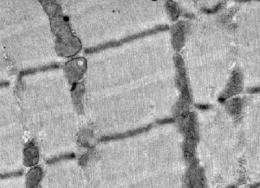
Muscle cell architecture looks normal in transgenic mice that lack ACTA1 but express human ACTC. Credit: Nowak, K.J., et al. 2009. J. Cell Biol. doi:10.1083/jcb.200812132

A heart muscle protein can replace its missing skeletal muscle counterpart to give mice with myopathy a long and active life, show Nowak et al. The findings will be published online on Monday, May 25, 2009 and will appear in the June 1, 2009 print issue of the Journal of Cell Biology.

The contraction machinery protein, actin, exists in different forms in the adult and skeletal muscles. The heart form, ACTC, is also the dominant form in skeletal muscle of the . But during development, the skeletal form, ACTA1, increases in production and by birth has taken over. It is not clear why the switch occurs, or why it doesn't occur in the heart, but it happens in every higher vertebrate and, for that reason, has been considered vitally important.

to the ACTA1 gene cause a rare but serious myopathy. Most patients die within the first year of life and some are born almost completely paralyzed. Mice lacking ACTA1 die nine days after birth. Nowak et al. wondered if ACTC could compensate for a lack of ACTA1. The two proteins differ only slightly but, like the developmental switch in production, this difference is conserved across species. Many researchers therefore assumed such compensation would never work.

But it did. Nowak and colleagues crossed Acta1 mutant mice with that express human ACTC at high levels in cells. The resulting mice didn't die at nine days. In fact, almost all of them (93.5%) survived more than three months, and some more than two years. The mice's locomotor performance was comparable with wild-type, as was their overall muscle strength (though individual muscle fibers were slightly weaker), and their endurance was actually higher—they ran faster and for longer.

This begs the question, Why do we even have ACTA1? Besides pondering that, Nowak and colleagues are also working out how to boost endogenous ACTC as a possible therapy for ACTA1-lacking patients.

More information: Nowak, K.J., et al. 2009. J. Cell Biol. doi:10.1083/jcb.200812132, www.jcb.org

Source: Rockefeller University (news : web)

Explore further: X-ray tomography on a living frog embryo

add to favorites email to friend print save as pdf

Related Stories

Key finding in rare muscle disease

Jan 17, 2007

The finding is in the current issue of Annals of Neurology, a leading international neurology journal, in work led by Professor Nigel Laing and Dr Kristen Nowak of the Laboratory for Molecular Genetics at the Western Austra ...

FHL1 helps build muscle mass

Dec 15, 2008

Cowling et al. report how to build muscle mass with FHL1. The protein partners with and activates the transcription factor, NFATc1. Encouraging this partnership might provide a possible treatment for muscle ...

Researchers develop mouse model for muscle disease

Sep 05, 2006

Researchers from the University of Minnesota have identified the importance of a gene critical to normal muscle function, resulting in a new mouse model for a poorly understood muscle disease in humans.

Lamin A/C deficiency is 'unnerving'

Jan 05, 2009

Mutations in the nuclear intermediate filament lamin A/C (LMNA) gene are associated with Emery-Dreifuss muscular dystrophy, but cause the disease by unknown mechanisms. Méjat et al. show that one mechanism ...

Recommended for you

X-ray tomography on a living frog embryo

May 16, 2013

Classical X-ray radiographs provide information about internal, absorptive structures of organisms such as bones. Alternatively, X-rays can also image soft tissues throughout early embryonic development of ...

Novel probe for live human iPS cell imaging

May 16, 2013

Researchers from the National Institute of Advanced Industrial Science and Technology (AIST) have developed a highly sensitive lectin probe, rBC2LCN, for human induced pluripotent stem cells (iPS cells). ...

User comments : 0

More news stories

Honeybees trained in Croatia to find land mines

(AP)—Mirjana Filipovic is still haunted by the land mine blast that killed her boyfriend and blew off her left leg while on a fishing trip nearly a decade ago. It happened in a field that was supposedly ...

Heat-related deaths in Manhattan projected to rise

Residents of Manhattan will not just sweat harder from rising temperatures in the future, says a new study; many may die. Researchers say deaths linked to warming climate may rise some 20 percent by the 2020s, ...

Mice, gerbils perish in Russia space flight

A number of mice and eight gerbils sent into space in a Russian capsule destined to find out how well organisms can withstand extended flights perished during their journey, scientists said Sunday as the ...