May 4, 2009 feature
Stretchable Nanotube Films May Advance Medical Electronics (Update)
(PhysOrg.com) -- One of the issues hindering the development of medical electronic devices capable of being implanted in the human body is the lack of suitable materials. Most semiconducting materials are stiff and brittle, while human tissue is soft and pliable. Scientists at the University of California, Los Angeles (UCLA), appear to have taken a key step forward in implantable electronics research.
The group studied a very thin nanotube-based material and measured how it responds electrically and optically to extreme strains. As described in the April 22, 2009, online edition of Applied Physics Letters, they found that the material continues to conduct electricity when subjected to strains of more than 700 percent - that is, stretched to seven times its starting dimensions - ceasing to perform only when cracks developed.
Implantable medical electronic devices can monitor a variety of bodily functions, including blood pressure, temperature, fluid flow; they can also sense chemical, electrical, and even magnetic properties within the body. But certain devices would require significant flexibility without compromising performance. Currently, the best materials for electronic medical devices develop cracks under less than 10 or 20 percent strain.
“Using nanotubes is an obvious solution to the problems that have faced the development of these materials because they have high length-to-width ratios, which means they can bridge the cracked regions to maintain conductivity,” said co-author Qibing Pei, a UCLA materials science professor, to PhysOrg.com.
Thin films of randomly distributed carbon nanotubes have been widely studied for a variety of electronics applications. They have displayed a variety of interesting and useful properties, such as very high flexibility, which is key for implantable medical electronics. There have been conflicting studies regarding the toxicity of carbon nanotubes, although recent studies concluded that they are not toxic to mice.
The UCLA team first deposited the nanotubes onto a highly elastic substrate so that the films could be properly stretched. They performed the stretching slowly, straining the material both uniformly - with equal strain applied to each end of the film - and non-uniformly. They applied a voltage across the film as it was stretched, measuring the changing electrical response.
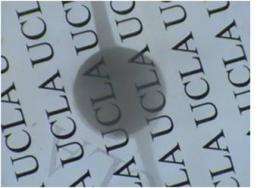
The group also studied the optical properties of the films, which are transparent before stretching but are rather dark. Prior to stretching, they placed the films over printed letters, observing that the letters appear crisp. As strain is increased the letters became “fuzzy”; simultaneously, the films lightened in color.
Using a scanning electron microscope, the group investigated the structural changes that occur during stretching and how they affect the films' electrical and optical properties. When the nanotubes are spray-deposited, they appear to be uniformly distributed but actually form clusters. As strain is applied the clusters begin to break up, but because the nanotubes are long and thin they form connections between the clusters, which do not disappear but rather become less dense. Thus, the conduction pathways remain intact.
The fuzziness that appears in the films is due to the spreading out of the nanotubes, which absorb and scatter light. The color change is due to the thinning of the films, which allows more light to pass through.
The researchers say that the films could be made to conduct under even greater strains, with the development of ways to more uniformly deposit the nanotubes onto the substrate or applying a top coat to the films to fill in cracks.
More information: Applied Physics Letters 94, 161108 (2009), link.aip.org/link/?APPLAB/94/161108/1
Copyright 2009 PhysOrg.com.
All rights reserved. This material may not be published, broadcast, rewritten or redistributed in whole or part without the express written permission of PhysOrg.com.


