Magnesium detected in MESSENGER flyby of Mercury (w/Video)
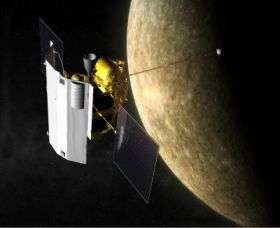
NASA's MESSENGER spacecraft served up another curveball to a University of Colorado at Boulder team after a second flyby of the hot inner planet Oct. 6 detected magnesium -- an element created inside exploding stars and which is found in many medicine cabinets on Earth -- clumped in the tenuous atmosphere of the planet.
Scientists had suspected magnesium would be present, but were surprised at its distribution and abundance, said Senior Research Associate William McClintock of CU-Boulder's Laboratory for Atmospheric and Space Physics. The discovery in the planet's wispy atmosphere, known as its exosphere, is one more clue to the mystery of the creation of the rocky, bizarre planet that resides closest to the sun.
"Detecting magnesium was not too surprising, but seeing it in the amounts and distribution we recorded was unexpected," said McClintock, a MESSENGER co- investigator who led the development of CU-Boulder's Mercury Atmospheric and Surface Composition Spectrometer, or MASCS. "This is an example of the kind of individual discoveries that the MESSENGER team will piece together to give us a new picture of how the planet formed and evolved."
A paper on the subject by McClintock is being published in the May 1 issue of Science. Co-authors on the paper are Ronald Vervack and Noam Izenberg of Johns Hopkins University, E. Todd Bradley of the University of Central Florida, Rosemary Killen, Nelly Mouand and Mathew Burger of the University of Maryland, Ann Sprague of the University of Arizona and Sean Solomon of the Carnegie Institution of Washington, D.C. Solomon is the MESSENGER principal investigator.
The CU-Boulder instrument also measured other elements in the exosphere during the Oct. 6 flyby, including calcium and sodium. "Since calcium and magnesium are chemically similar, we might expect them to have a similar distribution in Mercury's exosphere," McClintock said. "But they don't, and we don't yet understand why."
McClintock said materials escaping from Mercury's surface are accelerated by solar radiation pressure to form a gigantic tail of atoms flowing away from the sun. Their abundances change, however, depending on the season as well as changes in magnetic field orientation and solar wind intensity.
The LASP team suspects that other metallic elements from the surface -- including aluminum, iron and silicon -- also are present in the exosphere. The metals permeated the solar nebula when it was coalescing some 4.5 billion years ago, shaping the planets, said McClintock.
Traveling at 4.2 miles per second, the spacecraft dipped within 124 miles of Mercury Oct. 6 and imaged about 30 percent of the surface never before seen by spacecraft. Launched in August 2004, MESSENGER will make the last of three Mercury passes in September 2009 before finally settling into orbit in 2011. The circuitous, 4.9 billion-mile-journey to Mercury requires more than six years and 15 loops around the sun to guide it closer to Mercury's orbit.
The desk-sized MESSENGER spacecraft is carrying seven instruments -- a camera, a magnetometer, an altimeter and four spectrometers. McClintock led the development of MASCS, which was miniaturized to weigh less than seven pounds for the arduous journey. Data from MASCS obtained during the first flyby in January 2008 provided LASP researchers with evidence that about 10 percent of the sodium atoms ejected from Mercury's hot surface during the daytime were accelerated into a 25,000-mile-long sodium tail trailing the planet, according to McClintock.
MESSENGER took data and images from Mercury for about 90 minutes on Oct. 6, when LASP turned on a detector in MASCS for its first look at Mercury's surface in the far ultraviolet portion of the light spectrum, said McClintock.
LASP Director Daniel Baker, also a co-investigator on the MESSENGER mission, is using data from the mission to study Mercury's magnetic field and its interaction with the solar wind. Mark Lankton is the LASP program manager for the MASCS instrument. Dozens of undergraduates and graduate students will be involved in analyzing data over the next several years as information and images pour back to Earth from MESSENGER.
Source: University of Colorado at Boulder (news : web)


