Michigan Astronomer to Search in Space for Precursors of Life
Apr 30, 2009
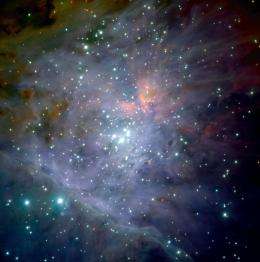
The Orion Nebula is one of the places where astronomer Ted Bergin will search for organic molecules using the Herschel Space Observatory.

Many of the organic molecules that make up life on Earth have also been found in space. A University of Michigan astronomer will use the Herschel Space Observatory to study these chemical compounds in new detail in the warm clouds of gas and dust around young stars.

They hope to gain insights into how organic molecules form in space, and possibly, how life formed on Earth.

"The chemistry of space makes molecules that are the precursors of life. It's possible that the Earth didn't have to make these things on its own, but that they were provided from space," said Ted Bergin, an associate professor in the Department of Astronomy.

Bergin is a co-investigator on the Heterodyne Instrument for the Infrared aboard Herschel and a principal investigator on one of its key observing programs. Herschel, a mission with NASA participation, is scheduled to launch May 6. An orbiting telescope that will unlock new wavelengths on the , it will allow astronomers to observe at the far-infrared wavelengths where organic molecules and water emit their chemical signatures.

"We'll be studying the full extent of chemistry in space and we hope to learn what types of organics are out there as a function of their distance from a star," Bergin said. "And we want to understand the chemical machinery that led to the formation of these organics."

Meteorites flecked with amino acids, which make proteins, have fallen to Earth from space. In faraway galaxies and stellar nurseries, astronomers have detected complex organic sugar and hydrocarbon molecules that are key components in chlorophyll in plants and RNA. Bergin expects to detect tens if not hundreds of these kinds of compounds---some of which have never been found before outside the Earth.

He is also involved in a Herschel project to look for water molecules in space. Traces of water in warm clouds of gas and dust around young stars could hold clues to how water forms and behaves in space, and how this elixir of life came to be so abundant on Earth. Scientists believe water got to Earth in a similar way as .

"Most of the water in the solar system is not where we are, but further out in the solar system," Bergin said. "Most theories suggest that the Earth formed dry and impacts from asteroids or other objects provided the water here."

Provided by Herschel Observatory

Explore further: Galaxies fed by funnels of fuel

add to favorites email to friend print save as pdf

Related Stories

Pre-life molecules present in comets

Jul 26, 2006

Evidence of atomic nitrogen in interstellar gas clouds suggests that pre-life molecules may be present in comets, a discovery that gives a clue about the early conditions that gave rise to life, according to researchers from ...

Life's Building Blocks Are Common In Space

Oct 11, 2005

A team of NASA exobiology researchers revealed today organic chemicals that play a crucial role in the chemistry of life are common in space. "Our work shows a class of compounds that is critical to biochemistry is ...

Clues to our birth may be written in space

Jan 22, 2005

Extraterrestrial molecules found in meteorites may hold the key to the origin of life on Earth, according to chemistry research at the University of Leeds. Dr Terence Kee and a team from Leeds and Bradford universities are ...

Ingredients for DNA and Protein Found Around Star

Dec 21, 2005

NASA's Spitzer Space Telescope has discovered some of life's most basic ingredients in the dust swirling around a young star. The ingredients - gaseous precursors to DNA and protein - were detected in the star's ...

Researcher Presents Origin-Of-Life Theory for Young Earth

Aug 14, 2007

Some of the elements necessary to support life on Earth are widely known - oxygen, carbon and water, to name a few. Just as important in the existence of life as any other component is the presence of adenine, an essential ...

Recommended for you

Galaxies fed by funnels of fuel

22 hours ago

(Phys.org) —Computer simulations of galaxies growing over billions of years have revealed a likely scenario for how they feed: a cosmic version of swirly straws.

Hubble reveals the ring nebula's true shape

May 23, 2013

(Phys.org) —The Ring Nebula's distinctive shape makes it a popular illustration for astronomy books. But new observations by NASA's Hubble Space Telescope of the glowing gas shroud around an old, dying, ...

User comments : 0

More news stories

Galaxies fed by funnels of fuel

(Phys.org) —Computer simulations of galaxies growing over billions of years have revealed a likely scenario for how they feed: a cosmic version of swirly straws.

Century-old science helps confirm global warming

(Phys.org) —Ocean measurements taken more than 135 years ago during the scientific expedition of HMS Challenger have provided further confirmation of human-produced global warming over the past century.