The MAGIC-II Telescope is ready to team up
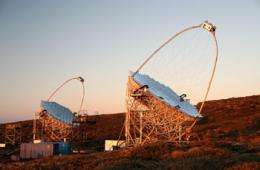
(PhysOrg.com) -- Together with the MAGIC-I telescope, MAGIC-2 allows stereoscopic observations using these two largest gamma-ray telescopes. Astronomers can explore sources of very-high energy gamma rays. The astrophysical study of particle acceleration processes in celestial objects could lead to fundamental insights into the dynamics of the so-called non-thermal Universe.
The MAGIC collaboration will celebrate the first light of their second MAGIC (Major Atmospheric Gamma-ray Imaging Cherenkov) telescope on the Canary island of La Palma on 24 and 25 April 2009. The event will mark the completion of the second telescope and the startup of the second phase of the experiment, MAGIC-II.
The mission of MAGIC-II is to discover astrophysical sources of very-high energy gamma radiation. This radiation traces the most violent processes in the Universe, and originates from, e.g., supernova remnants, pulsars, and active galactic nuclei. Profiting from the excellent atmospheric conditions at the Roque de los Muchachos observatory at 2200 meters above sea level, the two MAGIC telescopes are able to detect the gamma rays through short, faint blue flashes of the so-called Cherenkov light, which are produced when gamma-rays enter the Earth’s atmosphere. With two 17-m diameter mirrors, the MAGIC telescopes are the largest Cherenkov gamma-ray telescopes in the world.
Already the first MAGIC telescope, in operation since 2004, could establish a wealth of outstanding results, including the detection of the two extremely distant gamma-ray emitting active galactic nuclei, and limits on the gamma-ray emission of the mysterious gamma-ray bursts. MAGIC also recently established pulsed very-high energy gamma-ray emission from the Crab pulsar.
To study very high energy gamma-rays with an even higher sensitivity and resolution, the MAGIC Collaboration began the construction of MAGIC-II in 2005. MAGIC-II is similarly constructed as the first MAGIC telescope. The new telescope consists of a tessellated mirror of 247 square meters. The mirrors are supported by a light-weight carbon fiber reinforced plastic tube structure. Together with a powerful drive system, this permits MAGIC-II to be directed in any direction of the sky within 40 seconds, allowing the fast follow-up of gamma-ray bursts. The telescopes are situated 85 meters apart, allowing them to be operated stereoscopically.
The scientists expect to find many more and exciting sources of gamma-radiation. Apart from studying the sources themselves, they will also be able to contribute to a deeper understanding of the evolution of the Universe, and to the advance of fundamental physics, by searches for Dark Matter or the existence of Quantum Gravity. First results of MAGIC-II are expected in the early summer 2009.
The MAGIC telescopes were built and are operated by a large international collaboration, currently including about 150 scientists from Germany, Italy, Spain, Switzerland, Poland, Finland, Croatia, Bulgaria and the United States of America.
They have shared the construction costs of approximately 4 million Euros. Besides the Max Planck Institute for Physics (Munich), which has a leading role in MAGIC, the Universities of Würzburg and Dortmund, and the Deutsches Elektronen-Synchrotron (Zeuthen) are further German partners.
The first light ceremony of MAGIC-II on La Palma will include a half-day scientific seminar on 24 April 2009 on the MAGIC Project. The ceremony at the MAGIC site will take place on 25 April 2009.
More information: MAGIC Collaboration: wwwmagic.mpp.mpg.de/
Provided by Max Planck Institute


