Scientists solve mystery of starlight's origins
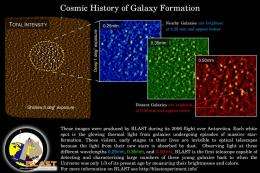
(PhysOrg.com) -- Scientists from the University of Toronto and the University of British Columbia have helped unveil the birthplaces of ancient stars using a two-tonne telescope carried by a balloon the size of a 33-storey building.
After two years spent analyzing data from the Balloon-borne Large-Aperture Sub-millimeter Telescope (BLAST) project, an international group of astronomers and astrophysicists from Canada, the U.S. and the U.K. reveals today in the journal Nature that half of the starlight of the Universe comes from young, star-forming galaxies several billion light years away.
"While those familiar optical images of the night sky contain many fascinating and beautiful objects, they are missing half of the picture in describing the cosmic history of star formation," says UBC Astronomy Prof. Douglas Scott.
"Stars are born in clouds of gas and dust," says Barth Netterfield, a cosmologist in the Department of Astronomy & Astrophysics at U of T. "The dust absorbs the starlight, hiding the young stars from view. The brightest stars in the Universe are also the shortest lived and many never leave their stellar nursery. However, the warmed dust emits light at far-infrared and submillimetre wavelengths - invisible to the human eye, but visible to the sensitive thermo-detectors on BLAST."
"The history of star formation in the universe is written out in our data. It is beautiful. And it is just a taste of things to come," says UBC Prof. Mark Halpern, part of the UBC team that also includes post-doctoral fellows Ed Chapin and Gaelen Marsden.
In the 1990s, NASA's COBE satellite discovered a nearly uniform glow of submillimetre light, known as the Far Infrared Background. It had been expected that this radiation was coming from warmed dust enshrouding bright young stars, but the nature of the galaxies which contain the dust had remained a mystery.
The Nature study combines BLAST submillimetre observations at wavelengths around 0.3 mm - between infrared and microwave wavelengths - with data at much shorter infrared wavelengths from NASA's Spitzer Space Telescope to confirm that all of the Far Infrared Background comes from individual distant galaxies, answering a decade-old question of the radiation's origin.
In addition to leading the data analysis, the Canadian scientists also constructed much of the hardware that made BLAST a reality. The aluminum gondola was designed to protect the telescope, the onboard computers and data upon landing. The motorized pointing system controlled the 2,000 kilogram payload with its two-metre-in-diameter telescope - the largest of its kind - to one one-hundredth of a degree in precision. The complex electronics monitored and recorded nearly 1,000 sensors while the software - nearly 300,000 lines of code - controlled the payload during its long flight 39 kilometres above the Earth.
Flying the telescope above much of the atmosphere allowed the BLAST team to peer out into the distant Universe at wavelengths nearly unattainable from the ground, and uncover dust-enshrouded galaxies that hide about half of the starlight in the Universe.
"Over the last decade, submillimetre telescopes on the ground have produced several 'black and white' images no larger than the size of a fingernail at the end of your outstretched arm," says Chapin. "In a single 11-day flight BLAST has taken a huge leap forward, producing colour images the size of your hand."
BLAST has acted as a pathfinder for the SPIRE (Spectral and Photometric Imaging Receiver) instrument on the upcoming Herschel satellite, in which Canadians are also involved. Using the same detectors as SPIRE, BLAST has provided an invaluable first look at the submillimetre sky.
"BLAST has given us a new view of the Universe," says Netterfield, whose U of T colleagues on the project include department chair Peter G. Martin and graduate students Marco P. Viero, Donald V. Wiebe (now a post-doc at UBC) and Enzo Pascale (now a faculty member at Cardiff University). "The data we collected enable us to make discoveries in topics ranging from the formation of stars to the evolution of distant galaxies."
BLAST is also uniquely capable of studying the earliest stages of star formation locally, in the Milky Way Galaxy. The BLAST collaboration is also releasing a study, submitted to the Astrophysical Journal, of the largest survey to date of the earliest stages of star formation. This study documents the existence of a large population of cold clouds of gas and dust, many of which have cooled to less than -260 C. These cold cores, which exist for millions of years, are the birthplaces of stars.
"Over the last nine years, I've followed BLAST from Vancouver to Toronto, Philadelphia, New Mexico, Texas, northern Sweden and Antarctica, and it feels great for us to finally announce the results," says Marsden. "These results are a very big step forward in submillimetre astronomy."
"The world-leading scientific success of Canadian graduate students and post-docs working on BLAST has been very impressive and, speaking as an educator, very gratifying," says Halpern.
Source: University of British Columbia (news : web)


