Tropical forest seed banks: A blast from the past
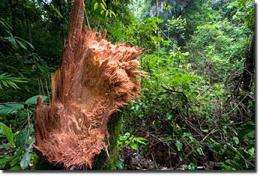
Seeds of some tree species in the Panamanian tropical forest can survive for more than 30 years before germinating. That is 10 times longer than most field botanists had believed.
Using the Lab's Center for Accelerator Mass Spectrometry to measure the amount of carbon 14 in seeds of the trees Croton billbergianus (Euphorbiaceae), Trema micrantha (Celtidaceae) and Zanthoxylum ekmannii (Rutaceae), Lawrence Livermore National Laboratory scientist Tom Brown and University of Illinois at Urbana-Champaign colleague James Dalling found that seeds survived in the soil for 38, 31 and 18 years, respectively.
Previous demographic studies of pioneer tree species showed that seed persistence (the ability to survive in soil, awaiting favorable conditions for germination) is short, lasting only for a few years at most.
But in the tropical forests of Barro Colorado Island (BCI), Panama, Brown and Dalling found the seeds of some pioneer trees remain viable for many years.
"This is part of nature that wasn't really what people in the field thought was going on," Brown said. "It turns out these seeds in soil just a few centimeters below the surface can survive a lot longer than anyone ever thought was possible."
To increase the probability of encountering "old" seeds, Brown and Dalling used data from a forest plot to target sites in the forest occupied 20 years previously by species they suspected were capable of long-term persistence.
After Dalling germinated seeds extracting from surface soil layers at these sites, Brown carbon dated samples taken from the seed coat. However, unlike carbon dating techniques used by archeologists to estimate the age of objects from antiquity, he used a modern radiocarbon signal that is a consequence of atmospheric nuclear testing in the 1950s and early 1960s. The decline in radiocarbon concentration that has occurred since the test-ban treaty went into effect can be used as a signal to determine precisely when carbon became incorporated into plant tissue.
When disturbance kills canopy trees in tropical forest, light reaches the forest floor triggering the germination of seeds of pioneer tree species buried in the soil.
The age of these seeds, and thus the time that populations of pioneer species are able to survive between disturbance events, has long been open to question.
"This is a surprising result," Dalling said. "Demographic models suggest that these species would not benefit from long persistence, and we doubted they would be able to survive anyway. Seeds dispersed onto the soil surface are prey to insect seed predators, and are exposed to an array of pathogens and decay organisms that proliferate in moist tropical soils."
The results imply that buried seeds may be an important reservoir for genetic diversity in pioneer populations and may be as important as long distance dispersal in maintaining populations in fragmented habitats.
More information: The research appears in the April edition of the journal, The American Naturalist.
Source: Lawrence Livermore National Laboratory


