Portuguese wave-power snake dead in the water
Mar 24, 2009 by Anne Le Coz
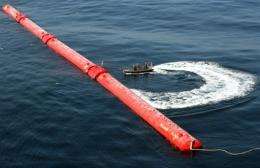
An off-shore electricity generator based on wave power off of Portugal?s coast. Opened in September as a world "first" in producing electricity from waves, a pioneering installation here is dead in the water having functioned for only a few weeks in a stormy process of research and development

Opened in September as a world "first" in producing electricity from waves, a pioneering installation here is dead in the water having functioned for only a few weeks in a stormy process of research and development.

First it had to be taken out of service and dismantled because of technical problems. And now one of the main investors in the project, which had a start-up cost of nine million euros (12.3 million dollars), has gone bankrupt.

The structure, five kilometres (three miles) out to sea off Povoa do Varzim in northern , was put into service officially in September by Economy Minister Manual Pinho after three years of development.

"The first project in the world for the commercial exploitation of ." With these words the minister launched the so-called "wave park." A frigate of the Portuguese navy stood by to honour the event.

The installation has modest generating capacity however, being capable of producing 2.25 megawatts or the output equivalent to that of one wind turbine.

It comprises three units built like articulated sea snakes which lie semi-submerged and undulate with the movement of the waves to generate current.

The three serpent-like units were taken ashore several times for so-called "checks" but since November they have been lying immobile in the northern port of Leixoes.

"There was a recurrent problem with the movements of the hydraulic screws in the three machines, and this is why they have been removed from deep water," Rui Barros, who is one of those in charge of the Agucadoura wave park told AFP.

But, on inspection, "we saw that the problem was serious, generalised, and not incidental."

The main partner in the park is Energias de Portugal. A senior executive in the group, Jorge Cruz Morais, said: "The machines had a hard winter in maritime conditions, and they have been brought ashore for repairs. Do not forget that this is a project."

However, several sources involved in the scheme said that beyond the technical failings, the very existence of the installation is now threatened by the bankruptcy of Australian investment group Babcock & Brown.

The Australian firm owns 35 percent of a consortium called Ondas de Portugal, which was created to develop the system. EDP owns 45 percent of the entity and Portuguese electrical engineering group Efacec owns 20 percent.

An unnamed source in the Australian company, quoted by the website of the Portuguese weekly magazine Expresso, said: "It is not a profitable project. It will become so by growing in size. But the current phase is compromised unless a new partner can be found."

Meanwhile, British company Pelamis Wave Power, the partner for technology in the project, announced in February that it had signed a contract with EON-UK, a subsidiary of EON, the leading energy group in Germany, to develop a similar project in Scotland using a new generation of power converters.

Cruz Morais said that EDP was also considering using this new version or "two or three other technologies" which exist.

EDP was still ready to invest in wave power despite "perfectly normal setbacks in a process of research," he said.

(c) 2009 AFP

Explore further: Juiced roads: Volvo explores electric power for trucks, buses

add to favorites email to friend print save as pdf

Related Stories

New work on leading wave power

Dec 09, 2008

A technology that is adapted to the special conditions for wave energy places the wave energy technology from Uppsala on the absolute cutting edge in the world. In his dissertation, Rafael Waters presents the findings from ...

The Inexhaustible Energy Source Beneath Our Feet

May 24, 2004

According to the expert Willy Gehrer, the environmentally friendly generation of electricity from geothermal sources is going to play an important role in the future of energy production. “I’m convinced that ...

Recommended for you

Poland may delay launch of nuclear plants

6 hours ago

Poland could delay building its first nuclear power plants as natural gas, including shale gas, becomes less costly, the prime minister of the central European heavyweight said Tuesday.

Qatar bails out Germany's Solarworld

10 hours ago

German solar panel manufacturer Solarworld announced Tuesday a capital injection by Qatar, a move which will save the company from bankruptcy as the German sector struggles against Asian competition.

User comments : 9

Adjust slider to filter visible comments by rank

Display comments: newest first

zevkirsh
2.3 / 5 (4) Mar 24, 2009
yea, making energy from something located inside a moving and highly abrasive medium: a salt water ocean, is not smart. all large energy harvesting facilities require massive maintanence, even mines, and oil rigs. why should renewables be any different. ...stick to land based energy factories.
Mayday
3.2 / 5 (5) Mar 24, 2009
Why not build underwater watermills to harvest the energy of sea currents(no pun intended)or deep rivers? The flow is regular and predictable, plus the mills would be out of sight. They could be made to turn slow enough to minimize the danger to aquatic life.
DGBEACH
1.8 / 5 (5) Mar 24, 2009
Why not build underwater watermills to harvest the energy of sea currents(no pun intended)or deep rivers? The flow is regular and predictable, plus the mills would be out of sight. They could be made to turn slow enough to minimize the danger to aquatic life.

THAT would only make sense! But then again, there are those here that will be more concerned with changing those undersea currents, and perhaps disturbing the odd crab or lobster, then with actually doing something to reduce our CO2 emissions!
david_42
4.5 / 5 (4) Mar 24, 2009
Mayday - there have been many ocean turbine projects dating back to the lift-translators from the 1970s. None of them have gotten very far, but people keep trying.
Velanarris
2.4 / 5 (5) Mar 24, 2009
THAT would only make sense! But then again, there are those here that will be more concerned with changing those undersea currents, and perhaps disturbing the odd crab or lobster, then with actually doing something to reduce our CO2 emissions!
Which has a greater affect on climate, altering the flow of ocean currents or adding 0.000028% CO2 over the course of 200 years?
Soylent
4.3 / 5 (3) Mar 25, 2009
Which has a greater affect on climate, altering the flow of ocean currents or adding 0.000028% CO2 over the course of 200 years?


Adding to the CO2 concentration by a few hundred ppm over the next 50-100 years.

RayCherry
5 / 5 (2) Mar 25, 2009
Anything in the water is less easy to maintain, even more so if it is on the bed of the ocean. However, the ocean has more energy than any other source we know. We are just beginning, and money will be spent, (and appear to be lost), discovering the right solution.

If we have only decades left before the ocean currents change, and the climate changes increase the energy requirements of domestic and public climate control systems, then we must all 'waste' some money now ... 'buying time from the future'.
Velanarris
2.6 / 5 (5) Mar 25, 2009
Which has a greater affect on climate, altering the flow of ocean currents or adding 0.000028% CO2 over the course of 200 years?

Adding to the CO2 concentration by a few hundred ppm over the next 50-100 years.

I rarely say this to you soylent, but you're wrong. Impeding an ocean current stops the transport of warm water, and in turn wind, to cold areas.

Also, we're not going to be adding several hundred ppm to the current CO2 count. Humans are only listed as being culpable for 50% of the increase. So over several hundred years we've produced a questionable 50 ppm. Now that we're utilizing many other more efficient sources of energy as well as a few cleaner ones (sporadically), I doubt we'll be able to match that increase even with the current population.
Roach
not rated yet Apr 17, 2009
Um, mayday, you migh want to check you numbers, if a low flow like a river or ocean current could drive a generator, then why would the Hoover Dam have been needed? I don't think the minimal mechanical energy of an underwater flow is enough to drive very much, for a large energy demand you've need a "windmill" bigger than the river.

As to the ocean having more energy than many other sources yes, but at 1.37 billion cubic kilometers the volume versus energy isn't very appealing.

More news stories

Mozilla lab wants scientists to step out of analog age

(Phys.org) —Talk about big ideas. Not satisfied to rest on laurels of having brought forth the open source browser Firefox, Mozilla—defined by some as a global project, by others as one of the key open-source ...

3D printing tiny batteries

(Phys.org) —3D printing can now be used to print lithium-ion microbatteries the size of a grain of sand. The printed microbatteries could supply electricity to tiny devices in fields from medicine to communications, ...