Greek fisherman nets 2,200-year-old bronze statue
Mar 24, 2009
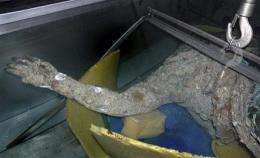
In this handout photo provided by the Greek Ministry of Culture on Monday, March 23, 2009, the torso and raised right arm of a 2,200-year-old statue are seen after it was raised in a fisherman's nets. The ministry said the find, dating to the late 2nd century B.C. was part of an equestrian statue of an armed man wearing a breastplate and carrying a sheathed sword. It was accidentally found last week in the eastern Aegean Sea between the islands of Kos and Kalymnos. (AP Photo / Greek Culture Ministry, HO)

(AP) -- A Greek fisherman must have been expecting a monster of a catch when he brought up his nets in the Aegean Sea last week. Instead, Greek authorities say his haul was a section of a 2,200-year-old bronze statue of a horseman.

A Culture Ministry announcement said Monday the accidental find was made in waters between the eastern islands of Kos and Kalymnos. The handed over the corroded metal figure to authorities, who have started the cleaning process.

Dating to the late 2nd century B.C., the statue represented a male rider wearing ornate breast armor over a short tunic and armed with a sheathed sword. The trunk of the horseman and his raised right arm have survived.

©2009 The Associated Press. All rights reserved. This material may not be published, broadcast, rewritten or redistributed.

Explore further: Actor Johnny Depp immortalized in ancient fossil find

add to favorites email to friend print save as pdf

Related Stories

New Evidence Suggests Need to Rewrite Bronze Age History

May 01, 2006

Separated in history by 100 years, the seafaring Minoans of Crete and the mercantile Canaanites of northern Egypt and the Levant (a large area of the Middle East) at the eastern end of the Mediterranean were never considered ...

Earthquake Protected Ancient Statue of Hermes

Feb 02, 2005

The world-renowned statue Hermes with the Infant Dionysos has been equipped with innovative seismic protective devices that will help the 7-foot-high marble statue of the Greek god withstand powerful earthquakes. ...

Recommended for you

The eloquence of the otoliths

May 16, 2013

Fish fossils that are about 23 million years old give unprecedented insight into the evolutionary history of the gobioid order, one of the most species-rich groups among the modern bony fishes.

Light cast on lifestyle and diet of first New Zealanders

May 16, 2013

(Phys.org) —A University of Otago-led multidisciplinary team of scientists have shed new light on the diet, lifestyles and movements of the first New Zealanders by analysing isotopes from their bones and teeth.

mtDNA study shows Minoans came from Europe not Africa

May 15, 2013

(Phys.org) —A new study conducted by a team of American and Greek researchers has found that the people of the ancient Minoan civilization living on the island of Crete most likely came from Europe. In ...

User comments : 0

More news stories

Evolution of lying

(Phys.org) —Ultimately, our ability to convincingly lie to each other may have evolved as a direct result of our cooperative nature.