Flight of the bumble (and honey) bee
Mar 20, 2009
Bee

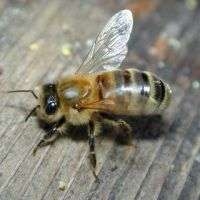
Insects such as honeybees and bumble bees are predictable in the way they move among flowers, typically moving directly from one flower to an adjacent cluster of flowers in the same row of plants. The bees' flight paths have a direct affect on their ability to hunt for pollen and generate "gene flow", fertilization and seed production that results when pollen moves from one plant to another. The study of gene flow has experienced more attention in part due to the recent introduction of genetically modified organisms (GMOs) into the environment.

Scientists, plant breeders, and growers seek to understand flight patterns of , bumble bees, and other insect "pollinators" as a way to increase production and healthy produce. Although several studies have focused on pollen movement among cucurbits, the plant family that includes cucumbers, gourds, melons, or pumpkins, little research has looked at pollinator flight patterns and, until recently, none has determined in watermelon plantings.

New research published in the February 2009 issue of HortScience by research scientists S. Alan Walters of Southern Illinois University and Jonathan R. Schultheis of North Carolina State University studied down and across rows in watermelon [Citrullus lanatus (Thunb.)] by tracking pollen flow. The direction of honeybees was tracked under field conditions during 2001 and 2002 at the Southern Illinois University Horticultural Research Center in Carbondale.

According to Walters, the study indicated that the evaluation of pollen flow showed a definite pattern of bee movement and gene migration in watermelon. "Although we detected pollinator movement that was strongly directional in both directions (east and west) down the row from the central block of donor plants, results also indicate that significant movement also occurred across rows in both directions (north and south) from the donor plot", he remarked.

Because watermelon vines grow in multiple directions, including across rows, bees can easily move across rows if the next closest flower is in that direction instead of down the row. Most pollen is deposited on the nearest neighboring flower from where pollen was collected.

Walters summarized the study stating, "Although significant amounts of linear pollinator movements occur down rows of watermelon plants, pollinator movements (in watermelon) are not as simple as just maintaining a linear direction straight down the row, but are related to the short flight distances that most likely occur to the closest neighboring flower from the one that was previously visited."

More information: The complete study and abstract are available on the ASHS HortScience electronic journal web site: hortsci.ashspublications.org/cgi/content/abstract/44/1/49

Source: American Society for Horticultural Science

Explore further: Scientists announce Top 10 New Species from 2012

add to favorites email to friend print save as pdf

Related Stories

How to share a bat

Aug 22, 2007

New research shows how different species of plants evolve unique floral adaptations in order to transfer pollen on different regions of bats’ bodies, thus allowing multiple plant species to share bats as pollinators.

Wild bees make honey bees better pollinators

Aug 29, 2006

When honey bees interact with wild native bees, they are up to five times more efficient in pollinating sunflowers than when native bees are not present, according to a new study by a pair of researchers at ...

Birds, Bees, and Moths Drive Flower Evolution

Jun 07, 2007

Flowers evolve in a predictable fashion to match the mouthparts of pollinating birds and insects, rather than engaging in a gradual "arms race" between flower and pollinator, according to a new study by researchers ...

Recommended for you

Scientists announce Top 10 New Species from 2012

4 hours ago

An amazing glow-in-the-dark cockroach, a harp-shaped carnivorous sponge and the smallest vertebrate on Earth are just three of the newly discovered top 10 species selected by the International Institute for ...

New cave-dwelling arachnids discovered in Brazil

16 hours ago

Two new species of cave-dwelling short-tailed whipscorpions have been discovered in northeastern Brazil, and are described in research published May 22 in the open access journal PLOS ONE by Adalberto Santos ...

Do songbirds hold key to stuttering?

21 hours ago

A tiny Australian songbird may hold the answer to discovering the biological source of stuttering, which affects 3 million Americans and is notoriously difficult to treat.

User comments : 0

More news stories

Wildlife losses now stabilising

Efforts to conserve biodiversity in the UK, Belgium and Netherlands may be working, despite the widespread perception that wildlife is in terminal decline, a new study suggests.

Unlocking secrets of cell reproduction

Research published in Open Biology today identifies, for the first time, nearly all the genes required for reproduction of a cell in a living organism.

Weird science: Crystals melt when they're cooled

(Phys.org) —Growing thin films out of nanoparticles in ordered, crystalline sheets, to make anything from microelectronic components to solar cells, would be a boon for materials researchers, but the physics ...

Researchers forward quest for quantum computing

Research teams from UW-Milwaukee and the University of York investigating the properties of ultra-thin films of new materials are helping bring quantum computing one step closer to reality.

Cold plasma successful against brain cancer cells

For the first time, physicists from the Max Planck Institute for Extraterrestrial Physics (MPE), biologists and physicians demonstrated the synergistic effect of cold atmospheric plasma - a partly ionized ...