A Black Hole in Medusa's Hair
Mar 11, 2009
Credits: X-ray: NASA/CXC/Univ. of Iowa/P. Kaaret et al. Optical: NASA/ESA/STScI/Univ. of Iowa/P. Kaaret et al.

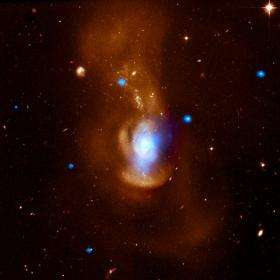
This composite image of the Medusa galaxy (also known as NGC 4194) shows X-ray data from NASA's Chandra X-ray Observatory in blue and optical light from the Hubble Space Telescope in orange. Located above the center of the galaxy and seen in the optical data, the "hair" of the Medusa -- made of snakes in the Greek myth -- is a tidal tail formed by a collision between galaxies. The bright X-ray source found towards the left side of Medusa's hair is a black hole.

Most bright X-ray sources in are containing either stellar mass or neutron that remain after the of a massive star. Because these compact objects can generate X-rays for much longer periods of time than the lifetime of their massive progenitor stars, X-ray binaries may be used as "fossils" to study the history of their host galaxies. In this Medusa image, the X-ray binaries are seen as the bright blue point-like objects.

A recent study of the Medusa galaxy and nine other galaxies measured the correlation between the formation of stars and the production of X- ray binaries. A key feature was to study this correlation for the Medusa galaxy and NGC 7541, two galaxies with particularly high star formation rates. It was found that both the number of bright X-ray sources and their average brightness were related to the rate at which stars formed. This work may be useful for attempts to use X-ray brightness to measure the rate of star formation in galaxies at very large distances.

It was also found that for every one million tons of gas that goes into making stars, one ton gets pulled onto a stellar mass black hole or a neutron star. This result may help create more accurate models of the formation of X-ray binaries.

Provided by NASA

Explore further: Unusual supernova is doubly unusual for being perfectly normal

add to favorites email to friend print save as pdf

Related Stories

Huge Black Holes Stifle Star Formation

Aug 23, 2006

Supermassive black holes in some giant galaxies create such a hostile environment, they shut down the formation of new stars, according to NASA Galaxy Evolution Explorer findings published in the August 24 ...

Hubble photographs grand spiral galaxy Messier 81

May 29, 2007

The beautiful galaxy Messier 81 is tilted at an oblique angle on to our line of sight, giving a "birds-eye view" of the spiral structure. The galaxy is similar to our Milky Way, but our favourable view provides ...

Baby booms and birth control in space

Sep 25, 2007

Stars in galaxies are a bit similar to people: during the first phase of their existence they grow rapidly, after which a stellar birth control occurs in most galaxies. Thanks to new observations from Dutch ...

Antennae Galaxies

May 19, 2008

This image of the Antennae galaxies is the sharpest yet of this merging pair of galaxies. During the course of the collision, billions of stars will be formed. The brightest and most compact of these star ...

Recommended for you

Three centaurs follow Uranus through the solar system

Jun 18, 2013

Astrophysicists from the Complutense University of Madrid have confirmed that Crantor, a large asteroid with a diameter of 70 km has an orbit similar to that of Uranus and takes the same amount of time to ...

Final curtain for Europe's deep-space telescope

Jun 17, 2013

The deep-space telescope Herschel took its final bow on Monday, climaxing a successful four-year mission to observe the birth of stars and galaxies, the European Space Agency (ESA) said.

Hubble spots a very bright contortionist

Jun 17, 2013

(Phys.org) —The contorted object captured by Hubble in this picture is IRAS 22491-1808, also known as the South America Galaxy. It is an ultra-luminous infrared galaxy (ULIRG) that emits a huge amount of ...

Study explains decades of black hole observations

Jun 14, 2013

(Phys.org) —A new study by astronomers at NASA, Johns Hopkins University and Rochester Institute of Technology confirms long-held suspicions about how stellar-mass black holes produce their highest-energy ...

User comments : 0

More news stories

Philippines financial capital bans plastic bags

The Philippines financial capital banned disposable plastic shopping bags and styrofoam food containers on Thursday, as part of escalating efforts across the nation's capital to curb rubbish that exacerbates ...

Singapore haze at worst yet, Malaysia schools shut

Singapore urged people to remain indoors amid unprecedented levels of air pollution Thursday as a smoky haze wrought by forest fires in neighboring Indonesia worsened dramatically. Nearby Malaysia closed ...

China astronauts float water blob in kids' lecture

Astronauts struck floating martial arts poses, twirled gyroscopes and manipulated wobbling globes of water during a lecture Thursday from China's orbiting space station that's part of efforts to popularize ...

Panic over MERS virus fades in Saudi

People in Saudi Arabia's Eastern Province have again started greeting friends with the traditional kiss on the cheek, and face masks in public are becoming rarer, as panic subsides over the outbreak of a deadly respiratory ...

S.Korean airlines ban shark fin as cargo

South Korea's two largest airlines, Korean Air and Asiana, said Thursday they had both decided to ban shark fin from their cargo flights as part of a growing global campaign against the Asian delicacy.

AP buys stake in live video service Bambuser

The Associated Press said Thursday that it has bought a minority stake in the live video service Bambuser, boosting its ability to acquire and distribute video collected by people who have witnessed news events.

UNESCO warns Syrian heritage sites endangered

UNESCO on Thursday added six ancient sites in Syria including a fortress of Saladin and a Crusader castle to the endangered World Heritage list, warning that more than two years of civil war had inflicted ...