Surviving lung cancer: New technique boasts high cure rates, offers hope in place of surgery
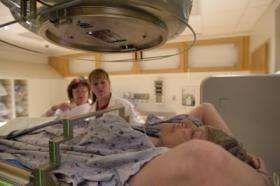
A body immobilizer keeps Carol Whelan still as she undergoes stereotactic body radiotherapy. She knows the technique may improve her chances of surviving lung cancer. Here, she undergoes her first treatment of targeted, high-dosage radiation, which will last from 30 to 45 minutes. Credit: Ryan S. Brandenberg/Temple University
Countless people have heard the phrase, "You have lung cancer," but only 50 can say they've completed a new treatment at Temple University that doubles their chances of surviving the deadly disease — and without the conventional radiation regimen or surgery. Doctors in the Radiation Oncology Department say the technique, stereotactic body radiotherapy, or SBRT, not only improves a person's odds of surviving early stage lung cancer, but may reduce the need for future surgeries.
"This is a big trend in radiation oncology for early stage lung cancer patients who either can't undergo surgery or refuse it," says Curtis Miyamoto, M.D., chair and professor of the Department of Radiation Oncology at the School of Medicine. "With the success of this technique, we're now questioning whether we'll even be doing surgeries on these patients in the future."
Treating lung cancer with conventional radiation is a burdensome process. Patients receive radiation therapy, which kills the cancerous cells and shrinks tumors, five days a week for six to seven weeks. The travel alone can be a hardship for patients not living in the city.
In contrast, SBRT requires only three to eight treatments, not 35. Once malignancy is confirmed through a PET CT scan or biopsy, treatments can begin. Patients are placed in an immobilizing body frame to reduce movement so that doctors can focus radiation on the tumor while reducing exposure of healthy tissue. Although both traditional treatments and SBRT methods involve radiation, SBRT administers large, highly precise doses instead of multiple smaller doses.
But perhaps the most important advantage of SBRT is its effectiveness: Patients who refuse or cannot receive conventional treatments for their lung cancer face a median survival range of nine months. For those who undergo SBRT, the median survival range is more than 32 months. And depending on the size and seriousness of the tumor, the two-year disease free survival, or cure rate through SBRT increases to approximately 81 percent and can reach up to 98 percent, according to findings in the International Journal of Radiation OncologyBiologyPhysics. The cure rate with conventional radiation is closer to 35 percent; SBRT doubles the odds of surviving early stage lung cancer and can actually cure at least half of the patients.
"Such high survival rates are equivalent to other techniques, like invasive surgery, but you don't have to go under the knife," says Miyamoto. "I think the big thing the patient notices is it's all done very quickly and the results are impressive."
That's welcome news to Americans considering lung cancer is the second most diagnosed cancer in men and women (after prostate and breast, respectively), but it is the number one cause of death from cancer every year in both men and women, according to statistics from LungCancer.org.
Source: Temple University
-
From lemons to lemonade: Reaction uses carbon dioxide to make carbon-based semiconductor,
32 comments
-
Thioridazine kills cancer stem cells in human while avoiding toxic side-effects of conventional cancer treatments,
3 comments
-
SpaceX private rocket blasts off for space station (Update),
42 comments
-
Climate scientists say they have solved riddle of rising sea,
31 comments
-
SpaceX capsule has 'new car' smell, astronauts say (Update),
4 comments
-
Potential Breakthrough in Seizure Control
May 26, 2012
-
Popping/Cracked sternum.
May 25, 2012
-
Which Mental Illness Encompasses This Problem?
May 25, 2012
-
A question about drug tolerance
May 23, 2012
-
Poor nutrition leading to overeating?
May 23, 2012
-
Math and dyslexia?
May 21, 2012
- More from Physics Forums - Medical Sciences
More news stories
T cells 'hunt' parasites like animal predators seek prey, study shows
By pairing an intimate knowledge of immune-system function with a deep understanding of statistical physics, a cross-disciplinary team at the University of Pennsylvania has arrived at a surprising finding: T cells use a movement ...
Medicine & Health / Medical research
9 hours ago |
5 / 5 (3) |
0
|
Same gene that stunts infants' growth also makes them grow too big: research
UCLA geneticists have identified the mutation responsible for IMAGe* syndrome, a rare disorder that stunts infants' growth. The twist? The mutation occurs on the same gene that causes Beckwith-Wiedemann syndrome, which makes ...
9 hours ago |
not rated yet |
0
|
Almost half of new vets seek disability
(AP) -- America's newest veterans are filing for disability benefits at a historic rate, claiming to be the most medically and mentally troubled generation of former troops the nation has ever seen.
7 hours ago |
not rated yet |
0
Color-changing contact lenses to help diabetics (w/ Video)
For the millions of Americans with diabetes, the inconvenient and often painful method of testing blood sugar levels is a way of life. But research and innovative product design by scientists at The University of Akron may ...
May 23, 2012 |
4.4 / 5 (7) |
5
|
Missouri opts for untested drug for executions
(AP) -- The same anesthetic that caused the overdose death of pop star Michael Jackson is now the drug of choice for executions in Missouri, causing a stir among critics who question how the state can guarantee ...
Medicine & Health / Medications
May 24, 2012 |
not rated yet |
5
Stunning image of smallest possible five-ringed structure
Scientists have created and imaged the smallest possible five-ringed structure about 100,000 times thinner than a human hair and you'll probably recognise its shape.
'Unzipped' carbon nanotubes could help energize fuel cells, batteries
Multi-walled carbon nanotubes riddled with defects and impurities on the outside could replace some of the expensive platinum catalysts used in fuel cells and metal-air batteries, according to scientists at ...
Change in developmental timing was crucial in the evolutionary shift from dinosaurs to birds: study
At first glance, it's hard to see how a common house sparrow and a Tyrannosaurus Rex might have anything in common. After all, one is a bird that weighs less than an ounce, and the other is a dinosaur that ...
Computer model used to pinpoint prime materials for efficient carbon capture
When power plants begin capturing their carbon emissions to reduce greenhouse gases and to most in the electric power industry, it's a question of when, not if it will be an expensive undertaking.
Land and sea species differ in climate change response: study
(Phys.org) -- Marine and terrestrial species will likely differ in their responses to climate warming, new research by Simon Fraser University and Australia’s University of Tasmania has found.
Yale study concludes public apathy over climate change unrelated to science literacy
Are members of the public divided about climate change because they don't understand the science behind it? If Americans knew more basic science and were more proficient in technical reasoning, would public consensus match ...