New building design withstands earthquake simulation (Video)
Feb 26, 2009
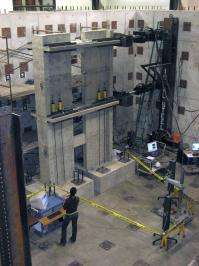
Engineers constructed a four-story, 40-percent replica of a building in a laboratory to test their new technique for bracing high rise buildings in earthquake zones. They simulated an earthquake by pushing and pulling the building with hydraulics. Image: Remy Lequesne

(PhysOrg.com) -- Researchers at the University of Michigan simulated an off-the-charts earthquake in a laboratory to test their new technique for bracing high-rise concrete buildings. Their technique passed the test, withstanding more movement than an earthquake would typically demand.

The engineers used steel fiber-reinforced concrete to develop a better kind of coupling beam that requires less reinforcement and is easier to construct. Coupling beams connect the walls of high rises around openings such as those for doorways, windows, and elevator shafts. These necessary openings can weaken walls.

"We simulated an earthquake that is beyond the range of the maximum credible earthquake and our test was very successful. Our fiber-reinforced concrete beams behaved as well as we expected they would, which is better than the beams in use today," said James Wight, the Frank E. Richart Jr. Collegiate Professor in the U-M Department of Civil and Environmental Engineering.

This video is not supported by your browser at this time.
Engineers at the University of Michigan simulated an off-the-charts earthquake in a laboratory in December to test the strength of their new technique for bracing high-rise buildings.

Working with Wight on this project are Gustavo Parra-Montesinos, an associate professor in the Department of Civil and Environmental Engineering, and Remy Lequesne, a doctoral student in the same department.

Today, coupling beams are difficult to install and require intricate reinforcing bar skeletons. The U-M engineers created a simpler version made of a highly flowable, steel fiber-reinforced concrete.

"We took quite a bit of the cumbersome reinforcement out of the design and replaced it with steel fibers that can be added to the concrete while it's being mixed," Parra-Montesinos said. "Builders could use this fiber-reinforced concrete to build coupling beams that don't require as much reinforcement."

The engineers envision that their brand of beam would be cast off the construction site and then delivered. Nowadays, builders construct the beams, steel skeletons and all, bit by bit as they're building skyscrapers.

Their fiber-reinforced concrete has other benefits as well.

"The cracks that do occur are narrower because the fibers hold them together," Parra-Montesinos said.

The fibers are about one inch long and about the width of a needle.

The engineers performed their test in December on a 40-percent replica of a 4-story building wall that they built in the Structures Laboratory. They applied a peak load of 300,000 pounds against the building, pushing and pulling it with hydraulic actuators.

To quantify the results, they measured the building's drift, which is the motion at the top of the building compared with the motion at the base. In a large earthquake, a building might sustain a drift of 1 to 2 percent. The U-M structure easily withstood a drift of 3 percent.

The new beams could provide an easier, cheaper, stronger way to brace buildings in earthquake-prone areas.

The researchers are now working with a structural design firm to install the beams in several high rises soon to be under construction on the west coast.

Provided by University of Michigan

Explore further: Multiview 3-D photography made simple

add to favorites email to friend print save as pdf

Related Stories

Snowden's life surrounded by spycraft

3 hours ago

In the suburbs edged by woods midway between Baltimore and the U.S. capital, residents long joked that the government spy shop next door was so ultra-secretive its initials stood for "No Such Agency." But ...

Winners and losers at this week's E3

3 hours ago

Since the first battles over "Pong" machines in local arcades four decades ago, video gamers have loved good competition. And this year's Electronic Entertainment Expo—the industry's largest annual gathering—presented ...

Europe's space truck docks with ISS

3 hours ago

A robot freighter bearing 6.6 tonnes of cargo docked with the International Space Station (ISS) on Saturday, the European Space Agency (ESA) said.

Secret to Prism program: Even bigger data seizure

4 hours ago

In the months and early years after the Sept. 11, 2001, terrorist attacks, FBI agents began showing up at Microsoft Corp. more frequently than before, armed with court orders demanding information on customers.

Recommended for you

Multiview 3-D photography made simple

13 hours ago

Computational photography is the use of clever light-gathering tricks and sophisticated algorithms to extract more information from the visual environment than traditional cameras can.

Giant 3-D printed bugs shed light on insect anatomy

13 hours ago

Minute insects, from the Australian National Insect Collection, have been super sized by up to forty times using a novel 3D scanning system and printed using a state of the art 3D printer.

Mathematical algorithms cut train delays

Jun 18, 2013

Commuters are already seeing a reduction in delays and waiting times thanks to new software able to adapt railway schedules in real time following unforeseen disruptions.

User comments : 1

Adjust slider to filter visible comments by rank

Display comments: newest first

WolfAtTheDoor
not rated yet Feb 26, 2009
That's great, but it's kind of a small building.

More news stories

Multiview 3-D photography made simple

Computational photography is the use of clever light-gathering tricks and sophisticated algorithms to extract more information from the visual environment than traditional cameras can.

Microsoft mulled buying Nokia unit

Microsoft was in talks to boost its position in the mobile phone market by buying the devices business from Nokia but failed to seal a deal, the Wall Street Journal reported Wednesday.