Reverse Chemical Switching of a Ferroelectric Film
Feb 25, 2009

(PhysOrg.com) -- Ferroelectric materials display a spontaneous electric polarization below the Curie temperature that can be reoriented, typically by applying an electric field. In this study, researchers from Argonne, Northern Illinois University, and The University of Pennsylvania have demonstrated that the chemical environment can control the polarization orientation in an ultrathin ferroelectric film.

This is complementary to recent predictions that polarization can affect surface chemistry and illuminates potential applications in sublithographic patterning and electrically tunable catalysts.

In situ synchrotron X-ray scattering measurements showed that high or low oxygen partial pressure induces outward or inward polarization, respectively, in an ultrathin PbTiO3 film. While X-ray scattering is not sensitive to interfacial charge from polarization, it is very sensitive to the atomic positions in the crystal structure of a ferroelectric film that determine its polarization.

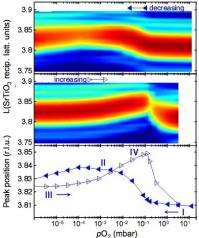
The image shows hysteresis in the ferroelectric film structure as a function of oxygen partial pressure indicating polarization switching. The most intense (red) feature is the PbTiO3 Bragg peak. By following the behavior in situ, one sees that chemical potential affects ferroelectric film polarization in the same way as electric potential. In combination with ab initio based modeling, these experiments show that the chemical environment can play a dominant role in the behavior of nanoscale ferroelectrics.

More information:
• Wang et al., "Reversible Chemical Switching of a Ferroelectric Film," Phys. Rev. Lett., 102, 047601 (2009),
• J. Hinka, "A Viewpoint on Reversible Chemical Switching of a Ferroelectric Film," Physics. 2, 8 (2009) (online)

Provided by Argonne National Laboratory

Explore further: Iron-platinum alloys could be new-generation hard drives

add to favorites email to friend print save as pdf

Related Stories

Non-wetting fabric drains sweat

1 hour ago

(Phys.org) —Waterproof fabrics that whisk away sweat could be the latest application of microfluidic technology developed by bioengineers at the University of California, Davis.

Recommended for you

Lab sets a new record for creating heralded photons

2 hours ago

(Phys.org) —Entanglement, by general consensus of physicists, is the weirdest part of quantum science. To say that two particles, A and B, are entangled means that they are actually two parts of an inseparable ...

Breakthrough calls time on bootleg booze

8 hours ago

(Phys.org) —Using a laser, the St Andrews scientists can now carry out detailed analysis of a spirit sample no bigger than a teardrop and can even confirm whether it is toxic or not. It's hoped the testing ...

Competition in the quantum world

11 hours ago

Innsbruck physicists led by Rainer Blatt and Peter Zoller experimentally gained a deep insight into the nature of quantum mechanical phase transitions. They are the first scientists that simulated the competition ...

Promising doped zirconia

May 17, 2013

Materials belonging to the family of dilute magnetic oxides (DMOs)—an oxide-based variant of the dilute magnetic semiconductors—are good candidates for spintronics applications. This is the object of ...

User comments : 0

More news stories

Lab sets a new record for creating heralded photons

(Phys.org) —Entanglement, by general consensus of physicists, is the weirdest part of quantum science. To say that two particles, A and B, are entangled means that they are actually two parts of an inseparable ...

Breakthrough calls time on bootleg booze

(Phys.org) —Using a laser, the St Andrews scientists can now carry out detailed analysis of a spirit sample no bigger than a teardrop and can even confirm whether it is toxic or not. It's hoped the testing ...

Competition in the quantum world

Innsbruck physicists led by Rainer Blatt and Peter Zoller experimentally gained a deep insight into the nature of quantum mechanical phase transitions. They are the first scientists that simulated the competition ...

New principle may help explain why nature is quantum

Like small children, scientists are always asking the question 'why?'. One question they've yet to answer is why nature picked quantum physics, in all its weird glory, as a sensible way to behave. Researchers ...

Practice makes perfect? Not so much

Turns out, that old "practice makes perfect" adage may be overblown. New research led by Michigan State University's Zach Hambrick finds that a copious amount of practice is not enough to explain why people ...