Astronomers Gravitate Toward Einstein's Telescope
Feb 20, 2009
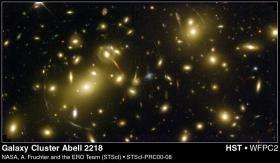
The gravity of galaxy cluster Abell 2218 bends and focuses the light from galaxies that lay behind it in this Hubble Space Telescope image. The effect distorts multiple images of the background galaxies into long, faint arcs. Image: NASA, A. Fruchter and the ERO (STScI), STScI-PRC00-08

Scientists are harnessing the cosmos as a scientific 'instrument' in their quest to determine the makeup of the universe.

The University of Chicago’s Evalyn Gates calls the instrument “Einstein’s telescope.” The instrument is actually the phenomenon of gravitational lensing, which acts as a sort of natural telescope. Gates’s new book, Einstein’s Telescope: The Hunt for Dark Matter and Dark Energy in the Universe, explains how it works.

Although based on Albert Einstein’s general theory of relativity, the effect is easily demonstrated. Look at a light through the bottom of a wine glass, Gates recommends, and see the resulting light distortion.

“Einstein’s telescope is using the universe itself as a lens through which we can seek out galaxies that would otherwise be too faint to be seen,” says Gates, Assistant Director of the University’s Kavli Institute for Cosmological Physics.

Einstein’s first inklings

Long ago Einstein recognized the potential existence of gravitational lensing, a consequence of his theory of general relativity. According to general relativity, celestial objects create dimples in space-time that bend the light traveling from behind.

Einstein realized that the gravitational influence of a foreground star could theoretically bend the light of another star sitting almost directly far beyond it, producing two images of the background star.

“Gravitational lensing magnifies things as well as making multiple images and distorting the shape of images, so you can actually use it as a magnifying glass,” Gates explains.

But, assuming that the effect would be too weak to detect, Einstein immediately dismissed its significance. “What he didn’t anticipate, among other things, were the incredible leaps forward in telescope technology,” Gates says.

Seeing the invisible

Astronomers now use gravitational lensing to look for dark matter and the imprint of dark energy, two of the greatest modern scientific mysteries.

Dark energy, which acts in opposition to gravity, is the dominant force in the universe.

“We can’t see dark energy directly by any means, but we’re looking for how it has sculpted the matter distribution of the universe over the past few billion years, since it’s been the dominant factor, and also how it has affected the rate at which the Universe is expanding” Gates says.

And gravitational lensing is essentially the only method astronomers have for tracing out the web of dark matter that pervades the Universe, and determining how dark energy has impacted the evolution of this web. “It’s really hot scientifically,” she says.

Like dark energy, dark matter is also invisible. It accounts for most of the matter in the universe, but exactly what it is remains unknown. Scientists only know that dark matter differs significantly from normal matter (which is essentially composed of protons and neutrons) that dominates everyday life.

“What we’re made of is just about five percent of everything that’s in the universe,” Gates says.

In 1990s scientists wondered if a significant quantity of dark matter in the halo consisted of MACHOs (Massive Astrophysical Compact Halo Objects) - faint objects such as dim stars, Jupiter-sized planets or stellar-mass black holes that are all composed of normal matter but hard to see.

Gates and her collaborators were among the researchers who used gravitational lensing to search for MACHOs within the halo of the Milky Way galaxy. “We have seen MACHOs - but what we found is that they make up at most a small fraction of the galactic halo,” Gates said.

A look into galaxies past

Scientists also use galaxy clusters as gravitational lenses to probe 13 billion years back into the history of the universe. “They’re seeing some of the very first galaxies,” she says.

Gravitational lensing offers astrophysicists a tool comparable to magnetic resonance imaging and computing tomography, which have provided health professionals with unprecedented new views of the human body.

“Gravitational lensing is going to allow us to image the universe in ways that wouldn’t have been possible even 50 years ago,” she says.

During the 20th century, quantum mechanics and general relativity radically altered scientists’ view of the universe, Gates says. Investigations of dark matter and dark energy may do likewise.

“It may lead us to another revolution in our understanding of the most fundamental aspects of the universe, time, matter, and energy.”

Provided by University of Chicago

Explore further: A hidden population of exotic neutron stars

add to favorites email to friend print save as pdf

Related Stories

'Space warps' project needs your help

May 08, 2013

(Phys.org) —Astronomers are asking volunteers to help them search for "space warps." More commonly known as "gravitational lenses," these are rare systems with very massive galaxies or clusters of galaxies that bend light ...

Gravity-bending find leads to Kepler meeting Einstein

Apr 04, 2013

(Phys.org) —NASA's Kepler space telescope has witnessed the effects of a dead star bending the light of its companion star. The findings are among the first detections of this phenomenon—a result of Einstein's ...

Are we closing in on dark matter?

Dec 18, 2012

As the search for dark matter intensifies, the Kavli Institute for Cosmological Physics at the University of Chicago and the National Academy of Sciences organized a colloquium that brings together cosmologists, ...

Recommended for you

A hidden population of exotic neutron stars

2 hours ago

(Phys.org) —Magnetars – the dense remains of dead stars that erupt sporadically with bursts of high-energy radiation - are some of the most extreme objects known in the Universe. A major campaign using ...

Very Large Telescope celebrates 15 years of success

8 hours ago

(Phys.org) —With this new view of a spectacular stellar nursery ESO is celebrating 15 years of the Very Large Telescope—the world's most advanced optical instrument. This picture reveals thick clumps ...

Fragile mega-galaxy is missing link in history of cosmos

May 22, 2013

Two hungry young galaxies that collided 11 billion years ago are rapidly forming a massive galaxy about 10 times the size of the Milky Way, according to UC Irvine-led research published Wednesday in the journal ...

User comments : 7

Adjust slider to filter visible comments by rank

Display comments: newest first

frajo
3 / 5 (4) Feb 20, 2009
Very nice picture, nice advertising, nothing new. :)
E_L_Earnhardt
not rated yet Feb 20, 2009
On the "Dark Energy" and "Dark Matter": Years ago, when I was a-wash in Physics, the mantra was: "All matter was created by ENERGY, and all matter CONSISTS
of ENERGY! "Full Circle" We are getting back to what common sense led us to surmise in the first place!
menkaur
not rated yet Feb 21, 2009
huh... i'm a bit annoyed by that 'dark matter' stuff... may be, there are 2 different types of gravitation? (I've read it somewhere)
On the other side, it would be really exciting if there was a distinctive type of matter, that would be "dark", and dark energy was a real thing
deatopmg
1 / 5 (1) Feb 22, 2009
If the effect of gravity (1/d2) in fact diminishes to zero at some distance, say the diameter of the largest galaxy, then the need for dark energy and dark matter patches vanish.

Can anyone explain how a force, gravity, that is weaker by many, many orders of magnitude than the electromagnetic force(s) can be the dominant force in the universe?? Is it true or does it just help support some dogma?
Damon_Hastings
5 / 5 (1) Feb 22, 2009
Can anyone explain how a force, gravity, that is weaker by many, many orders of magnitude than the electromagnetic force(s) can be the dominant force in the universe?? Is it true or does it just help support some dogma?


If counterevidence were to be observed, then that "dogma" would be changed (as it has been regularly every few decades for centuries). Thus, it can't reasonably be called dogma at all. ;-)

Dark energy is now considered "the" dominant cosmic force, with gravity as the runner up. Gravity can still operate at intergalactic distances because of the tremendous mass of a galaxy -- and don't forget the intervening threads of dark matter connecting galactic clusters to one another. The universe is like a web of dark matter with galactic clusters mostly at the web's vertices, like dewdrops on a spiderweb. The dark matter is really the dominant gravity producer, using gravity to hold itself together, with the galactic clusters just along for the ride.

Electromagnetic forces are indeed far stronger than gravity; however, the positive and negative charges tend to cancel out, so that a galaxy has very little net charge. Gravity, on the other hand, has only a "positive charge" (i.e. mass) as far as we have been able to observe so far. That's why galaxies produce a far stronger gravitational field than EM field.
yep
1 / 5 (4) Feb 24, 2009
There is counter-evidence called the Electric universe. The "Dogma " is a confirmatory bias in science.
http://www.holosc...7y7d3dn5&keywords=electromagnetic force#dest

yep
1 / 5 (3) Feb 25, 2009
Peratt proposed field aligned birkeland currents with magnitudes of a billion billion Ampemers.
http://plasmascie...smic.pdf

More news stories

A hidden population of exotic neutron stars

(Phys.org) —Magnetars – the dense remains of dead stars that erupt sporadically with bursts of high-energy radiation - are some of the most extreme objects known in the Universe. A major campaign using ...

Russia evacuates drifting Arctic research station

Russia has ordered the urgent evacuation of the 16-strong crew of a drifting Arctic research station after ice floe that hosts the floating laboratory began to disintegrate, officials said Thursday.

Century-old science helps confirm global warming

(Phys.org) —Ocean measurements taken more than 135 years ago during the scientific expedition of HMS Challenger have provided further confirmation of human-produced global warming over the past century.

A quantum simulator for magnetic materials

Physicists understand perfectly well why a fridge magnet sticks to certain metallic surfaces. But there are more exotic forms of magnetism whose properties remain unclear, despite decades of intense research. An important ...

Review: Google music plan solid, serendipitous

Google's new music service offers a lot of eye candy to go with the tunes. The song selection of around 18 million tracks is comparable to popular services such as Spotify and Rhapsody, and a myriad of playlists ...