Roles of DNA packaging protein revealed
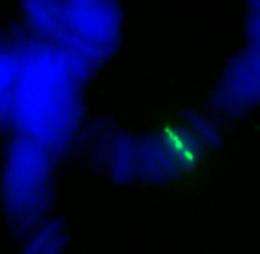
Scientists at Albert Einstein College of Medicine of Yeshiva University have found that a class of chromatin proteins is crucial for maintaining the structure and function of chromosomes and the normal development of eukaryotic organisms. The research, reported in today's print issue of Genes and Development, also found that this protein class, known as linker histones, works to regulate gene expression in vivo.
H1 is one of the five histones - proteins that help to "package" the DNA within chromosomes. All organisms whose cells contain a nucleus - from yeast to humans - have histones in their nuclei. Interest in histones has deepened over the past decade, especially since a growing number of reports indicate that cancer cells often contain unusual patterns of histone modifications.
A chromosome's combination of histone proteins and DNA is referred to as chromatin. Four of the five histones called core histones form protein "spools" around which DNA is tightly wound into a nucleosome; H1 is called a "linker" histone because it binds the DNA between nucleosomes. H1 is thought to help in organizing and compacting the DNA in chromosomes, but questions persist about its actual role.
In previous studies, co-corresponding author Arthur I. Skoultchi, Ph.D., chair and Resnick Professor of Cell Biology at Einstein, showed that H1 is important to an organism's normal development by observing the effects of partially reducing H1 levels in mice. In this study, to assess H1's role in more detail, Dr. Skoultchi and his colleagues looked at what happened in fruit fly larvae when H1 protein within their nuclei was reduced to only 5 percent of normal levels.
The researchers found that H1 is necessary for holding together pericentric heterochromatin, the chromatin region close to the center of each chromosome. In cells in which H1 was depleted, heterochromatin was much more diffuse than normal. In addition, H1 was also found to be important for regulating the expression of those genes that reside in the heterochromatin region of chromosomes.
"We are especially excited about the system we've developed for studying H1 in fruit flies, because it allows us to closely examine H1's role in gene regulation," says Dr. Skoultchi.
More information: The paper, "Linker Histone H1 Is Essential for Drosophila Development, the Establishment of Pericentric Heterochromatin and a Normal Polytene Chromosome Structure," appeared in Genes in Development advanced online section on February 9, 2009 and in the February 15, 2009 print issue: www.genesdev.cshlp.org
Source: Albert Einstein College of Medicine


