ESA extends key missions studying Mars, Venus and Earth’s magnetosphere
February 10, 2009

Mars Express

Enlarge

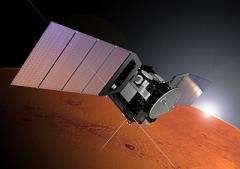
Artist's impression of Mars Express. Credits: Alex Lutkus

ESA’s Science Programme Committee has extended the operations of ESA’s Mars Express, Venus Express and Cluster missions until 31 December 2009.

The decision to extend the three successful missions was taken on 4 February this year.

Mars Express — global view of the Red Planet

Mars Express, launched in June 2003, has been orbiting the Red Planet since the end of 2003, and has produced a treasure of discoveries.

The first European mission to Mars, it has taken breathtaking, high-resolution images of the surface in 3D and in colour. The spacecraft carries the first radar instrument ever flown to Mars which has returned pioneering sub-surface sounding measurements that show underground water-ice deposits.

Mars Express has provided the first sub-surface sounding measurements thanks to the first radar instrument ever flown to Mars, and discovered underground water-ice deposits.

It has beamed back mineralogical evidence for the presence of liquid water throughout martian history and studied the density of the Martian crust in detail. It was also the first spacecraft to detect methane in the planet’s atmosphere from orbit.

The spacecraft pioneered the detection of aurorae at mid latitudes, provided estimates on the rate at which Mars’ atmosphere escapes into space, and studied the Martian moon Phobos at close quarters.

The mission has been extended twice in the past, the second extension lasting until May 2009. This third extension will make it possible to continue with the mission’s extensive study of the Red Planet which includes, amongst others: the study of its subsurface, the observation of the upper atmospheric layers under varying solar conditions, observation of methane in the atmosphere, and high resolution mapping of its surface.

Venus Express — lifting the veil on Venus

Venus Express was launched in November 2005 and reached Venus in April 2006, initiating the most comprehensive investigation of Earth’s sister planet to date. Its mission was extended once to last until May 2009.

Since it reached Venus in April 2006, Venus Express has been mapping Venus’s noxious and thick atmosphere globally and in 3D for the first time. With the data, scientists have put together extensive meteorological maps of Venus, providing measurements of wind fields and temperatures and the chemical composition of the atmosphere.

The spacecraft has revealed astonishing details of the planet’s dynamic cloud system, including its striking double-eyed atmospheric vortex that dominates the south pole.

Venus Express has also detected water molecules escaping into space, found concrete evidence for lightning in the venusian atmosphere, and provided infrared glimpses of the hot surface.

The new extension will provide, among other objectives, an improved understanding of how Venus’ climate works, and scientists will continue the search for suspected active volcanism on the surface.

Cluster — the Sun-Earth connection in focus

The Cluster constellation was launched in summer 2000 and started operating in early 2001. Since then, this four-satellite mission is performing the first and best ever stereo investigation of the Earth’s magnetosphere — the magnetic bubble surrounding our planet.

Thanks to Cluster, scientists have reached an unprecedented understanding of the way solar activity affects the near-Earth environment.

Cluster has provided the first 3D observation of magnetic reconnection in space — a phenomenon that reconfigures the magnetic field and releases high amounts of energy.

Cluster pioneered measurements of electric currents in space, revealed the nature of black aurorae, and discovered that plasma — a gas of charged particles surrounding Earth — makes ‘waves’.

The Cluster mission has been extended twice in the past, up to June 2009. The new extension will make it possible to study the auroral regions above Earth’s poles and widen the investigations of the magnetosphere — its inner region in particular.

Provided by ESA


Rank 4 /5 (2 votes)
Relevant PhysicsForums posts
  • Distance of planets from stars and revolution
    created9 hours ago
  • revamping general concept and cosmological principle
    createdMay 25, 2012
  • Transiting Exoplanet Light Curve
    createdMay 25, 2012
  • Math behind Theoretical Physics
    createdMay 24, 2012
  • Do we know whats at the center of galaxies yet?
    createdMay 23, 2012
  • Structure of the Milky Way?
    createdMay 20, 2012
  • More from Physics Forums - General Astronomy

More news stories

Land and sea species differ in climate change response: study

(Phys.org) -- Marine and terrestrial species will likely differ in their responses to climate warming, new research by Simon Fraser University and Australia’s University of Tasmania has found.

Space & Earth / Environment

created 7 hours ago | popularity 3.8 / 5 (4) | comments 5 | with audio podcast

Yale study concludes public apathy over climate change unrelated to science literacy

Are members of the public divided about climate change because they don't understand the science behind it? If Americans knew more basic science and were more proficient in technical reasoning, would public consensus match ...

Space & Earth / Environment

created 9 hours ago | popularity 4.8 / 5 (5) | comments 20 | with audio podcast

10 million years needed to recover from mass extinction

It took some 10 million years for Earth to recover from the greatest mass extinction of all time, latest research has revealed.

Space & Earth / Earth Sciences

created 9 hours ago | popularity 4 / 5 (4) | comments 1 | with audio podcast

Sophisticated simulations predict future warming

The chances of our planet being hit by a global warming of 3 degrees Celsius by 2050 is as likely as it being hit by an increase of 1.4 degrees, new research shows. Presented in the journal Nature Geoscience, the British study ...

Space & Earth / Earth Sciences

created May 22, 2012 | popularity 3.8 / 5 (11) | comments 51

Aliens don't want to eat us, says former SETI director

Alien life probably isn’t interested in having us for dinner, enslaving us or laying eggs in our bellies, according to a recent statement by former SETI director Jill Tarter.

Space & Earth / Space Exploration

created May 25, 2012 | popularity 4.4 / 5 (15) | comments 41


Stunning image of smallest possible five-ringed structure

Scientists have created and imaged the smallest possible five-ringed structure – about 100,000 times thinner than a human hair – and you'll probably recognise its shape.

'Unzipped' carbon nanotubes could help energize fuel cells, batteries

Multi-walled carbon nanotubes riddled with defects and impurities on the outside could replace some of the expensive platinum catalysts used in fuel cells and metal-air batteries, according to scientists at ...

Change in developmental timing was crucial in the evolutionary shift from dinosaurs to birds: study

At first glance, it's hard to see how a common house sparrow and a Tyrannosaurus Rex might have anything in common. After all, one is a bird that weighs less than an ounce, and the other is a dinosaur that ...

Computer model used to pinpoint prime materials for efficient carbon capture

When power plants begin capturing their carbon emissions to reduce greenhouse gases – and to most in the electric power industry, it's a question of when, not if – it will be an expensive undertaking.

T cells 'hunt' parasites like animal predators seek prey, study shows

By pairing an intimate knowledge of immune-system function with a deep understanding of statistical physics, a cross-disciplinary team at the University of Pennsylvania has arrived at a surprising finding: T cells use a movement ...

Scientists develop ultra-sensitive test that detects diseases in their earliest stages

Scientists have developed an ultra-sensitive test that should enable them to detect signs of a disease in its earliest stages, in research published today in the journal Nature Materials.