Carbon Nanotubes Make Fuel Cells Cheaper
Feb 09, 2009 by Lisa Zyga weblog
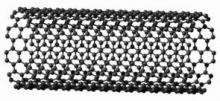
Researchers from the University of Dayton have showed that carbon nanotubes can replace platinum as the catalyst in fuel cells, which could significantly reduce fuel cells' overall cost.

(PhysOrg.com) -- As fuel cells are becoming more popular due to their potential use in applications such as hydrogen-powered vehicles, auxiliary power systems, and electronic devices, the need for the precious metal platinum is also increasing. In fuel cells, platinum is often used as the catalyst for oxygen reduction by splitting oxygen molecules into oxygen ions. However, platinum is rare and expensive: in a fuel cell for a typical car, the platinum catalyst costs about $4,000.

Now, researchers from the University of Dayton have showed that carbon nanotubes can replace platinum as the catalyst in fuel cells, which could significantly reduce fuel cells' overall cost. Carbon nanotubes could even have advantages over platinum, since they could be less resistant to corrosion.

The Dayton researchers, led by Liming Dai, doped an array of nanotubes with nitrogen (VA-NCNTs) to prevent the carbon from reacting with oxygen and forming carbon monoxide (CO). Without the nitrogen, CO would build up on the surface and shorten the catalyst's lifetime. With the nitrogen, the nanotubes are more resistant to this carbon monoxide corrosion and have the potential for long-term operation.

The researchers have not built a complete prototype of a fuel cell with nitrogen-containing carbon nanotubes, and they have not estimated the cost to produce them. However, since carbon is abundant and cheap compared with platinum, the overall cost of the proposed design would likely be much less expensive. Hopefully, the metal-free catalyst will assist researchers in moving fuel cell technology forward.

More information: Kuanping Gong et al. (2009) "Nitrogen-Doped Carbon Nanotube Arrays with High Electrocatalytic Activity for Oxygen Reduction." Science Vol. 323. no. 5915, p. 753 doi: 10.1126/science.1166510.

via: Ecogeek

© 2009 PhysOrg.com

Explore further: Hybrid material as gold-leaf substitute

add to favorites email to friend print save as pdf

Related Stories

Snowden's life surrounded by spycraft

4 hours ago

In the suburbs edged by woods midway between Baltimore and the U.S. capital, residents long joked that the government spy shop next door was so ultra-secretive its initials stood for "No Such Agency." But ...

Winners and losers at this week's E3

5 hours ago

Since the first battles over "Pong" machines in local arcades four decades ago, video gamers have loved good competition. And this year's Electronic Entertainment Expo—the industry's largest annual gathering—presented ...

Europe's space truck docks with ISS

5 hours ago

A robot freighter bearing 6.6 tonnes of cargo docked with the International Space Station (ISS) on Saturday, the European Space Agency (ESA) said.

Secret to Prism program: Even bigger data seizure

5 hours ago

In the months and early years after the Sept. 11, 2001, terrorist attacks, FBI agents began showing up at Microsoft Corp. more frequently than before, armed with court orders demanding information on customers.

Recommended for you

Hybrid material as gold-leaf substitute

Jun 18, 2013

(Phys.org) —A team of researchers headed by Professor Raffaele Mezzenga has created a hybrid material out of gold and milk proteins that looks like a wafer-thin gold leaf. Thanks to its properties, it could ...

Antioxidant with a long shelf life

Jun 17, 2013

(Phys.org) —Scientists from ETH Zurich have developed a nanomaterial that protects other molecules from oxidation. Unlike many such active substances in the past, the ETH-Zurich researchers' antioxidant ...

Fast pollutant degradation by nanosheets

Jun 17, 2013

(Phys.org) —Waste from textile and paint industries often contains organic dyes such as methylene blue as pollutants. Photocatalysis is an efficient means of reducing such pollution, and molybdenum trioxide ...

Unzipped nanotubes unlock potential for batteries

Jun 13, 2013

(Phys.org) —Researchers at Rice University have come up with a new way to boost the efficiency of the ubiquitous lithium ion (LI) battery by employing ribbons of graphene that start as carbon nanotubes.

Nanoparticle opens the door to clean-energy alternatives

Jun 13, 2013

(Phys.org) —Cheaper clean-energy technologies could be made possible thanks to a new discovery. Research team members led by Raymond Schaak, a professor of chemistry at Penn State University, have found ...

User comments : 2

Adjust slider to filter visible comments by rank

Display comments: newest first

moj85
1 / 5 (1) Feb 09, 2009
Post the article once a prototype has been made. *yawn*
Nerdle
not rated yet May 12, 2009
Agreed. Also yes carbon is all around us, but carbon nanotubes are not cheap to make

More news stories

Sound waves precisely position nanowires

(Phys.org) —The smaller components become, the more difficult it is to create patterns in an economical and reproducible way, according to an interdisciplinary team of Penn State researchers who, using ...

Hybrid nanostructures: Getting to the core

Material scientists expect the new multifunctional properties of hybrid nanostructures will transform the development of high-performance devices, including batteries, high-sensitivity sensors and solar cells. ...

LA to give every student an iPad; $30M order

Los Angeles' school system, the second largest in the United States, is ordering iPads for all its students, handing Apple a major success in its quest to make the tablet computer a replacement for textbooks.