Ice storm tree damage offers chance to detect emerald ash borer
Jan 29, 2009 By Jennifer Stewart
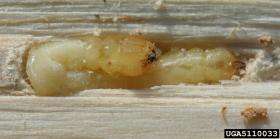
Emerald ash borer overwinters about half an inch below the bark of ash trees. In its larval stage, the insect has a creamy white, flat, segmented body. (Michigan State University photo/Dave Cappert)

(PhysOrg.com) -- Wood debris from January ice storms in Southern Indiana and Kentucky provides an opportunity for emerald ash borer detection, said one Purdue University expert.

"The silver lining in these ice storms is that homeowners and city foresters can use fallen limbs as an early detection tool for EAB," said Purdue entomologist Cliff Sadof. "When cleaning up debris, people should look closely for woodpecker damage or D-shaped exit holes in the bark. If these signs are found, the debris should be inspected for overwintering larval-stage emerald ash borers about half an inch beneath the bark's surface."


In its larval stage, emerald ash borer has a creamy white, flattened, segmented body. They can grow up to an inch in length.

"Early detection is extremely important because it gives city foresters a chance to reduce the number of ash trees destroyed by the insect through infested tree removal and insecticide treatments," Sadof said. "It also gives replacement trees a chance to grow before EAB depletes the ash population."

If signs of emerald ash borer are found in Indiana, it should be reported to the Indiana Department of Natural Resources by calling (866) NO EXOTIC (663-9684). In Kentucky, finds should be reported to the state entomologist's office at (859) 257-5838.

In addition to inspecting for signs of emerald ash borer in wood debris, it's also important that the material is disposed of properly.

Indiana's quarantine does not permit ash wood from infested counties to cross county lines. A federal quarantine also prohibits regulated ash products from leaving the state. Quarantine violations can result in large fines.

More information about emerald ash borer detection and quarantines is available online at www.entm.purdue.edu/EAB/ or by contacting Sadof at (765) 494-5983, csadof[at]purdue.edu.

Provided by Purdue University

Explore further: Researchers identify new target to boost plant resistance to insects and pathogens

add to favorites email to friend print save as pdf

Related Stories

Cornell leads fight against invasive emerald ash borer

Sep 02, 2010

Cornell University is leading efforts to manage outbreak populations of the emerald ash borer (EAB), a beetle that has the potential to devastate ash trees in the Northeast. The new invasive species is already ...

Decoys could blunt spread of ash-killing beetles

Feb 15, 2013

As the emerald ash borer ravages North American ash trees, threatening the trees' very survival, a team of entomologists and engineers may have found a way to prevent the spread of the pests.

Tree and human health may be linked

Jan 16, 2013

Evidence is increasing from multiple scientific fields that exposure to the natural environment can improve human health. In a new study by the U.S. Forest Service, the presence of trees was associated with human health.

Recommended for you

EU bans three pesticides harmful to bees

3 hours ago

The European Commission said Friday that it will ban for two years beginning in December pesticides blamed for killing the bees that pollinate food and fruit crops.

Studying the Noble King Mackerel

3 hours ago

They are sometimes called "smokers," due to the speed at which a fishing line zips out the reel and "smokes" after they hit on the bait.

Scientists take a new look at an ancient crop

4 hours ago

Though the price makes you wince, you might just buy that bottle of your favorite olive oil anyway. Perhaps it's exactly what you want for the salad dressing you're making tonight and for your special stir-fry ...

User comments : 0

More news stories

EU bans three pesticides harmful to bees

The European Commission said Friday that it will ban for two years beginning in December pesticides blamed for killing the bees that pollinate food and fruit crops.