'Core-Shell' Silicon Nanowires May Improve Lithium-Ion Batteries
Jan 20, 2009 By Laura Mgrdichian feature
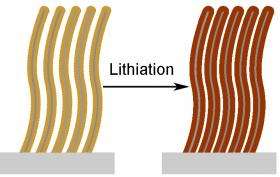
A schematic of the silicon core-shell nanowires, showing how they increase in volume before lithium ions are inserted (left) and after. Figure courtesy Yi Cui.

(PhysOrg.com) -- Researchers have found a way to incorporate silicon into the structure of rechargeable lithium-ion batteries, which are used to power a wide variety of portable electronic devices, including digital cameras and cell phones. The group's method, using a nanowire form of silicon, overcomes the roadblocks that have prevented the use of silicon and may help extend the batteries' lifetimes.

Lithium ion batteries work are based on the movement of lithium ions between two battery terminals, the anode and cathode. The ions are stored in the anode, nestled between the layers of the anode material, which is often graphite. When they discharge, the ions move to the cathode.

One advantage of a graphite anode is the small volume change that occurs when the ions enter it. Additionally, existing lithium-ion batteries do boast fast ion movement rate between the terminals. But, despite their success, the batteries have a limited charge storage capacity and are not expected to be able to meet the needs of new technologies, which demand higher charge storage and longer battery life.

Silicon has been eyed as a material that can allow researchers to overcome challenges, but there have been problems making it work. Silicon expands too much during ion insertion, for example, and bulk silicon breaks and loses capacity too quickly.

Researchers from Stanford University seem to have overcome these issues using a nanostructured form of silicon. As described in the December 23, 2008, online edition of Nano Letters, they created silicon nanowires with a "core-shell" structure, consisting of a center solid wire surrounded by a cylindrical shell, similar to a coaxial cable. The core is crystalline while the shell has a disordered, or "amorphous," structure. This works builds upon a result they published in January 2008 in Nature Nanotechnology, where they reported using a single-crystal nanowire to achieve a charge storage capacity ten times that of carbon.

"The crystalline and amorphous components have separate qualities that make the overall wires successful as a battery anode material," said the study's corresponding researcher Yi Cui, a materials scientist at Stanford, to PhysOrg.com. "We thought it might be possible to use the amorphous shell to store the ions, while the core would provide mechanical support and an efficient electron conduction pathway."

Both crystalline and amorphous silicon can store lithium ions similarly well, but amorphous silicon seems to perform better over many cycles. It also reacts with lithium at a higher electric potential, a convenient way of making ion storage the exclusive job of the amorphous shell. If the potential is maintained at the higher level, lithium ions cannot be stored in the core.

Core-shell silicon nanowires have been incorporated into other technologies, such as solar cells, but not before in batteries. Cui and his colleagues found that the amorphous shell does expand when limiting the charging potential, but not significantly. And the wires have a high charge-storage capacity—about three times that of carbon—and retain the capacity at the 90% level over 100 charge-discharge cycles. The core-shell nanowire design enables a very fast cycle, about seven minutes, and can provide a very large amount of power.

Citations:

1. Nano Lett., Article ASAP DOI:10.1021/nl8036323
2. Nature Nanotechnology, 2008, vol 3, p 31, DOI:10.1038/nnano.2007.411

Copyright 2007 PhysOrg.com.
All rights reserved. This material may not be published, broadcast, rewritten or redistributed in whole or part without the express written permission of PhysOrg.com.

Explore further: 3D printing tiny batteries

add to favorites email to friend print save as pdf

Related Stories

Beyond NYC: Other places adapting to climate, too

5 hours ago

From Bangkok to Miami, cities and coastal areas across the globe are already building or planning defenses to protect millions of people and key infrastructure from more powerful storm surges and other effects ...

China paper hits out at US surveillance programme

5 hours ago

China's official army newspaper on Sunday branded the United States Internet surveillance programme exposed by former spy Edward Snowden as "frightening", and accused the US of being a "habitual offender" ...

German spy service plans 'more online surveillance'

5 hours ago

Germany's foreign intelligence service plans a major expansion of Internet surveillance despite deep unease over revelations of US online spying, Der Spiegel news weekly reported on Sunday.

Recommended for you

An environmentally friendly battery made from wood

29 minutes ago

Taking inspiration from trees, scientists have developed a battery made from a sliver of wood coated with tin that shows promise for becoming a tiny, long-lasting, efficient and environmentally friendly energy ...

Sound waves precisely position nanowires

41 minutes ago

(Phys.org) —The smaller components become, the more difficult it is to create patterns in an economical and reproducible way, according to an interdisciplinary team of Penn State researchers who, using ...

Hybrid nanostructures: Getting to the core

2 hours ago

Material scientists expect the new multifunctional properties of hybrid nanostructures will transform the development of high-performance devices, including batteries, high-sensitivity sensors and solar cells. ...

3D printing tiny batteries

20 hours ago

(Phys.org) —3D printing can now be used to print lithium-ion microbatteries the size of a grain of sand. The printed microbatteries could supply electricity to tiny devices in fields from medicine to communications, ...

World's most powerful microscope ready for research

Jun 18, 2013

(Phys.org) —The world's most powerful microscope, which resides in a specially constructed room at the University of Victoria, has now been fully assembled and tested, and has a lineup of scientists and businesses eager ...

User comments : 9

Adjust slider to filter visible comments by rank

Display comments: newest first

joefarah
3.7 / 5 (3) Jan 20, 2009
No question, this is significant. But compare it to the Altair Nanotechnology battery technology and, at least technically, it doesn't measure up. Altair's batter technology can be recycled 1000's of times while maintaining very hi recharge capacity, and can be charged rapidly. It is extremely safe technology as well.
SongDog
not rated yet Jan 20, 2009
If it's going to be usable for cars, it'll need to handle at least one deep cycle per day for a decade.
vladik
not rated yet Jan 20, 2009
"for a decade"
I'd agree for 3-4 years, then change it for a reasonable price.
NeilFarbstein
not rated yet Jan 20, 2009
What's the big deal? Their first silicon nanowire batteries hold ten times the charge of graphite electrodes now these electrodes hold three times charge.
dirk_bruere
not rated yet Jan 20, 2009
Isn't this the third time its been reported in less than a year???
Soylent
5 / 5 (1) Jan 20, 2009
Their first silicon nanowire batteries hold ten times the charge of graphite electrodes now these electrodes hold three times charge.


It's easy to optimize one aspect of a battery; it's very difficult to optimize power output, energy density, durability, cost/kWh and safety all at once.
Merkk
not rated yet Jan 21, 2009
Anyone else hungry for bacon after looking at the picture?

It does seem to be fairly promising, but the real test will be how much more are batteries going to cost and will the public spring for the extra $ just for an extra hour of charge in Timmy's RC car.
Duude
1 / 5 (1) Jan 21, 2009
I remember reading about this 6 months ago and feeling a little excited at the time. I find this follow up article missing mention of the most important feature of this research which was that battery capacity is supposedly in the neighborhood of 10 times current lithium ion capacity. It was also later reported that they didn't see it yet functional for automobiles for some unexplained reason. Today's regurgitation is surely just a first stab at federal funding from the new administration and nothing more.
GlenM
not rated yet Jan 26, 2009
IIRC the first iteration of Cui's silicon nanowire electrode degraded quickly. Maybe this version trades capacity for cycles.

More news stories

Sound waves precisely position nanowires

(Phys.org) —The smaller components become, the more difficult it is to create patterns in an economical and reproducible way, according to an interdisciplinary team of Penn State researchers who, using ...

An environmentally friendly battery made from wood

Taking inspiration from trees, scientists have developed a battery made from a sliver of wood coated with tin that shows promise for becoming a tiny, long-lasting, efficient and environmentally friendly energy ...

3D printing tiny batteries

(Phys.org) —3D printing can now be used to print lithium-ion microbatteries the size of a grain of sand. The printed microbatteries could supply electricity to tiny devices in fields from medicine to communications, ...

Hybrid nanostructures: Getting to the core

Material scientists expect the new multifunctional properties of hybrid nanostructures will transform the development of high-performance devices, including batteries, high-sensitivity sensors and solar cells. ...

Pearly perfection

The mystery of how pearls form into the most perfectly spherical large objects in nature may have an unlikely explanation, scientists are proposing in a new study. It appears in ACS' journal Langmuir, named ...