Plant life not a villain in methane emissions debate
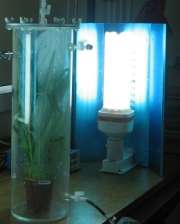
(PhysOrg.com) -- A comprehensive investigation of plant emissions led by University of South Australia molecular biologist Dr Ellen Nisbet has put pay to the assertion that plants are producing and releasing large quantities of methane into the environment.
Dr Nisbet’s project was sparked by an article in Nature magazine in 2006 that asserted plants were responsible for up to 45 per cent of the methane produced in the world’s atmosphere.
“At a time when people are so concerned about the environment and the problem of global warming, any assertion that plants could be responsible for an increase in methane was really alarming,” Dr Nesbit said.
“I’m the daughter of an atmospheric chemist and am a molecular biologist myself, so my first thought was that it was very strange. So, I got together a group of colleagues to investigate.”
With fellow researchers from Cambridge University, the Universities of London, Stockholm, Oxford and Bristol the team set up a range of experiments to clear the record for plants.
What the researchers found was that plants were only ever a passive transmitter of the methane present in other places - for example methane in water, soaked into the soil, could be taken up by a plant and released - but the methane was not produced by the plant. In fact it is soil based bacteria that manufacture methane.
“Publication of these study results is extremely important because the last thing we need is for people to believe they have any justification for harming the planet,” Dr Nisbet said.
“Of particular concern in the Keppler, Hamilton, Brass and Röckmann paper published in Nature was the inference that invaluable areas of tropical rainforest were emitting big amounts of methane that could be tracked using satellite imagery.
“Our team looked at this in light of improved procedures for obtaining methane concentrations from satellite data, and found that clouds were a potential source of bias in the original study. So it seems very unlikely that tropical rainforests are producing vast amounts of methane.”
The results of the study, Emission of Methane from Plants, were published in Transactions of the Royal Society this week.
Dr Nisbet says she hopes the new research will get wide coverage and help play a role in rebuilding plants’ reputation.
“Forests are immensely precious and growing plants remove enormous amounts of carbon dioxide from the atmosphere each day through photosynthesis - carbon dioxide that would otherwise be causing global warming,” she said.
“Plants are a life source fundamental to our ongoing well being.”
Provided by University of South Australia


