Primary-care physicians can fill gap in colorectal cancer screening
Jan 12, 2009
Primary-care physicians can fill gap in colorectal cancer screening
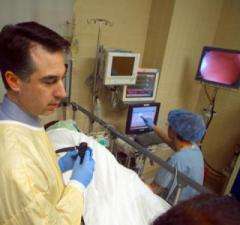
The number of people who need colonoscopies to screen for colorectal cancer is outpacing the number of endoscopists available to perform them, Medical College of Georgia researchers say. But properly trained primary care physicians -- internists, family medicine physicians, obstetricians and gynecologists and general practitioners -- can perform the test as safely and effectively as endoscopists, according to a study published in the Jan. 12 issue of the Annals of Family Medicine Credit: Phil Jones, Medical College of Georgia campus photographer

The number of people who need colonoscopies to screen for colorectal cancer is outpacing the number of endoscopists available to perform them, Medical College of Georgia researchers say.

A booming aging population has increased the number of people over 50, the age when the American Cancer Society recommends beginning regular screening for colorectal cancer, the third most common and second most fatal cancer in the United States.

"The key to changing that is catching the disease early through screening," says Dr. Thad Wilkins, a family medicine physician in the MCG School of Medicine. "With slightly more than 12,000 board-certified gastroenterologists, who perform endoscopy procedures like colonoscopies, the capacity for a national screening program is limited. Resources to screen every eligible person for colorectal cancer do not currently exist in the U.S. medical system and, as a result, less than one-third of those who are eligible for colonoscopies are screened."

Properly trained primary care physicians - internists, family medicine physicians, obstetricians and gynecologists and general practitioners - can perform the test as safely and effectively as endoscopists, according to a study published in the January 12 issue of the Annals of Family Medicine.

Dr. Wilkins and colleagues from the University of Virginia Health System and Lexington Medical Center in Lexington, S.C., analyzed 12 studies of 18,292 patients who had colonoscopies performed by a "trained and competent" primary care physician. To determine whether the tests were performed safely and effectively, they looked at the number of complications, such as tears caused by the scope and bleeding problems; the completeness of the test, as measured by whether the physician reached the cecum, or end of the colon; and the polyp and cancer detection rates. Polyps are extra tissue inside the colon that can potentially indicate or turn into cancer.

"In our study we found a very low complication rate - only three cases of perforation and four cases of bleeding complications," he added. The analysis also reflected a nearly 90 percent reach-the-cecum rate, and a polyp-detection rate of nearly 29 percent.

"Each of these outcomes are comparable to published results by other specialists," Dr. Wilkins says. "The take-home point is that colonoscopies performed by trained and competent primary care physicians can be just as safe and effective as those performed by other endoscopists."

The U.S. Preventive Services Task Force and other recognized groups have recommended colonoscopies as a suitable and, perhaps, the most cost-effective screening methods for colorectal cancers.

"Therefore the demand for colonoscopy will continue to grow," Dr. Wilkins says. "Primary care physicians can help meet that demand."

Source: Medical College of Georgia

Explore further: Survey points out deficiencies in addictions training for medical residents

add to favorites email to friend print save as pdf

Related Stories

Innovative Web-based tool helps doctors improve care

Oct 02, 2010

A Web-based tool that extracts information from the electronic medical record (EMR) helps primary care physicians improve care and manage their entire panel of patients. Those are the findings of two new Kaiser Permanente ...

Preventive cancer surgeries save women's lives

Aug 31, 2010

A new study underscores the importance for women with a family history of breast or ovarian cancer to get genetic counseling and testing for the BRCA1 and BRCA2 genes that make them more likely to develop lethal breast or ...

Functional genomics gets tiny

May 17, 2012

A little more than a decade ago, researchers discovered an ancient mechanism that cells use to silence genes. Like a dimmer switch turning down a light, RNA interference (RNAi) dials down gene activity in ...

States stop circumcisions funds amid budget crisis

Jun 24, 2011

(AP) -- A nationwide debate about circumcisions for newborn boys, combined with cash-strapped public health budgets, has Colorado taking sides with 17 other states that no longer fund Medicaid coverage of ...

Recommended for you

People on higher incomes are happier with new knees

May 21, 2013

Knee replacement surgery is a very common procedure. However, it does not always resolve function or pain in all the recipients of new knees. A study by Robert Barrack, MD and his colleagues from the Washington University ...

New search engine finds rare diagnoses

May 21, 2013

Doctors are trained to think "common disease" when they meet patients in their practices, and as they rarely or never meet a rare disease, it often takes many years to reach the right diagnosis. A new search tool called FindZebra ...

User comments : 0

More news stories

Brain can be trained in compassion, study shows

Until now, little was scientifically known about the human potential to cultivate compassion—the emotional state of caring for people who are suffering in a way that motivates altruistic behavior.

Theorists weigh in on where to hunt dark matter

(Phys.org) —Now that it looks like the hunt for the Higgs boson is over, particles of dark matter are at the top of the physics "Most Wanted" list. Dozens of experiments have been searching for them, but ...