Study: Facial expressions of emotion are innate, not learned
Dec 29, 2008
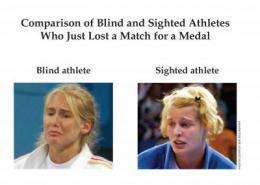
Photos show comparison of facial expressions by blind and sighted athletes who just lost a match for a medal. Image: Bob Willingham

Facial expressions of emotion are hardwired into our genes, according to a study published today in the Journal of Personality and Social Psychology. The research suggests that facial expressions of emotion are innate rather than a product of cultural learning. The study is the first of its kind to demonstrate that sighted and blind individuals use the same facial expressions, producing the same facial muscle movements in response to specific emotional stimuli.

The study also provides new insight into how humans manage emotional displays according to social context, suggesting that the ability to regulate emotional expressions is not learned through observation.

San Francisco State University Psychology Professor David Matsumoto compared the facial expressions of sighted and blind judo athletes at the 2004 Summer Olympics and Paralympic Games. More than 4,800 photographs were captured and analyzed, including images of athletes from 23 countries.

"The statistical correlation between the facial expressions of sighted and blind individuals was almost perfect," Matsumoto said. "This suggests something genetically resident within us is the source of facial expressions of emotion."

Matsumoto found that sighted and blind individuals manage their expressions of emotion in the same way according to social context. For example, because of the social nature of the Olympic medal ceremonies, 85 percent of silver medalists who lost their medal matches produced "social smiles" during the ceremony. Social smiles use only the mouth muscles whereas true smiles, known as Duchenne smiles, cause the eyes to twinkle and narrow and the cheeks to rise.

"Losers pushed their lower lip up as if to control the emotion on their face and many produced social smiles," Matsumoto said. "Individuals blind from birth could not have learned to control their emotions in this way through visual learning so there must be another mechanism. It could be that our emotions, and the systems to regulate them, are vestiges of our evolutionary ancestry. It's possible that in response to negative emotions, humans have developed a system that closes the mouth so that they are prevented from yelling, biting or throwing insults."

Paper: "Spontaneous Facial Expressions of Emotion in Congenitally and Non-Congenitally Blind Individuals" will be published in the January issue of The Journal of Personality and Social Psychology, Vol. 96, No.1.

Source: San Francisco State University

Explore further: SimuCase avatars advance speech-language pathology training

add to favorites email to friend print save as pdf

Related Stories

Snowden's life surrounded by spycraft

5 hours ago

In the suburbs edged by woods midway between Baltimore and the U.S. capital, residents long joked that the government spy shop next door was so ultra-secretive its initials stood for "No Such Agency." But ...

Winners and losers at this week's E3

5 hours ago

Since the first battles over "Pong" machines in local arcades four decades ago, video gamers have loved good competition. And this year's Electronic Entertainment Expo—the industry's largest annual gathering—presented ...

Europe's space truck docks with ISS

6 hours ago

A robot freighter bearing 6.6 tonnes of cargo docked with the International Space Station (ISS) on Saturday, the European Space Agency (ESA) said.

Secret to Prism program: Even bigger data seizure

6 hours ago

In the months and early years after the Sept. 11, 2001, terrorist attacks, FBI agents began showing up at Microsoft Corp. more frequently than before, armed with court orders demanding information on customers.

Recommended for you

SimuCase avatars advance speech-language pathology training

2 hours ago

A new commercial venture, using technology developed at Case Western Reserve University's College of Arts and Sciences and Case School of Engineering, has made available avatars—virtual patients—to train speech-language ...

Medical assessment in the blink of an eye

Jun 17, 2013

Have you ever thought that you knew something about the world in the blink of an eye? This restaurant is not the right place for dinner. That person could be The One. It turns out that radiologists can do this with mammograms, ...

User comments : 4

Adjust slider to filter visible comments by rank

Display comments: newest first

Bob_Kob
5 / 5 (3) Dec 29, 2008
Next obvious study: Pain hurts!
Egnite
not rated yet Dec 29, 2008
http://www.naturalnews.com/

Any other interesting non-political sites out there?
gmurphy
5 / 5 (1) Dec 29, 2008
dum de dum de dum. ok, this is the first study to show this (obvious) finding with respect to blind people. This have been known for a long time previously though and the article suffers from not mentioning this.
x646d63
not rated yet Dec 29, 2008
Another one for the "duh" file.

More news stories

3D printing tiny batteries

(Phys.org) —3D printing can now be used to print lithium-ion microbatteries the size of a grain of sand. The printed microbatteries could supply electricity to tiny devices in fields from medicine to communications, ...