Reduction in antibody gene rearrangement in B cells related to type 1 diabetes, lupus
December 23, 2008

Reduction in antibody gene rearrangement in B cells related to type 1 diabetes, lupus

Enlarge

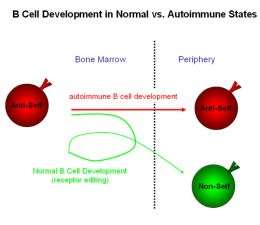
When B cells produce antibodies, self-binding or anti-self antibodies are often formed (red-colored cells). Such anti-self cells must be eliminated, either by cell death or by revising the specificity of the antibody through a process called receptor editing. When successful, receptor editing produces a B cell that is non-self binding (green-colored cell). The Penn study documented lower levels of antibody gene rearrangements in B cells from some patients with autoimmune disease, suggesting a defect in this early B-cell tolerance checkpoint. Credit: Nina Luning Prak, M.D., Ph.D, Univeristy of Pennsylvania School of Medicine

(PhysOrg.com) -- More drafts usually mean a better product and so it also seems to go with the human immune system. As B cells develop, genes rearrange to allow antibodies to recognize different foreign invaders or pathogens. But sometimes antibodies are created that recognize and attack the body's own cells. These self-reactive antibodies, like early drafts of a manuscript, must be edited into versions that won't attack self. This process is called receptor editing and is important for central or early B cell tolerance, which occurs while B cells are still developing in the bone marrow.

A research team led by Nina Luning Prak, M.D., Ph.D, Assistant Professor in the Department of Pathology and Laboratory Medicine at the University of Pennsylvania School of Medicine, has discovered that this editing process may go awry in people with certain types of autoimmune diseases.

Prak and her colleagues, including the study's first author, Penn MD-PhD student Anil Panigrahi, observed that the amount of antibody edits in the development of B cells is related to two types of autoimmune disease, lupus and type 1 diabetes. The findings, which appeared online this month in the Journal of Experimental Medicine, have implications for new tests and more personalized treatments for autoimmune diseases.

The investigators found a lower level of antibody editing in mouse models and in blood samples from lupus and diabetes patients. In the samples from autoimmune patients, 30 percent had low editing levels, a high proportion, but also indicative that not all autoimmunity is caused by errors in editing. A targeted, personalized approach may be necessary to treat these complex diseases, according to the researchers. New assays derived from this study to assess the level of editing may help direct appropriate therapies.

"Right now we have a very crude approach to treating autoimmunity: depleting or inactivating circulating B or T cells wholesale," explains Prak. "Editing errors develop before B cells leave the bone marrow. However, treatments such as B-cell depletion might be less likely to work in patients with editing errors because the self-attacking B cells can be regenerated rapidly as they develop in the bone marrow."

The researchers found a way to look at the editing history of B cells in the human and mouse samples, by monitoring the frequency of a non-functional light chain genetic rearrangement in the B cell antibody, which is termed RS. The investigators surmise that a decrease in RS levels indicates that B cells that react with self can evade editing of their self-reactivity and that defects in editing, in turn, may lead to an increased risk of developing autoimmune disease.

The measurement of RS frequency is independent of antibody specificity and, because it is non-functional and irrevertible, it can be used to monitor the level of antibody gene rearrangement in any B cell population and in any autoimmune disease. The team is now interested in testing if RS frequency is altered in other autoimmune diseases and if a low RS level in an apparently healthy person is predictive of future autoimmunity. The RS assay may also be of use to clinicians who treat patients with established autoimmunity and to researchers who are mapping genes that are associated with different underlying causes of autoimmunity.

In addition to Nina Luning Prak and Anil Panigrahi, Penn co-authors are Noah G. Goodman, Robert A. Eisenberg, Michael R. Rickels, and Ali Naji.

ource: University of Pennsylvania


Rank not rated yet
Tags

Relevant PhysicsForums posts
  • Potential Breakthrough in Seizure Control
    createdMay 26, 2012
  • Popping/Cracked sternum.
    createdMay 25, 2012
  • Which Mental Illness Encompasses This Problem?
    createdMay 25, 2012
  • A question about drug tolerance
    createdMay 23, 2012
  • Poor nutrition leading to overeating?
    createdMay 23, 2012
  • Math and dyslexia?
    createdMay 21, 2012
  • More from Physics Forums - Medical Sciences

More news stories

T cells 'hunt' parasites like animal predators seek prey, study shows

By pairing an intimate knowledge of immune-system function with a deep understanding of statistical physics, a cross-disciplinary team at the University of Pennsylvania has arrived at a surprising finding: T cells use a movement ...

Medicine & Health / Medical research

created 9 hours ago | popularity 5 / 5 (3) | comments 0 | with audio podcast

Same gene that stunts infants' growth also makes them grow too big: research

UCLA geneticists have identified the mutation responsible for IMAGe* syndrome, a rare disorder that stunts infants' growth. The twist? The mutation occurs on the same gene that causes Beckwith-Wiedemann syndrome, which makes ...

Medicine & Health / Genetics

created 9 hours ago | popularity not rated yet | comments 0 | with audio podcast

Almost half of new vets seek disability

(AP) -- America's newest veterans are filing for disability benefits at a historic rate, claiming to be the most medically and mentally troubled generation of former troops the nation has ever seen.

Medicine & Health / Health

created 7 hours ago | popularity not rated yet | comments 0

Color-changing contact lenses to help diabetics (w/ Video)

For the millions of Americans with diabetes, the inconvenient and often painful method of testing blood sugar levels is a way of life. But research and innovative product design by scientists at The University of Akron may ...

Medicine & Health / Diabetes

created May 23, 2012 | popularity 4.4 / 5 (7) | comments 5 | with audio podcast

Missouri opts for untested drug for executions

(AP) -- The same anesthetic that caused the overdose death of pop star Michael Jackson is now the drug of choice for executions in Missouri, causing a stir among critics who question how the state can guarantee ...

Medicine & Health / Medications

created May 24, 2012 | popularity not rated yet | comments 5


Stunning image of smallest possible five-ringed structure

Scientists have created and imaged the smallest possible five-ringed structure – about 100,000 times thinner than a human hair – and you'll probably recognise its shape.

'Unzipped' carbon nanotubes could help energize fuel cells, batteries

Multi-walled carbon nanotubes riddled with defects and impurities on the outside could replace some of the expensive platinum catalysts used in fuel cells and metal-air batteries, according to scientists at ...

Change in developmental timing was crucial in the evolutionary shift from dinosaurs to birds: study

At first glance, it's hard to see how a common house sparrow and a Tyrannosaurus Rex might have anything in common. After all, one is a bird that weighs less than an ounce, and the other is a dinosaur that ...

Computer model used to pinpoint prime materials for efficient carbon capture

When power plants begin capturing their carbon emissions to reduce greenhouse gases – and to most in the electric power industry, it's a question of when, not if – it will be an expensive undertaking.

Land and sea species differ in climate change response: study

(Phys.org) -- Marine and terrestrial species will likely differ in their responses to climate warming, new research by Simon Fraser University and Australia’s University of Tasmania has found.

Yale study concludes public apathy over climate change unrelated to science literacy

Are members of the public divided about climate change because they don't understand the science behind it? If Americans knew more basic science and were more proficient in technical reasoning, would public consensus match ...