Humans and chimps register faces by using similar brain regions
Dec 18, 2008
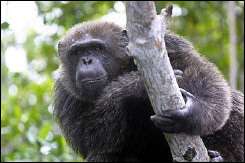
A chimpanzee

Chimpanzees recognize their pals by using some of the same brain regions that switch on when humans register a familiar face, according to a report published online on December 18th in Current Biology, a Cell Press publication. The study—the first to examine brain activity in chimpanzees after they attempt to match fellow chimps' faces—offers new insight into the origin of face recognition in humans, the researchers said.

"We can learn about human origins by studying our closest relatives," said Lisa Parr, a researcher at the Yerkes National Primate Research Center, Emory University. "We can discover what aspects of human cognition are really unique and which are present in other animals."

Earlier studies had shown that chimpanzees, like humans, are adept at recognizing their peers. "We knew [from behavioral studies] that chimps and humans process faces similarly," Parr said. "We wondered whether similar brain regions were responsible, and, for the most part, they seem to be."

In the study, the researchers examined brain activity (as reflected by blood sugar metabolism) in five chimpanzees by using Positron Emission Tomography (PET) scans. (Parr noted that the Yerkes National Primate Research Center is the only center of its kind to have on-site MRI, PET, and cyclotron facilities, making studies like Parr's possible.) The chimps were shown three faces, two of which were identical, while the third was of a different chimp. Subjects were then asked to indicate the faces that matched. In other trials, the chimpanzees did the same matching task with clip art images.

The imaging studies revealed significant face-selective activity in brain regions known to make up the distributed cortical face-processing network in humans. Further study showed distinct patches of activity in a region known as the fusiform gyrus—the primary site of face-selective activity in humans—when chimps observed faces.

The researchers concluded that the brain regions that are active during facial recognition may represent part of a distributed neural system for face processing in chimpanzees, like that proposed in humans, in which the initial visual analysis of faces activates regions in the occipital and temporal lobes of the cerebral cortex (a portion of the brain involved in memory, attention, and perceptual awareness) followed by additional processing in the fusiform gyrus and other regions.

Parr emphasized, however, that there have been decades of research on face processing in the human brain. As the first such study in chimpanzees, the new findings raise more questions than they can answer, and follow-up studies are underway.


Source: Cell Press

Explore further: 100K Pathogen Genome Project maps first genomes

add to favorites email to friend print save as pdf

Related Stories

Recommended for you

100K Pathogen Genome Project maps first genomes

2 minutes ago

(Phys.org) —Striking a blow at foodborne diseases, the 100K Pathogen Genome Project at the University of California, Davis, today announced that it has sequenced the genomes of its first 10 infectious microorganisms, including ...

Getting to the bottom of the zombie ant phenomenon

2 minutes ago

(Phys.org) —While unraveling a dramatic case of mind control, biologist David Hughes is taking calls from Hollywood—and gaining new insights into the role behavior plays in spreading disease.

New DNA cattle test beefs up dairy and meat quality

12 minutes ago

(Phys.org) —A genomics technique developed at Cornell to improve corn can now be used to improve the quality of milk and meat, according to research published online May 17 in the journal PLOS ONE.

Strawberry fields forever and fungus-free

19 minutes ago

(Phys.org) —Strawberries are one of the most economically important berry crops in the world, and a high value export crop for the Australian horticultural industry.For the first time, researchers at The ...

Coral reefs 'ruled by earthquakes and volcanoes'

52 minutes ago

(Phys.org) —Titanic forces in the Earth's crust explain why the abundance and richness of corals varies dramatically across the vast expanse of the Indian and Pacific Oceans, a world-first study from the ...

User comments : 0

More news stories

Coral reefs 'ruled by earthquakes and volcanoes'

(Phys.org) —Titanic forces in the Earth's crust explain why the abundance and richness of corals varies dramatically across the vast expanse of the Indian and Pacific Oceans, a world-first study from the ...

Coccoliths thrive despite ocean acidification

Ocean acidification is damaging some marine species while others thrive, say scientists. An international team studied the effect of ocean acidification on plankton in the North Sea over the past forty years, ...

Strawberry fields forever and fungus-free

(Phys.org) —Strawberries are one of the most economically important berry crops in the world, and a high value export crop for the Australian horticultural industry.For the first time, researchers at The ...

Single-cell sequencing

When studying any kind of population—people or cells—averaging is a useful, if flawed, form of measurement. According to the US Census Bureau, the average American household size in 2010 was 2.59. Of ...

Theorists weigh in on where to hunt dark matter

(Phys.org) —Now that it looks like the hunt for the Higgs boson is over, particles of dark matter are at the top of the physics "Most Wanted" list. Dozens of experiments have been searching for them, but ...