Moon's polar craters could be the place to find lunar ice, scientists report
Dec 18, 2008
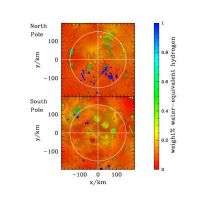
A map showing the north and south polar regions of the moon. The dark blue shaded areas represent the highest concentrations of hydrogen. Credit: Dr. Vincent Eke, Durham University/NASA

Scientists have discovered where they believe would be the best place to find ice on the moon.

Astrophysicists, led by an expert at Durham University, say if frozen water exists then it is most likely to be found near to the moon's poles in craters that are permanently shaded from the sun.

Their findings are based on a new computer analysis of data from the Lunar Prospector, a space probe sent to the moon in 1998 by NASA. The researchers showed that hydrogen on the moon is concentrated into polar craters where temperatures are colder than minus 170 degrees Celsius.

Hydrogen, together with the oxygen that is abundant within moon rock, is a key element in making water.

If ice is present in the craters then the researchers say it could potentially provide a water source for the eventual establishment of a manned base on the moon. A moon base could be used as a platform for exploration into the further reaches of our solar system.

The findings are published in the International Journal of Solar System Studies, Icarus.

They show that if the hydrogen is present as water ice, then the average concentration in some craters corresponds to ten grams of ice in each kilogram of moon rock.

However the researchers say that instead of being water ice, hydrogen may be present in the form of protons fired from the sun into the dusty lunar surface.

Dr Vincent Eke, in the Institute for Computational Cosmology, at Durham University, said: "This research applies a newly developed technique to data from the Lunar Prospector mission to show that hydrogen is actually concentrated into the permanently shaded polar craters.

"Water ice should be stable for billions of years on the moon provided that it receives no sunlight.

"If the hydrogen is present as water ice then our results imply that the top metre of the moon holds about enough water to fill up Kielder Water."

Kielder Water, in Northumberland, UK, holds 200,000 million litres of water, making it the largest UK manmade reservoir in Northern Europe.

The research may be of immediate use in lunar exploration. Dr Richard Elphic, in the Planetary Systems Branch, NASA Ames Research Center, said: "These results will help NASA's soon-to-be launched Lunar Crater Observation and Sensing Satellite (LCROSS) and Lunar Reconnaissance Orbiter (LRO) missions.

"For example, LCROSS aims to liberate water by impacting into permanently shadowed polar terrain where ice may exist, and our improved maps of hydrogen abundance can help LCROSS select a promising impact site.

"These maps will also help focus LRO's search for possible polar ice by identifying hydrogen-rich locales".

Source: Durham University

Explore further: Field tests in Mojave Desert pave way for human exploration of small bodies

add to favorites email to friend print save as pdf

Related Stories

Eyeball earths

May 03, 2013

Alien worlds resembling giant eyeballs might exist around red dwarf stars, and researchers are now proposing experiments to simulate these distant planets and see how capable they are of supporting life.

Image: Facing Enceladus

Apr 23, 2013

(Phys.org) —A patchwork network of frozen ridges and troughs cover the face of Enceladus, Saturn's most enigmatic of icy moons.

Is there an atmosphere on the Moon?

Apr 16, 2013

(Phys.org) —Until recently, most everyone accepted the conventional wisdom that the moon has virtually no atmosphere. Just as the discovery of water on the moon transformed our textbook knowledge of Earth's ...

Explosive crater twins on Mars

Apr 12, 2013

(Phys.org) —Dramatic underground explosions, perhaps involving ice, are responsible for the pits inside these two large martian impact craters, imaged by ESA's Mars Express on 4 January.

NASA celebrates four decades of plucky Pioneer 11

Apr 09, 2013

Forty years ago, on April 5, 1973, a small, ambitious spacecraft launched from Cape Canaveral, heading towards the third-brightest point of light in the night sky. Following in the footsteps of its sister ...

Mapping the chemistry needed for life at Europa

Apr 05, 2013

(Phys.org) —A new paper led by a NASA researcher shows that hydrogen peroxide is abundant across much of the surface of Jupiter's moon Europa. The authors argue that if the peroxide on the surface of Europa ...

Recommended for you

Mars rover Opportunity examines clay clues in rock

May 18, 2013

(Phys.org) —NASA's senior Mars rover, Opportunity, is driving to a new study area after a dramatic finish to 20 months on "Cape York" with examination of a rock intensely altered by water.

NASA's STEREO detects a CME from the sun

May 17, 2013

On 5:24 a.m. EDT on May 17, 2013, the sun erupted with an Earth-directed coronal mass ejection or CME, a solar phenomenon that can send billions of tons of solar particles into space that can reach Earth ...

Nine-year-old Mars rover passes 40-year-old record

May 17, 2013

While Apollo 17 astronauts Eugene Cernan and Harrison Schmitt visited Earth's moon for three days in December 1972, they drove their mission's Lunar Roving Vehicle 19.3 nautical miles (22.210 statute miles ...

Bright explosion on the Moon

May 17, 2013

For the past 8 years, NASA astronomers have been monitoring the Moon for signs of explosions caused by meteoroids hitting the lunar surface. "Lunar meteor showers" have turned out to be more common than anyone ...

User comments : 0

More news stories

Galaxy's Ring of Fire

Johnny Cash may have preferred this galaxy's burning ring of fire to the one he sang about falling into in his popular song. The "starburst ring" seen at center in red and yellow hues is not the product of ...

Fracking risks to ground water assessed

(Phys.org) —Extraction of "unconventional" gas from sedimentary rocks such as shale could provide a clean energy source and help some regions to become energy independent, but concerns have been raised ...