Photoacoustics useful in cancer research
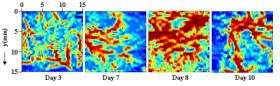
(PhysOrg.com) -- Photoacoustics can be used to show the development of blood capillaries in and around a tumour. PhD student, Kiran Kumar Thumma, of the University of Twente (Netherlands) is the first to use the technology to follow the development of a tumour over a period of time. His results show that the application of photoacoustics is a useful addition to the methods usually used in tumour research. Mr Thumma will be awarded his PhD at the faculty of Science and Technology today.
Angiogenesis, the growth of new blood capillaries, is an important indicator for the growth and spread of tumours. It is not only possible to follow the growth of blood capillaries using photoacoustics, but also to measure the oxygen saturation of the blood in these blood capillaries. This yields valuable information, given that the formation of new blood capillaries drives rapid tumour growth and that the oxygen saturation of the blood can give an indication of the nature of the tumour. Photoacoustics is, therefore, a useful addition to the existing methods used to map tumours, that is, magnetic resonance imaging (MRI), computed axial tomography (CT) and ultrasonography.
Photoacoustics
The photoacoustic method investigated in this research fires (laser) light pulses lasting a fraction of a second at a tissue. These light pulses cause a slight, localised heating of the tissue, which subsequently causes a pressure wave. The pressure wave propagates through the body and can be detected as ultrasound at the tissue surface. As is the case with ultrasonography, a three-dimensional picture can then be reconstructed of absorbent structures, in this case, of the blood vessels in the tumour. The wavelength of the light pulses used in this research was chosen such as to reveal haemoglobin, an important component of blood.
The research was carried out by the PhD student in cooperation with the Erasmus Medical Center in Rotterdam. This is the first time that photoacoustic technology has been used to follow the development of a tumour over a period of time. To this end, Mr Thumma introduced tumour cells under the skin of a rat, which then developed into a tumour. On various days images were made of the tumour and the oxygen saturation was displayed.
Provided by Universiteit Twente


