NASA STUDIES SPACE RAILWAY TO EXPLORE ORIGINS OF PLANETS, STARS, AND GALAXIES
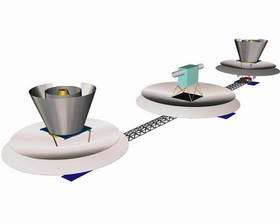
A NASA-led team is studying the construction of a railway in space for a pair of telescopes that will provide views of planet, star, and galaxy formation in unprecedented detail. The proposed Space Infrared Interferometric Telescope (SPIRIT) mission will also examine the atmospheric chemistry of giant planets around other stars.
SPIRIT will consist of two telescopes at opposite ends of a 120-foot (40-meter) beam. The telescopes will move along the beam like cars on a railway, combing their images using the techniques of interferometry to achieve the resolving power of a single giant telescope 120 feet across.
NASA's Goddard Space Flight Center, Greenbelt, Md., will lead a NASA/university/industry team to develop a preliminary design for SPIRIT. The team will evaluate various mission concepts, create a roadmap of the technology development required for the mission, and generate independent cost assessments.
The study was commissioned in July 2004 by NASA Headquarters, Washington, D.C., as one of nine proposals that will help strategic planning for NASA's Origins Space Science research theme. NASA's Origins program seeks to answer the fundamental questions about the universe, such as where we came from and whether or not we are alone. The team will report to the Origins Roadmap Committee in early January, 2005, and a final report is due three months later.
“I’m delighted that SPIRIT was chosen for study," said Dr. David Leisawitz of NASA Goddard, Principal Investigator for the proposed mission. "We’re going to give NASA a chance to build a telescope that will dazzle the world with crisp, clear infrared pictures of the universe."
"These images will help us to answer some very profound questions. How did we living critters wind up on a rocky planet bathed in light from the Sun, one of a hundred billion stellar denizens of the magnificently spiral-shaped Milky Way galaxy? Perhaps even more tantalizing, we should expect the unexpected, as that’s what we find whenever a big step is taken to improve the scientific community’s tools. SPIRIT will use techniques pioneered a century ago by Nobel Laureate Albert A. Michelson, so we know it can be done, and I think it’s an excellent match to the Origins mission class envisioned in NASA’s call for proposals,” said Leisawitz.
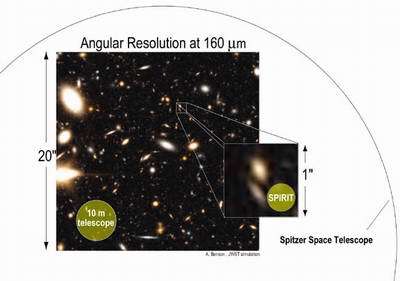
SPIRIT will examine the universe in the far-infrared and sub-millimeter wavelengths of light. This light is invisible to the human eye, but some types of infrared light are perceived as heat.
The processes that build planets, stars, and galaxies are most readily visible in these kinds of light. For example, stars are born when massive interstellar clouds collapse under their own gravity. The collapse generates heat, causing the central star-forming region of the cloud to glow in infrared. Newborn stars are frequently surrounded by disks of dust and gas, which also collapse under their own gravity to form planets. While the planets are too small to be seen directly, their gravity disturbs the dust disk, forming ripples and lumps. Warmed by the central star, the dust glows in infrared light, revealing the dusty structures to SPIRIT and divulging the locations and sizes of previously unknown planets.
Looking farther into space is equivalent to seeing back in time, because the speed of light is finite, and it takes light a significant amount of time to traverse immense cosmic distances. We see the nearest large galaxy (Andromeda) as it appeared about two million years ago, because that’s how long it took for its light to reach us. We cast our gaze back billions of years by looking toward the limit of the observable universe, and thus can watch galaxies as they evolve. However, since the universe is expanding, light emitted by remote galaxies has been stretched by the expansion of space to infrared and sub-millimeter wavelengths, so we need telescopes highly sensitive to these types of light to observe distant galaxy formation.
Many of these objects appear too small, or shine too faintly at their remote distances for existing telescopes to observe in great detail. To accomplish such ambitious observations, SPIRIT will have 100 times the angular resolution (ability to see fine detail) than existing infrared telescopes, complemented with a matching improvement in sensitivity.
Technical challenges to overcome include keeping the telescope mirrors extremely cold (about 4 degrees Kelvin or minus 452 degrees Fahrenheit) so their own heat does not obscure the faint infrared light they are trying to collect. The detectors also need to have greater sensitivity and more pixels. The Goddard/industry team is up to the challenge: "Our engineers love working on this project; there’s a lot of room for creative thought, and everyone understands that this is an opportunity to take a giant leap forward scientifically while inspiring the next generation of explorers." says Leisawitz.
If approved, SPIRIT could be ready for launch in 2014, on board a large expendable rocket. SPIRIT would travel to the L2 libration point one million miles from Earth where it will automatically unfold its beam and deploy the telescopes. The Goddard-led team includes collaborators from Caltech, Cornell, the Harvard-Smithsonian Center for Astrophysics, the University of Maryland, the Massachusetts Institute of Technology, the Naval Research Laboratory, Princeton, the University of California, Los Angeles, the University of Wisconsin, and NASA’s Jet Propulsion Laboratory and Marshall Space Flight Center. The industry team includes Ball Aerospace, Boeing, Lockheed-Martin, and Northrop-Grumman.
Source: NASA


