Two-phase microbial resistance: the example of insects
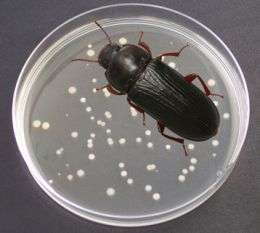
The immune system of the Tenebrio molitor beetle eliminates the great majority of bacteria infecting it within less than an hour, and then restricts the development of resistant bacteria thanks to the production of antimicrobial peptides over several days, thus preventing the emergence of resistant bacteria. Might it not be possible to copy this model when designing drug therapies that would reduce the development in pathogens of multidrug resistance to antibiotics? © Yannick Moret/Biogéosciences-Dijon (CNRS/Université de Bourgogne)
(PhysOrg.com) -- In less than an hour, the immune system of the beetle Tenebrio molitor neutralizes most of the bacteria infecting its hemolymph (the equivalent to blood in vertebrates); this is rendered possible by a cascade of ready-to-use cells and enzymes. Bacteria that resist these "front-line" defenses are then dealt with by antimicrobial peptides – a sort of natural antibiotic – which halt their proliferation.
A clearer understanding of these actors in insect immunity may make it possible to design treatments that prevent the development of drug resistance. This has been shown in the results of a study carried out by the Equipe Ecologie Evolutive in the Laboratoire Biogéosciences (CNRS/Université de Bourgogne in Dijon), in collaboration with a British research group, and published in the last issue of Science.
Microorganisms have a considerable capacity for adaptation to the many strategies implemented to destroy them. Over the past 400 million or so years, the immune system of animals, and notably the relatively simpler system in insects, appears to have succeeded in preventing the evolution of microbial resistance. The secret to this achievement lies in a small toolbox of targeted natural antibiotics, the antimicrobial peptides.
In the present case, the researchers showed that the so-called "constitutive" front-line of cellular and enzymatic defenses in the insect immune system spares a small number of bacteria and thereby favors the development of microbial resistance. However, a second line of defenses involving antimicrobial peptides synthesized following the elimination of most bacteria by the front line, is able to restrict the growth of these surviving microorganisms, which may lead to their removal.
Thus the principal function of the antimicrobial peptides produced by the insect immune system is to prevent the resurgence of bacteria resistant to the host's constitutive defenses, which will consequently reduce the emergence of resistant bacteria.
References: Antimicrobial defence and persistent infection in insects, Eleanor R. Haine, Yannick Moret, Michael T. Siva-Jothy and Jens Rolff, to appear in Science, 21 November 2008
Provided by CNRS
-
From lemons to lemonade: Reaction uses carbon dioxide to make carbon-based semiconductor,
32 comments
-
Thioridazine kills cancer stem cells in human while avoiding toxic side-effects of conventional cancer treatments,
3 comments
-
SpaceX private rocket blasts off for space station (Update),
42 comments
-
Climate scientists say they have solved riddle of rising sea,
31 comments
-
SpaceX capsule has 'new car' smell, astronauts say (Update),
4 comments
More news stories
Manufacturing genes to attack flu virus
An international research team has manufactured a new protein that can combat deadly flu epidemics.
9 hours ago |
not rated yet |
0
|
Scientist: Evolution debate will soon be history
(AP) -- Richard Leakey predicts skepticism over evolution will soon be history. Not that the avowed atheist has any doubts himself.
May 26, 2012 |
3.4 / 5 (21) |
98
More plant species responding to global warming than previously thought
(Phys.org) -- Far more wild plant species may be responding to global warming than previous large-scale estimates have suggested.
May 22, 2012 |
4.6 / 5 (14) |
18
|
For monogamous sparrows, it doesn't pay to stray (but they do it anyway)
It's quite common for a female song sparrow to stray from her breeding partner and mate with the male next door, but a new study shows that sleeping around can be costly.
May 22, 2012 |
5 / 5 (2) |
8
|
Thousands of shellfish found dead in Peru
Thousands of crustaceans were found dead off the coast of Lima following the mystery mass death of dolphins and pelicans, the Peruvian Navy said Friday.
May 26, 2012 |
4.7 / 5 (7) |
7
Stunning image of smallest possible five-ringed structure
Scientists have created and imaged the smallest possible five-ringed structure about 100,000 times thinner than a human hair and you'll probably recognise its shape.
'Unzipped' carbon nanotubes could help energize fuel cells, batteries
Multi-walled carbon nanotubes riddled with defects and impurities on the outside could replace some of the expensive platinum catalysts used in fuel cells and metal-air batteries, according to scientists at ...
Change in developmental timing was crucial in the evolutionary shift from dinosaurs to birds: study
At first glance, it's hard to see how a common house sparrow and a Tyrannosaurus Rex might have anything in common. After all, one is a bird that weighs less than an ounce, and the other is a dinosaur that ...
Computer model used to pinpoint prime materials for efficient carbon capture
When power plants begin capturing their carbon emissions to reduce greenhouse gases and to most in the electric power industry, it's a question of when, not if it will be an expensive undertaking.
T cells 'hunt' parasites like animal predators seek prey, study shows
By pairing an intimate knowledge of immune-system function with a deep understanding of statistical physics, a cross-disciplinary team at the University of Pennsylvania has arrived at a surprising finding: T cells use a movement ...
Land and sea species differ in climate change response: study
(Phys.org) -- Marine and terrestrial species will likely differ in their responses to climate warming, new research by Simon Fraser University and Australia’s University of Tasmania has found.