High-Temp Superconducting Nanowire System is First of its Kind
Nov 26, 2008 By Laura Mgrdichian feature
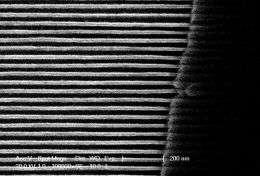
An array of YBCO nanowires with 20-nanometer diameters. Image courtesy of James Heath.

(PhysOrg.com) -- Scientists from the California Institute of Technology have, for the first time, created an array of nanowires that are superconducting at relatively high temperatures. This work, published recently in Nano Letters, could lead to the incorporation of superconducting nanowires into emerging nanotechnologies.

Researchers around the world have been working to create superconducting nanowires, but few studies have investigated the feasibility of nanowires made of high-critical-temperature (high-Tc) superconducting materials and, prior to this work, no such nanowires had been produced.

"We did not know whether high-Tc superconductivity could be maintained for very long, thin nanowires or whether their behavior would follow traditional superconductor models," said CalTech chemist James Heath, the paper's corresponding author, to PhysOrg.com.

He added, "High-Tc materials as nanostructures are also notoriously difficult to fabricate because their crystal structure and other properties must be maintained, and this is not easy to do."

High-Tc materials are often more desirable than traditional superconductors because they function at temperatures "warmer" than the boiling point of liquid nitrogen, or 77 degrees Kelvin (about -321 degrees Fahrenheit). While still ultra-cold by everyday standards, these temperatures are easier to achieve in the laboratory because liquid nitrogen, which is commercially available and relatively easy to work with, can be used to cool them. This makes high-Tc materials more suitable for many applications.

Despite the roadblocks, Heath and colleague Ke Xu created high-Tc nanowires using a widely known high-Tc material, a copper-oxide compound known as YBCO. The nanowires were fabricated from YBCO strips into arrays of up to 400 nanowires each, lined up in parallel. Metal contacts run across the wires perpendicularly so that their electrical properties could be measured.

The wires are as narrow as 10 nanometers and as long as 200 micrometers (millionths of a meter). The critical temperature, the temperature below which a material superconducts, varies with the wires' dimensions. For example, while all the wires exhibit a superconducting transition above liquid-nitrogen temperature, the temperature width of the transition broadens as the nanowires' widths decrease. For example, the 10 and 15 nanometer wide wires become fully superconducting 20 K and 10 K, respectively.

Because of this increased transition width, Heath and Xu's high-Tc nanowires exhibit both superconducting and normal resistive behavior over a wide temperature range—greater than 50 K. This feature could be useful in nanowire-based superconducting quantum-interference devices, or SQUIDs, in which resistance oscillations caused by quantum interference between two wires is used to measure extremely small magnetic fields.

In future work, Heath and Xu are designing nanomaterials to potentially increase the "critical current" of the high-Tc nanowire systems—the point at which the current is too high to pass through the material with no resistance.

Citation: Nano Lett., 2008, 8 (11), pp 3845–3849

Copyright 2008 PhysOrg.com.
All rights reserved. This material may not be published, broadcast, rewritten or redistributed in whole or part without the express written permission of PhysOrg.com.

Explore further: Researchers develop some of the world's smallest metallic nanorods

add to favorites email to friend print save as pdf

Related Stories

Recommended for you

Engineers' nanoantennas improve infrared sensing

May 20, 2013

(Phys.org) —A team of University of Pennsylvania engineers has used a pattern of nanoantennas to develop a new way of turning infrared light into mechanical action, opening the door to more sensitive infrared ...

Stacking 2-D materials produces surprising results

May 16, 2013

(Phys.org) —Graphene has dazzled scientists, ever since its discovery more than a decade ago, with its unequalled electronic properties, its strength and its light weight. But one long-sought goal has proved ...

User comments : 7

Adjust slider to filter visible comments by rank

Display comments: newest first

physpuppy
1 / 5 (2) Nov 26, 2008
Now the question is what the current capacity of these wires are before they quench. Other high temp superconductors have an issue with current capacity - which is one of the reasons why they have not found application in MRI, transmission lines, etc.
Ant
1 / 5 (2) Nov 26, 2008
does this discovery not suggest that superconductivity is more to do woth thickness rather than anything else? therefore the number of atoms within that thickness?
earls
3 / 5 (2) Nov 26, 2008
Sort of ant, it's like lining them up in a perfectly straight gapless line. It's just that working with smaller/narrower materials makes it easier to achieve the effect,.
Alizee
1 / 5 (3) Nov 26, 2008
..It's just that working with smaller/narrower materials makes it easier to achieve the effect..
Not quite, by AWT HT superconductivity is based on quantum condensation of electrons under pressure, which is indeed easier to achieve and maintain in smaller scales. The superconductivity transition of YBaCuO stripes doesn't improve significantly by such way, the division of material into thin stripes just blurs the superconductivity transition over wider interval of temperatures - which is generally not quite welcomed. The formation of thin stripes decreases the sensitivity of superconductors towards magnetic fields, instead. http://www.physor...248.html
Ant
not rated yet Nov 27, 2008
Hi Earls, Alizee
Sorry but I may have confused the discussion, by thin I meant in the Z direction, the actual thickness of the layer whether it be a stripe or solid plane. I theorise that a thickness of one or two atoms will only allow atomic movement in two dimensions not three. I remember an experiment published in a science mag some years ago (probably "new scientist") where a few layers of atoms epitaxially deposited between two inert layers gave surprising results. I would think of it as Brownian motion restricted to planar form. Alizee wouldnt high presure have a simular effect of reducing the amount of atomic movement? passing a ball between a group is far simpler if the group members are touching each other rarther than widwly spread.
Ant
not rated yet Nov 27, 2008
Hi Earls, Alizee
Surely what you are really doing by supercooling any cunductive material is slowing atomic moement perhaps even bring the atoms closer together, therin reducing the atomic chaos and allowing the buggers to conduct without energy chasing them all over the place. Simpicity is everything
ramo007
not rated yet Nov 27, 2008
blending of supercondutivity and nanotechnology is a awesome technology which when extended to the field of robotics will have a tremendous impact

More news stories

Weird science: Crystals melt when they're cooled

(Phys.org) —Growing thin films out of nanoparticles in ordered, crystalline sheets, to make anything from microelectronic components to solar cells, would be a boon for materials researchers, but the physics ...

Researchers forward quest for quantum computing

Research teams from UW-Milwaukee and the University of York investigating the properties of ultra-thin films of new materials are helping bring quantum computing one step closer to reality.

Fast-acting mothers' milk for healthier babies

Human breastmilk responds quickly to protect the child when there is an infection in mothers or babies, according to new international research led by The University of Western Australia.