Supercritical CO2 boosts super optimism in sequestering greenhouse gas
Nov 17, 2008
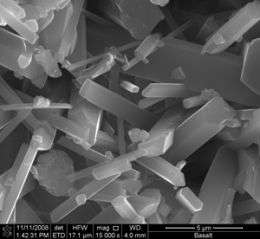
Shafts of calcite mineral grow rapidly on basalt after exposure to supercritical CO2 for 30 days. Use of dual beam focused ion beam scanning electron microscopy at the Environmental Molecular Sciences Laboratory helped capture the formation of the calcite. Image: PNNL

(PhysOrg.com) -- Scientists appear to have the rock-solid evidence that suggests carbon dioxide can be safely and permanently sequestered in deep, underground basalt rock formations, without risk of it eventually escaping to the atmosphere. The findings have potential implications for sequestering carbon in other reservoir systems as well.

Researchers at the Department of Energy's Pacific Northwest National Laboratory have discovered key factors that show water-saturated liquid CO2, under conditions mimicking deep geologic settings, will plug cracks within the rock that otherwise might allow the hazardous greenhouse gas to escape.

"The implications of this discovery are far reaching," said PNNL scientist Pete McGrail. "Sufficient molecular water is apparently present in the supercritical CO2 phase to carry out multi-step reactions directly with minerals in the basalt. In essence, the carbon dioxide can self-seal undetected cracks or fissures that might allow the CO2 to migrate vertically to shallower depths."

Recently, McGrail exposed samples of basalt rock under high pressure to the two phases of CO2 that would exist after injecting it deep underground. The two phases include CO2-saturated water and water-saturated liquid CO2 or CO2 gas in a supercritical phase. Previous tests exposed basalt to CO2-saturated water, which forms over time as injected CO2 interacts with existing water in the porous and permeable basalt layers. However, these previous experiments ignored reactions to rock samples exposed to CO2 in a supercritical phase, which is dehydrated for transport by pipeline, but will absorb water from the surrounding basalt formation after injection.

McGrail presents his findings Tuesday, Nov. 18, at the 9th International Conference on Greenhouse Gas Technologies.

Scientists hoped the experiments would shed light on how both forms of CO2 might react with minerals found in the layers of basalt thousands of feet below the earth's surface, and if it would impact the speed in which the CO2 mineralized, thus affecting its stability.

McGrail's research, funded by the Department of Energy's Office of Fossil Energy and National Energy Technology Laboratory, revealed that water-saturated liquid CO2 - CO2 gas in a supercritical phase - showed similar or even greater reactivity than observed for CO2-saturated water. The swift chemical reaction detected on metal and oxide surfaces, as well as the silicate surfaces found in basalt rock, were surprising and impressive according to McGrail.

Current reservoir simulation tools are quite sophisticated in their ability to model complex sets of heterogeneous reactions in aqueous media, but are presently incapable of treating similar reactions in the liquid or supercritical CO2 phase itself. McGrail suggests a need for development of significant new modeling capabilities to analyze the chemical reactivity of water dissolved in the dense CO2 phase.

"Although these initial experiments focused on basalt, the principles are not unique to basalts and would apply generally to other reservoir systems and caprocks," McGrail said.

He also noted that pilot-scale field injections will help validate these bench-scale findings.

Provided by PNNL

Explore further: NASA's BARREL mission launches 20 balloons

add to favorites email to friend print save as pdf

Related Stories

Bringing carbon capture to a rock near you

Aug 01, 2011

For coal-rich countries like the United States, the concept of "clean coal" is too intriguing to ignore. With the implementation of carbon capture and sequestration, America's most abundant energy resource ...

Storing carbon dioxide deep underground in rock form

Jun 17, 2010

As carbon dioxide continues to burgeon in the atmosphere causing the Earth's climate to warm, scientists are trying to find ways to remove the excess gas from the atmosphere and store it where it can cause no trouble.

Scientists target East Coast rocks for CO2 storage

Jan 04, 2010

Scientists say buried volcanic rocks along the heavily populated coasts of New York, New Jersey and New England, as well as further south, might be ideal reservoirs to lock away carbon dioxide emitted by power ...

Fighting climate change by turning CO2 to stone

Nov 17, 2009

(PhysOrg.com) -- While politicians debate the best ways to cut global carbon dioxide emissions, researchers at Idaho National Laboratory's Center for Advanced Energy Studies are charging ahead on a strategy ...

Geologists map rocks to soak CO2 from air

Mar 05, 2009

A new report by scientists at Columbia University's Earth Institute and the US Geological Survey points to an abundant supply of carbon-trapping rock in the US that could be used to help stabilize global warming. ...

Recommended for you

Volcanoes cause climate gas concentrations to vary

6 hours ago

Trace gases and aerosols are major factors influencing the climate. With the help of highly complex installations, such as MIPAS on board of the ENVISAT satellite, researchers try to better understand the ...

Explainer: Why are tornadoes so destructive?

7 hours ago

Tornadoes are a part of life for people living in the Great Plains of the United States. In Oklahoma, a state that averages 62 tornadoes a year, people are prepared as best as they can be and are well warned.

NASA's BARREL mission launches 20 balloons

21 hours ago

(Phys.org) —In Antarctica in January, 2013 – the summer at the South Pole – scientists released 20 balloons, each eight stories tall, into the air to help answer an enduring space weather question: ...

User comments : 14

Adjust slider to filter visible comments by rank

Display comments: newest first

mikiwud
3.1 / 5 (15) Nov 17, 2008
Why use 30 to 40% of the power generated at a powerplant to do this when the CO2 would be better used to feed plants?
Also,power bills are high enough witout paying extra for this rubbish.
NeilFarbstein
3.9 / 5 (9) Nov 17, 2008
will it really take that much power?
NeilFarbstein
2 / 5 (13) Nov 17, 2008
we really ought to invest in solar forever
M_N
3.2 / 5 (11) Nov 17, 2008
mikiwud, I totally agree. Even modest increases in atmospheric CO2 concentrations produce HUGE gains in plant growth. This could be very important for feeding the Earth's growing population. The additional greenhouse warming is likely to be very minimal, despite what the AGW alarmists would have us believe.
Graeme
3 / 5 (7) Nov 17, 2008
What we need is an algae or bacteria that can use CO2 at about the concentration emmitted by a smokestack, and that can also use the nitrogen oxides. This would be better than causing pollution underground, where you can't see it any more but still exists.
Soylent
2.8 / 5 (11) Nov 18, 2008
M_N, that's what the AGW deniers would have you believe but reality is far less glamorous.

Added heat stress and less secure water availabillity for irrigation more than offset the potential benefits to agriculture of increased atmospheric CO2. CO2-fertilization has no beneficial effect on land that is not cultivated by humans because of fertilizer constraints(mainly phosphorous and nitrogen).
lengould100
2.1 / 5 (7) Nov 18, 2008
mikiwud, M_N: "The additional greenhouse warming is likely to be very minimal, despite what the AGW alarmists would have us believe."

Now there's true science (NOT). Since when did "likely to be" become a scientific measure on which to base decisions affecting the future of the species? Ah, since you species-haters got access to communications, I guess.
GrayMouser
3.7 / 5 (6) Nov 18, 2008
Now there's true science (NOT). Since when did "likely to be" become a scientific measure on which to base decisions affecting the future of the species?


Since the IPCC made it the gold standard?
lengould100
1.8 / 5 (5) Nov 18, 2008
That's ___crap, GrayMouser. IPCC bases ALL conclusions on the concensus of peer-reviewed scientific publications. mikiwud, NOT SO MUCH.
thermodynamics
2 / 5 (4) Nov 18, 2008
mikiwud said: "Why use 30 to 40% of the power generated at a powerplant to do this when the CO2 would be better used to feed plants?"

Those 30% - 40% numbers are years old. New research by the National Energy Technology Laboratory, Alstom, and B&W is showing a drop in net output that is closer to 15% for oxy-coal systems with compressed cabon dioxide ready for sequestration. The energy recovered from sensible heat in oxy-coal (that is lost in normal flue gas) and latent heat from condensed moisture in the oxy-coal combustion product stream makes up the difference. That sensible and latent heat is lost in a normal power plant (where they avoid condensation to prevent corrosion and need the sensible heat to loft the exhaust plume) but can be recovered using oxy-coal. I suggest you update your rant by reading a little of the literature.
wfl
4 / 5 (7) Nov 18, 2008
Before we destroy our economy and squander a few trillion dollars in the process, it would be nice to know, based upon experimental research with empirical data, the maximum and minimum levels of CO2 that can be tolerated before our survival is threatened. By this I mean lets use real science to provide the answers.

The current situation is that Hansen, Gore et al demand that we accept their model outputs and expert opinions based thereon. Sorry there approach is not real science. There model results and expert opinions are not facts, just opinions based upon hypothetical scenarios.

We owe it to ourselves to get scientific proof before we destroy our economy and squander a few trillion dollars while doing so.
thermodynamics
3 / 5 (6) Nov 18, 2008
wfl said:
Before we destroy our economy and squander a few trillion dollars in the process, it would be nice to know, based upon experimental research with empirical data, the maximum and minimum levels of CO2 that can be tolerated before our survival is threatened. By this I mean lets use real science to provide the answers.


Look out your window at the for sale signs. In case you have missed it, the free "market over all" mentality has already destroyed the economy (or do you believe: "the economy is still fundamentally strong?"). The science points to AGW. To rant about those on the far left is just as useless as ranting about those on the far right. The science is in the middle. The bottom line is that the science shows that we are increasing the CO2 levels. It also shows that CO2 fills the IR window left by water vapor. The result is that less IR can escape the earth. That was known more than 100 years ago in a very rough estimate (since corrected many times)by Arrhenius.

Check this link:
http://en.wikiped...rrhenius

What we don't know is how much this AGW effect will be and there are hundreds of scientists trying to make better estimates on this issue. It does little good for those on the left to declare an immediate disaster for mankind when there is little evidence to support that drastic conclusion (as you rightly point out) or those on the far right to dismiss a possible serious problem for our children (as you seem to do). Lets look closely at the science as it evolves, test the hypotheses as they pop up, and act responsibly to mitigate the risks that are discovered. That might easily include trillions of dollars in investment (as is going on right now trying to save the economy you seem to think is in good shape). ;-)
Velanarris
5 / 5 (3) Nov 19, 2008
That's ___crap, GrayMouser. IPCC bases ALL conclusions on the concensus of peer-reviewed scientific publications. mikiwud, NOT SO MUCH.
Since when did anything other than politics have a "concensus"?
Velanarris
5 / 5 (3) Nov 19, 2008
What we don't know is how much this AGW effect will be and there are hundreds of scientists trying to make better estimates on this issue. It does little good for those on the left to declare an immediate disaster for mankind when there is little evidence to support that drastic conclusion (as you rightly point out) or those on the far right to dismiss a possible serious problem for our children (as you seem to do).


Here it is. The children argument. What's more liable to affect my children negatively for their life:

Growing up in the streets

or

A .8 degree F increase in seasonal temperature at the poles?

More news stories