Students, engineers set record fuel-cell-powered, radio-controlled airplane flight
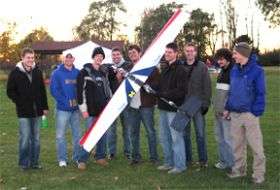
The longest fuel-cell-powered flight of a radio-controlled aerial vehicle has been achieved by students at the University of Michigan and engineers at Ann Arbor-based fuel-cell manufacturer Adaptive Materials Inc.
Their plane, named Endurance, flew for 10 hours, 15 minutes and four seconds in a flight that lasted from sunrise to sunset on Oct. 30, 2008, at Field of Dreams Park in Milan, Mich. The previous world record, held by a California-based company, lasted just over nine hours.
The student SolarBubbles team built the airframe, which has an eight-foot wingspan. Adaptive Materials funded the project and built the aerial vehicle’s propane-powered solid oxide fuel cell. The Adaptive Materials fuel cell for the aerial vehicle was a hybrid battery system.
"It’s great to be at the forefront of radio-controlled vehicles," said Nick Rooney, a senior aerospace engineering undergraduate who is the leader of SolarBubbles. "I'm really excited about this and proud of all the people who have worked on it."
Adaptive Materials has worked extensively in the air vehicle space and will work with SolarBubbles to achieve a 20-hour test flight.
"It's critical for unmanned aerial vehicles to have extended flight times to provide the functionality needed for military missions," said Michelle Crumm, chief business officer at Adaptive Materials. "The flight time achieved with the SolarBubbles team surpassed any of Adaptive Materials’ previous work with aerial vehicles and shows that we’re just scratching the surface for what’s possible with a lightweight, reliable fuel cell."
Endurance had enough fuel to fly for five more hours, but it had to land at dusk because it wasn’t made to fly at night. The plane flew almost 99 miles over the course of the day as students took turns flying it in a holding pattern.
"SolarBubbles is an extraordinary student team with the enthusiasm, ingenuity and dedication to accomplish most any goal," said Ella Atkins, an associate professor in the Department of Aerospace Engineering and one of the team’s advisers. "The 10-plus hour Endurance flight represented the highly successful culmination of a long progression of design, build and test cycles. I look forward to continued support of the team as they pursue even more ambitious flight endurance goals."
The SolarBubbles team designs, builds and tests unmanned aircraft. In addition to this fuel cell project, students are working to build a solar-powered unmanned aircraft with a wingspan smaller than 15 feet that can fly for more than 36 hours.
Atkins is also an associate professor in the Department of Electrical Engineering and Computer Science.
Provided by University of Michigan


